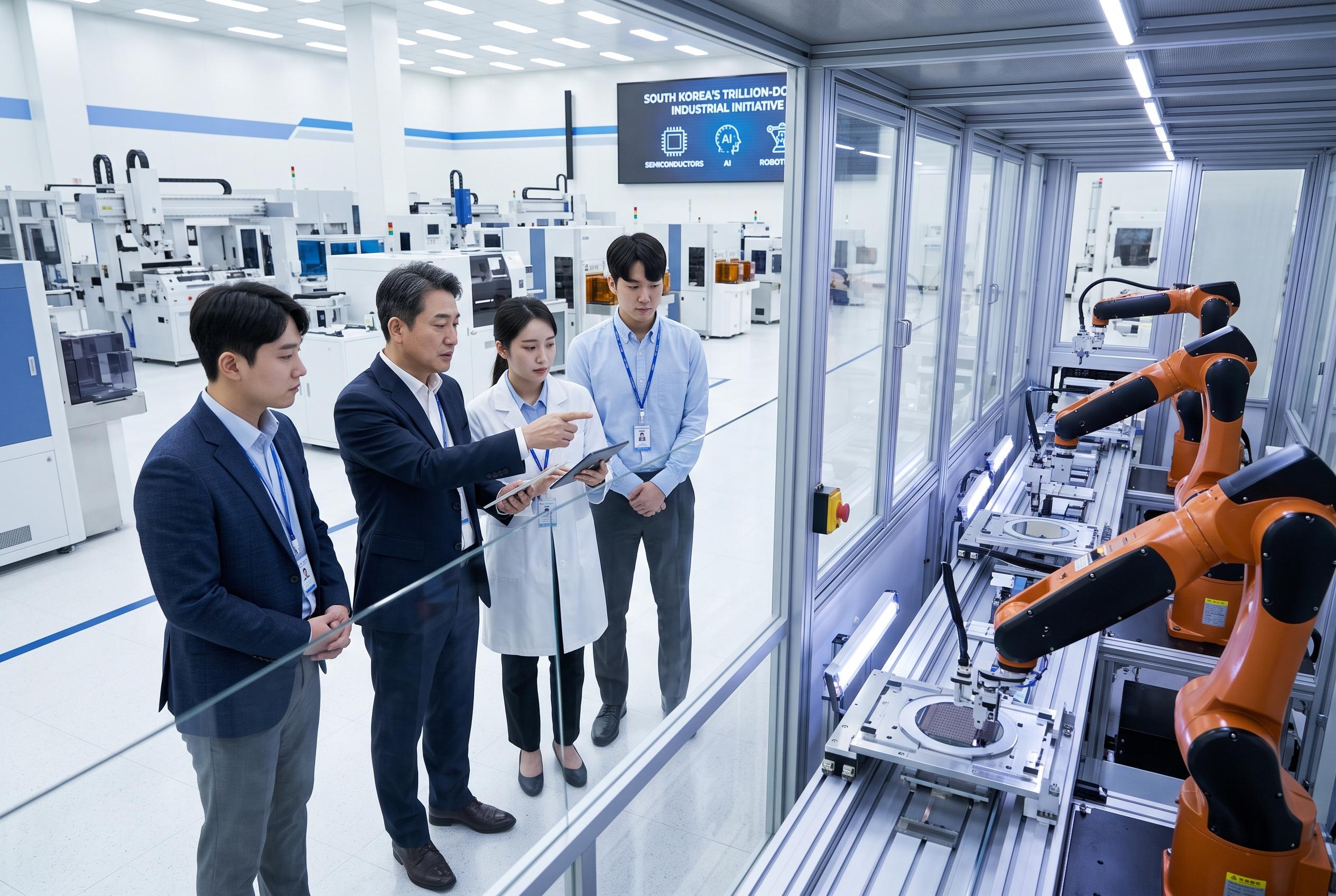

South Korea embarks on a trillion-dollar initiative to boost semiconductors, AI, and robotics, drawing lessons from its historic industrial transformation but facing new global challenges and competition.
South Korea’s latest push into industrial policy marks a return to a familiar playbook, but on a far more ambitious stage. President Lee Jae-myung’s government is backing semiconductors, artificial intelligence infrastructure, robotics and other frontier sectors in an effort to secure future growth and reinforce national competitiveness. The scale of the programme has drawn comparisons with the country’s heavy and chemical industry drive of the 1970s, when the state helped steer capital into strategic manufacturing sectors.
That earlier campaign remains one of the most studied episodes in East Asia’s development history. Research from the National Bureau of Economic Research found that output, input use and labour productivity rose faster in the targeted industries and regions than in non-targeted ones, although the policy also created resource misallocation inside those sectors. Other studies from Korean institutions have pointed to the importance of bureaucratic rivalry in shaping the policy and to the role of industrial complexes in pulling private capital into heavy industry.
The historical record also shows that success depended on more than subsidies and direction from above. According to the Korea Development Institute, targeted credit, tax breaks, foreign borrowing guarantees and industrial estates helped shift exports towards more capital-intensive products, even as the strategy added to inflation and foreign debt. Lee Jong-Wha, writing on the Orissa Post website, said the approach worked because South Korea combined state support with capable institutions, policy continuity and a workforce able to absorb and improve foreign technology.
The new campaign is designed for a very different technological era. South Korea’s government says it wants to become one of the world’s top three artificial intelligence powers while cementing leadership in semiconductors. It has introduced a Special Act on Semiconductors to speed up infrastructure and regulatory support and outlined three major projects to build regional hubs for chips, AI data centres and robotics through public-private investment.
The numbers involved are striking. Lee said the government and major companies have announced plans worth more than about $1 trillion, or roughly two-thirds of South Korea’s gross domestic product, making it the largest industrial initiative since the 1970s drive. Samsung Electronics and SK Hynix are central to the effort, according to a report by Tom’s Hardware, which said the companies and the state have unveiled an 800 trillion won investment plan aimed at strengthening memory-chip production and AI-related capacity.
The practical obstacles are formidable. Semiconductor fabrication plants and AI infrastructure require vast capital, skilled engineers and steady supplies of power and water. Permitting, land access and utility connections can take years, and the long build-out times leave projects exposed to cyclical swings in chip demand. Reuters-style analysis of South Korea’s policy challenge suggests that today’s tighter regulation and shorter political horizons may make it harder to reproduce the conditions that supported the earlier industrial transformation.
China also presents a tougher competitive environment than the one South Korea faced in the 1970s. Lee noted that China is already strong in AI and advanced manufacturing and is closing the gap in semiconductors with continued state backing. That leaves Seoul facing a central question that is now being asked in many capitals: not whether governments should intervene, but how far they can go in directing markets before uncertainty and complexity overwhelm the policy itself.
The lesson from South Korea’s earlier success is not that governments can reliably choose winners. It is that they can create the conditions in which firms, researchers and engineers are more likely to find them. That means funding basic research, strengthening universities, improving energy infrastructure and keeping regulation efficient. In the new race for frontier technology, the state may be able to shape the terrain, but it cannot fully script the outcome.
Disclaimer: This content is intended for informational purposes only. Readers are advised to exercise their own judgement, conduct due diligence, or consult a qualified expert before acting on any information provided.