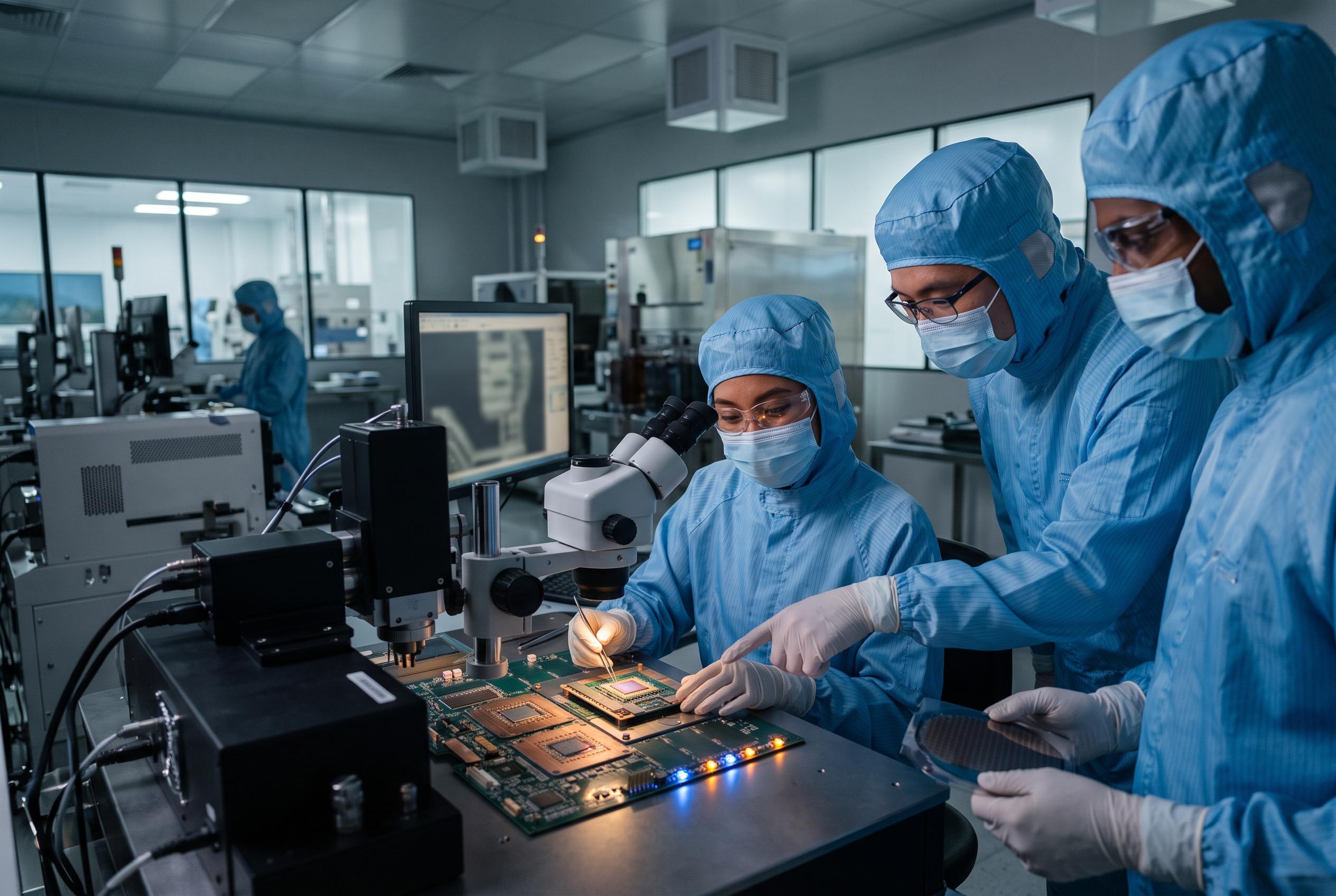

Malaysian policymakers are pushing beyond traditional chip assembly to foster design, advanced packaging, and research capabilities, seeking to elevate the country’s role in the global semiconductor industry amid rising demand from AI and electric vehicles.
Malaysia is trying to turn a long-standing role in semiconductor assembly into something broader and more profitable. The country already sits at an important point in the global chip supply chain, but policymakers now want it to move deeper into design, advanced packaging, equipment and research, where margins and strategic value are higher. According to the Malaysian Investment Development Authority, Malaysia accounts for about 13 per cent of global back-end assembly, testing and packaging, giving it a platform from which to climb further up the industry.
That ambition matters because semiconductors now underpin almost every major area of modern computing and industry. Chips power phones, cars, payment cards, cloud servers and the data-centre hardware behind artificial intelligence. Demand has been rising with the expansion of AI systems, electric vehicles and industrial automation, and Malaysian trade data shows how large the sector already is for the economy: semiconductor devices, integrated circuits, transistors and valves made up a substantial share of the country’s electrical and electronics exports in 2024. In a further sign of momentum, the Malaysia Semiconductor Industry Association said the sector generated about RM400 billion in revenue in 2025.
Recent investment has helped reinforce that base. MIDA said approved investment in electronic components in 2025 reached RM16.9 billion across 59 projects, with foreign capital making up the overwhelming majority. The agency also reported RM218.5 billion in total approved investment in the first half of 2026, including RM16.6 billion for electrical and electronics manufacturing. Separately, Chipbond Technology Corporation opened a new advanced manufacturing plant in Penang in February 2026, with an investment of about RM800 million, underscoring continued interest in Malaysia as an outsourced semiconductor assembly and test hub.
The government’s longer-term plan is more ambitious than adding factory capacity. Its National Semiconductor Strategy, launched in 2024, aims to attract RM500 billion in combined investment by 2030, build local firms with global reach and train 60,000 high-skilled engineers. A central plank is the four-year partnership with ARM Limited, announced in 2025, which is intended to train 10,000 integrated-circuit design professionals and give selected Malaysian firms access to ARM technology and intellectual property. In August, Economy Minister Akmal Nasrullah Mohd Nasir said several companies had already entered the design and IP evaluation stage, with the first locally developed chips expected to move towards production by 2030.
Malaysia is also trying to deepen its capabilities in advanced packaging, an area that is becoming more important as chipmakers look for better performance and efficiency for AI and high-performance computing. In June 2026, the Science, Technology and Innovation Ministry launched a RM185 million research and development, innovation, commercialisation and economy programme focused on advanced packaging, working with universities and local companies. Industry groups have broadly welcomed the direction, but they also warn that execution will be critical. The country still relies heavily on foreign investment, faces intense competition for talent and capital, and must persuade more engineers to stay if it wants to become more than a major manufacturing base.
Disclaimer: This content is intended for informational purposes only. Readers are advised to exercise their own judgement, conduct due diligence, or consult a qualified expert before acting on any information provided.