South Korea is orchestrating a major shift from policy slogans to transforming physical AI into an integrated industrial programme, leveraging extensive semiconductor growth, factory automation, and AI infrastructure investments to secure a competitive edge in industrial technology.
South Korea is moving to turn “physical AI” from a policy slogan into an industrial programme, linking a vast semiconductor expansion, factory automation and new AI infrastructure into one national bet. That ambition was set out most starkly in late June, when President Lee Jae Myung appeared with the heads of Samsung Electronics and SK Group to unveil an 800 trillion won investment plan for a semiconductor hub in the southwest. According to AP, Lee cast semiconductors, physical AI and AI data centres as the three pillars of the country’s next leap, while Samsung and SK hynix each committed to two new fabrication plants outside their traditional base around greater Seoul.
The government’s own planning shows that it is not defining physical AI narrowly as robotics. ChosunBiz reported in July that the Ministry of Science and ICT wants a domestic full stack built around a world model that can generate physics-based synthetic data, a general-purpose foundation model, devices and AI semiconductors. The ministry’s sequence is practical: prove the technology first in Korean manufacturing, defence, care and agriculture, then export it as a bundled offering of models, chips, robots and industrial equipment. First Vice Minister Koo Hyuk-chae described the field as “a major opportunity for Korea”, reflecting the view in Seoul that the country’s industrial base is as important as its software talent.
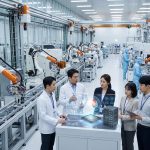
There is already some evidence that this approach can deliver measurable results on factory floors rather than just in presentations. Aju Press reported in August that the Ministry of Trade, Industry and Energy’s AI Factory drive had reached about 170 worksites, with 42 early adopters recording average productivity gains of 30.1 per cent and average defect-rate reductions of 15.5 per cent. The ministry highlighted examples that show how varied the applications are: Surplus Global, which dismantles and recovers parts from used chip equipment, lifted productivity by 66.7 per cent after introducing AI sorting; Asan Sungwoo Hitech cut electric-vehicle battery inspection time by 90 per cent through an unmanned manufacturing system; and HD Hyundai Samho raised rudder-trunk production productivity by 50 per cent with AI-driven autonomous welding. The target is now 500 AI factories by 2030, supported by 25 industrial testbed complexes.
Semiconductors occupy a special place in that plan because they are both the tool and the test case. On one side, the June chip-hub announcement shows that Korea wants far more capacity in the hardware layer that will power AI systems. On the other, Hyundai Motor Group’s Robotics LAB has given a clearer picture of how that hardware is supposed to work in machines. In January, the company said it had completed a three-year collaboration with DEEPX on an on-device AI chip for robots that consumes less than five watts and allows real-time decisions without cloud or network connectivity. Hyundai said the chip had already been integrated into its Facey facial-recognition system and the DAL-e Delivery robot, with broader plans under what it calls a Robotics Total Solution strategy.
The commercial logic extends beyond domestic policy. Korea JoongAng Daily reported during Jensen Huang’s June visit to Seoul that Korean companies are becoming entwined with Nvidia’s next growth areas, not only as memory suppliers but as partners in robotics, autonomous driving and on-device AI. Huang acknowledged that Samsung, SK hynix and Micron had passed Nvidia’s quality test for HBM4 destined for the Vera Rubin platform, underlining how central Korean memory remains to the AI build-out. The same report said Nvidia, Hyundai Motor and the Korean government were in the final stages of talks over an AI research and development centre in Seoul. It also noted that Hyundai’s robotics push through Boston Dynamics has brought physical AI and the car industry closer together, with Nvidia processors positioned for both factory robots and future in-vehicle intelligence.
What makes this more than an assembly of separate projects is the scale of the infrastructure plan around it. ChosunBiz said private investment proposals for AI data centres from SK, GS and Naver total 550 trillion won, and officials expect those projects to create large domestic demand for servers, power systems and cooling equipment. The ministry’s own breakdown suggests roughly 60 per cent of capital spending would go to IT equipment, 20 per cent to power and 10 per cent to cooling. AP added a regional dimension to the chip strategy, reporting that officials argued the southwest’s renewable-energy base could become an advantage as chipmakers face greater pressure to secure cleaner electricity for new fabs.
Still, South Korea is not operating from a position of unchallenged strength. The Korea Institute for Industrial Economics and Trade concluded in February that China now holds the overall value-chain advantage across robots, electric vehicles, batteries and autonomous vehicles. Korea retains stronger positions in semiconductors, especially through memory, and KIET said it still has a slight lead in robotics research and development for product design. But the institute’s warning was blunt: the old “ultra-gap” strategy is no longer viable. Its recommendation was a shift towards competitive co-operation and more deliberate use of premium markets in the US and EU, rather than assuming Korean industry can simply outrun Chinese scale.
That leaves South Korea with a narrower but more concrete test than much of the physical AI rhetoric suggests. The country does not need to dominate every layer of robotics or every branch of AI. It needs to prove that its chipmaking, automotive, shipbuilding and advanced manufacturing sectors can be connected tightly enough that software decisions improve yields, cycle times, quality control and machine autonomy in ways customers will pay for. If those demonstrations keep working, Korea’s exportable product may not be a single model or a single robot at all, but a packaged industrial system: models trained for real environments, domestic semiconductors, robotic hardware and factory equipment sold together.
Disclaimer: This content is intended for informational purposes only. Readers are advised to exercise their own judgement, conduct due diligence, or consult a qualified expert before acting on any information provided.