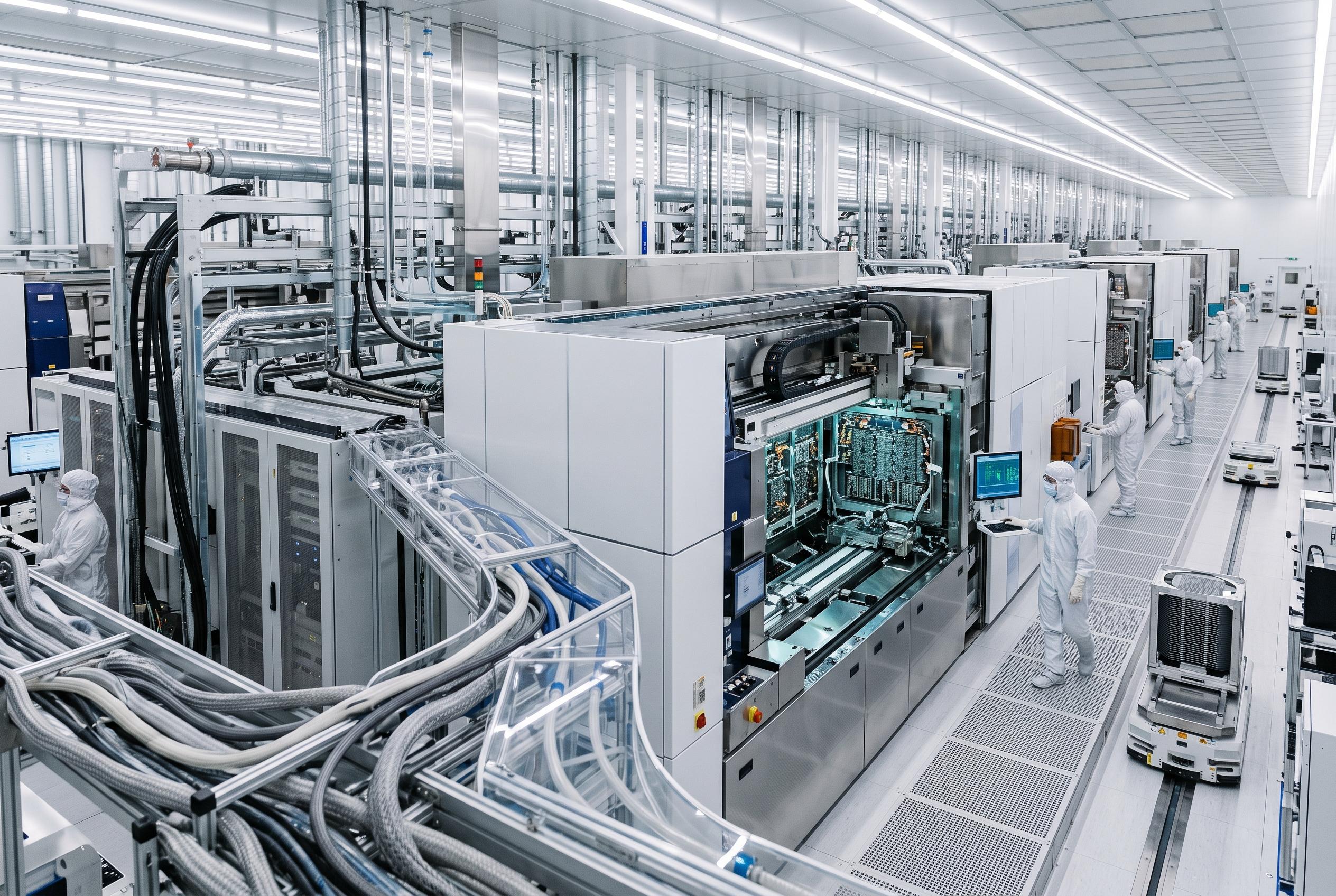

Taiwan Semiconductor Manufacturing’s latest earnings reveal continued dominance in AI chip manufacturing amid soaring demand and capacity challenges, prompting expanded investments and strategic shifts amidst geopolitical tensions.
Taiwan Semiconductor Manufacturing has entered the second half of 2026 with a stronger hand than many of its admirers, or critics, expected. After reporting second-quarter revenue of $40.2 billion, gross margin of 67.7% and operating margin of 60.3%, the company said third-quarter sales should rise again to between $44.6 billion and $45.8 billion. Analysts tracked by Visible Alpha, in research published by S&P Global Market Intelligence, responded by lifting both quarterly and full-year forecasts even as investors fretted about the cost of keeping up with artificial-intelligence demand. (spglobal.com)
Those figures matter because TSMC is not simply another beneficiary of the AI boom. It remains the contract manufacturer at the centre of it. Morningstar said its share of the foundry market had risen to just over 70% in 2025 year to date, and argued that the group is insulated from shifts between cloud AI and edge AI, or between custom and standard chips, because all of those routes still depend on TSMC’s production lines. The company’s own January results showed how concentrated its mix had already become: by the fourth quarter of 2025, 77% of wafer revenue came from 7-nanometre processes and below, with 3nm alone accounting for 28% and 5nm for 35%. (morningstar.com)
The real tension in the story is not whether demand exists, but whether anybody can satisfy it. In January, EE Times, citing TSMC’s earnings call and analyst interviews, reported that revenue from AI accelerators for customers such as Nvidia and AMD made up a high-teen percentage of TSMC’s sales in 2025. Chief executive C.C. Wei said growth from AI accelerators should approach a mid- to high-50s percentage compound annual rate from 2024 to 2029, compared with overall company growth of about 25% in US-dollar terms. Analysts interviewed by the publication said the constraint was now physical: Goldman Sachs’ Bruce Lu said, “The gap is still there”, while International Business Strategies’ Handel Jones estimated that wafer demand at 5nm and below would exceed capacity by 25% to 30% in 2026, with shortages likely to continue into 2027. (eetimes.com)
That imbalance helps explain why TSMC’s investment programme keeps rising, and why the market is torn between excitement and caution. In January, the company guided for 2026 capital spending of $52 billion to $56 billion. By July, according to S&P Global Market Intelligence, post-results expectations had moved higher still, with capital expenditure guidance at $60 billion to $64 billion, well above the pre-quarter consensus of $53.6 billion. The same research note said 3nm wafer revenue beat expectations by 4.2% and 5nm by 6%, while early 2nm revenue came in about 51% below consensus because the ramp was still at an early stage. Fab utilisation reached 96.6%, roughly four percentage points above expectations, but management also warned that the accelerated 2nm build-out would weigh on margins in the near term. Wei himself acknowledged the risk in January, telling analysts: “I’m also very nervous about it.” (pr.tsmc.com)
The company is also trying to prove that scale abroad need not come at the expense of technical control at home. Reuters reported in July that TSMC had raised its Arizona commitment by a further $100 billion, taking the planned investment there to $265 billion. Chief financial officer Wendell Huang said the first Arizona fab was already delivering yields “as good as” TSMC’s flagship plant in Taiwan; a second site was preparing to move in equipment; a third was under construction; and preparatory work had started on a fourth fab and the site’s first advanced-packaging facility. Yet Huang also made clear where the company believes its core must remain, saying that the closest collaboration between research and operations for the newest nodes “has to be in Taiwan”. Morningstar had earlier argued that the group’s previously announced US commitment of $165 billion could help it secure exemptions from semiconductor tariffs, but that number has plainly been overtaken by events. (investing.com)
Even so, the premium attached to TSMC’s position is still checked by forces that are not financial. Reuters Breakingviews argued in April that the company’s grip on advanced chipmaking was strong enough to prompt governments and rivals to start building alternatives, citing Japan’s $16 billion push behind Rapidus and Intel’s tie-up with Elon Musk’s Terafab project as evidence of discomfort with so much reliance on one manufacturer. Reuters also reported in July that TSMC faces a possible penalty of $1 billion or more in a US export-control investigation into a chip that ended up inside a Huawei AI processor. At the same time, Huang said Arizona expansion was running into ordinary but serious limits, including shortages of construction workers and infrastructure. (breakingviews.com)
That leaves the valuation argument more complicated than a simple claim of neglect. Morningstar said the shares were trading at 19 times 2026 earnings and called that undervalued for a business with TSMC’s market position and earnings growth. Reuters Breakingviews, writing earlier in the year, said any serious challenge to the company would take years. But the discount investors apply is not hard to understand. It reflects the need for ever larger capital commitments, the likelihood that 2nm expansion will dilute margins before it rewards them, the concentration of the most advanced research and manufacturing base in Taiwan, and the risk that US-China controls and industrial policy become more intrusive. The latest operating data nonetheless point in one direction: for now, AI’s most durable pricing power still sits less with the designers of chips than with the foundry that can manufacture them at scale. (morningstar.com)
Disclaimer: This content is intended for informational purposes only. Readers are advised to exercise their own judgement, conduct due diligence, or consult a qualified expert before acting on any information provided.