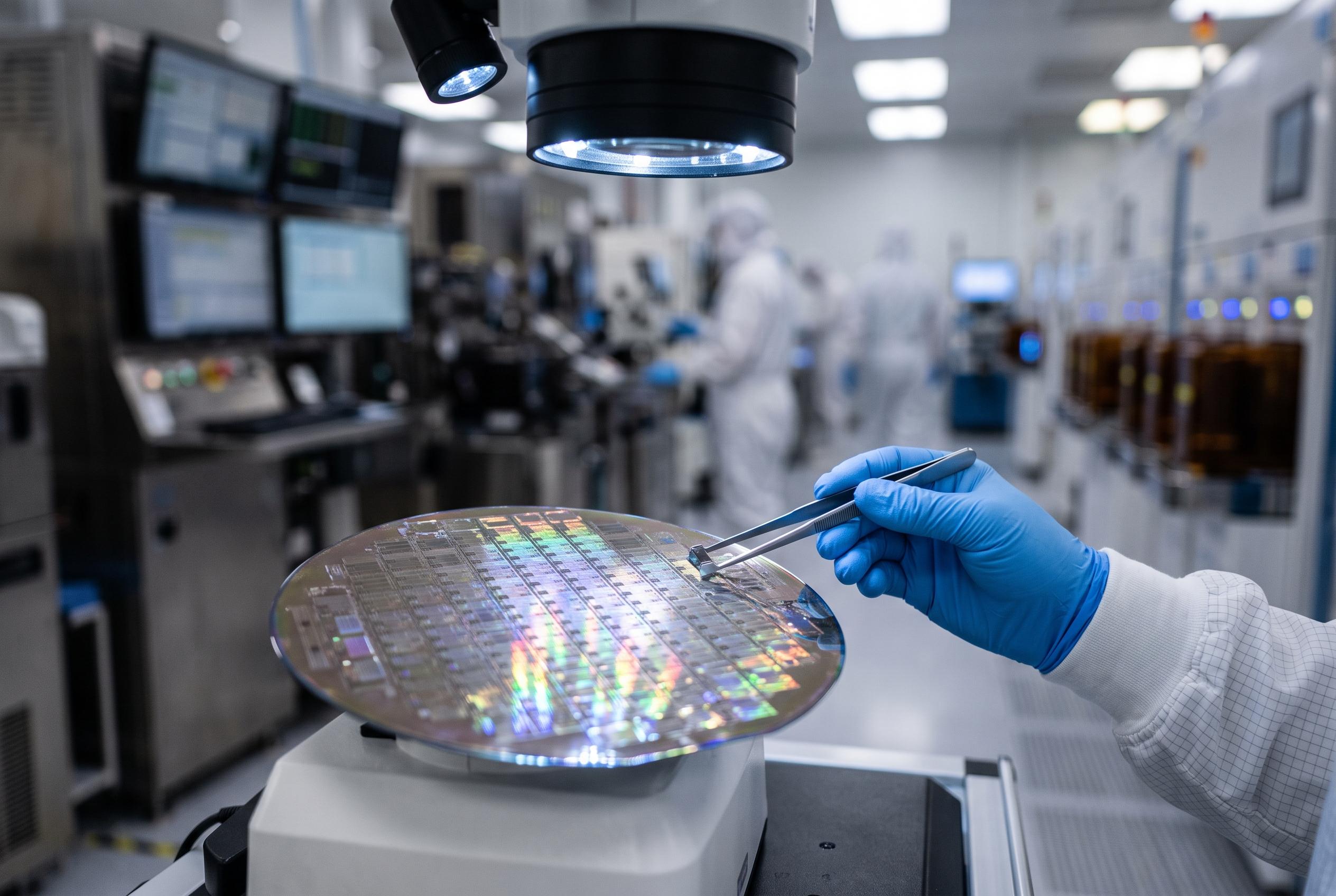

SkyeChip’s rapid growth and strategic IP investments highlight Malaysia’s evolving semiconductor landscape, aiming to transform local engineering talent into a global technology powerhouse amid government-backed ambitions.
Malaysia’s National Semiconductor Strategy is moving from slogans to proof, and SkyeChip is becoming one of the clearest companies through which that test will be judged. The Penang-based integrated-circuit designer has grown fast enough to be named by Prime Minister Anwar Ibrahim among four Malaysian chip design firms posting annual revenue growth above 25 per cent, at a time when Putrajaya says the strategy has already drawn more than RM63 billion in investment. In the Prime Minister’s Office account of that push, the state now wants 10 semiconductor companies with revenue above US$1 billion and 100 with revenue above RM1 billion, turning a young listed company such as SkyeChip into something larger than an ordinary stock-market story.
The immediate attraction is easy to see. SkyeChip’s first quarter as a listed company produced revenue of US$12.25 million and net profit of US$3.43 million for the three months to June 2026, after a full FY2026 in which revenue rose to RM155 million and net profit to RM48.5 million. But the harder question is what investors are really buying into. At present, the business is still driven mainly by non-recurring engineering work and fixed-fee silicon IP licences. The excitement rests on whether those designs can later yield much richer economics through product sales or royalties. That helps explain why the IPO drew unusually heavy demand even before the company had demonstrated a repeatable royalty stream.
The company has at least spent as if it intends to build that model properly. Its prospectus shows research and development spending rising from RM22.1 million in FY2023 to RM39.9 million in FY2024 and RM59.7 million in FY2025. As at March 2026, 365 of its 391 employees were engineers, giving it an engineering intensity that is rare even by semiconductor-sector standards. It had filed 113 patents by that point, with 36 granted and 77 still pending. After the May listing, RM211.5 million of the RM352 million gross proceeds was set aside for research and development on silicon IP and chip products, including future work in LPDDR6 and HBM4 memory interfaces, AI accelerators, compute-in-memory dies and chiplet-related technologies. That staffing profile also fits neatly with the government’s wider talent narrative, which calls for 60,000 engineers under the national strategy.
For SkyeChip, the logic is that spending heavily upfront can create a body of reusable intellectual property whose economics improve with scale. Datuk Fong Swee Kiang, the co-founder and chief executive, put it bluntly in an interview with The Edge: “For us, our IP can eventually become a chip.” That ambition also matches the policy language coming from Kuala Lumpur. Economy Minister Akmal Nasrullah Mohd Nasir said when Arm platform access was handed to selected domestic firms that “Ultimately, we want to see ‘Made by Malaysia’ products in the global market.” In other words, SkyeChip is not being judged only on whether it can win design projects, but on whether it can turn Malaysian engineering into technology that can be licensed again and again, and perhaps eventually sold in silicon form.
That is why the Arm relationship matters, but also why it needs careful reading. The Star reported in May that three companies – Great Asic Technology, SkyeChip and Oppstar Technology – were collectively given four tokens covering Arm Compute Subsystems and Arm Flexible Access, with Akmal warning that “it is not merely an approval, but a call to deliver.” However, an Edge cover story republished by KLSE Screener described the latest allocation differently, saying GreatAsic received both Arm Flexible Access and Arm Compute Subsystems while SkyeChip and Oppstar obtained Arm Flexible Access licences. The same report added that SkyeChip had already received an offer letter in December 2025 to join Arm’s Compute Subsystems platform alongside Xenith Technology, which would mean its access path was not identical to the others. RTM then reported after the listing that Fong was still reviewing the detailed terms and negotiating with the government before beginning high-performance chip development, underscoring that access to tools is not the same as immediate execution.
Public investors, however, clearly decided the opportunity was worth backing. New Straits Times, citing Bernama, reported that SkyeChip’s IPO was oversubscribed 95.03 times. It said the public applied for 3.45 billion shares against 35.92 million shares available, representing RM3.04 billion of demand and the largest such response since Petronas Chemicals Group’s 2010 flotation. The Bumiputera retail portion was 36.21 times covered, the tranche for other Malaysian investors 153.86 times, and the bookbuilt shares 38.76 times. On the company’s first trading day, RTM reported, the stock changed hands at RM3.50, a premium of RM2.62 or 297.73 per cent above the 88 sen offer price, with 23.21 million shares traded.
The policy backdrop helps explain why enthusiasm ran so far ahead of the company’s age. Akmal said Malaysia’s electrical and electronics sector reached a record RM711.61 billion in 2025, but added that the country could no longer depend only on assembly, testing and packaging at the back end of the chain. He also said 1,362 trainees had already enrolled in Arm’s on-demand training programme. Anwar, in turn, described at least 13 homegrown semiconductor companies as potential national champions and linked that industrial ambition to a five-year, RM1.2 billion talent collaboration between CREST and HRD-Corp. His language was unusually explicit: Malaysia, he said, should look back on this period as the “tipping point” for producing its own Fortune 500 technology companies.
SkyeChip’s management has been equally direct about the scale of its ambitions, while drawing a line around what it is not trying to do. Fong has said the company wants to become the “Broadcom of Malaysia”, not a head-on rival to Nvidia, AMD or Intel. That sounds more plausible than it might have a few years ago. SkyeChip already has a profitable design business, a dense engineering base, government visibility, and at least some form of access to Arm’s development ecosystem. But the central issue remains unchanged: a contract design house and a true IP company are not valued in the same way. What will decide SkyeChip’s next phase is not simply whether it can keep winning projects, but whether its existing designs can move into volume products and royalties with the low incremental cost that makes semiconductor IP so valuable.
Disclaimer: This content is intended for informational purposes only. Readers are advised to exercise their own judgement, conduct due diligence, or consult a qualified expert before acting on any information provided.