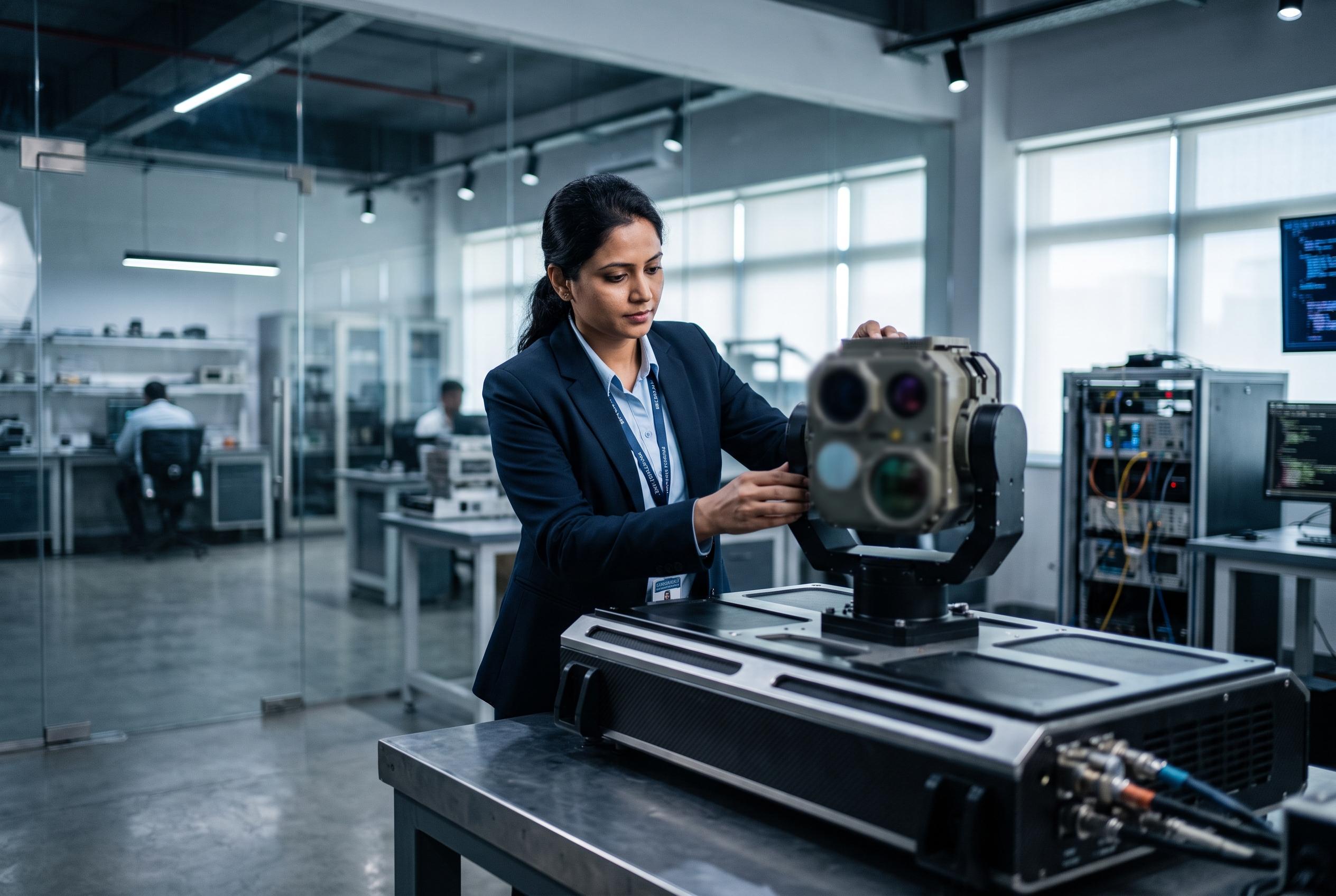

India is simultaneously liberalising its missile and surveillance technology sectors, inviting private industry into strategic domains while imposing stringent licensing, localisation, and security protocols to retain control over critical technologies amid a changing national security landscape.
India is recasting the rules for two of its most sensitive technology chains at once: missiles and surveillance cameras. In one move, New Delhi has opened the production of state-developed conventional missile systems to qualified domestic companies. In the other, it has imposed a much stricter security regime on internet-connected CCTV equipment, forcing vendors to prove where critical chips and firmware come from. Together, the measures show a broader policy shift: the state still wants tight control over strategic technology, but it no longer wants to be the only builder. (business-standard.com)
The more recent of the two steps came on 25 August 2026, when Defence Minister Rajnath Singh approved the transfer of all DRDO-developed conventional missile technologies to Indian industry for production inside the country. Business Standard reported that the change covers missiles used against ships, aircraft and ground targets, as well as air-defence systems, but not strategic weapons such as the Agni series. It also marks a break from the older nomination-heavy model under which state-owned manufacturers often had the inside track. According to Business Standard, the right to receive the technology will now be decided through competitive bidding. The Ministry of Defence said the aim was “to enhance domestic manufacturing capabilities, strengthen the defence industrial base and create opportunities for the participation of Indian MSMEs and other technology partners in the supply chain”. (business-standard.com)
That does not amount to a free hand for industry. DRDO’s 2025 transfer policy makes clear that control of the production base must remain Indian. The policy says eligible domestic entities can include companies, partnerships and proprietorships, but more than half of the capital must be beneficially owned by resident Indian citizens or by Indian companies ultimately controlled by them. Foreign direct investment is capped at 49%, and the policy bars layered structures that would dilute that rule. It also draws a line between sensitive and non-sensitive technologies: only Category B spinoff technologies may be transferred to foreign entities or to firms with foreign equity, and even then only with senior approval. Products based on DRDO technology cannot be exported, and overseas manufacturing cannot proceed, without government clearance. (drdo.gov.in)
The space sector is following a similar template, though through a more formal commercial chain. ISRO said a technology-transfer agreement for the Small Satellite Launch Vehicle was signed on 10 September 2025 by NewSpace India Limited, ISRO, IN-SPACe and Hindustan Aeronautics Limited. The SSLV is a three-stage, all-solid launcher designed to place satellites of up to 500kg into low Earth orbit. ISRO describes it as suitable for rapid turnaround and on-demand launches, and as a vehicle that can be manufactured industrially for the global small-satellite market. The agency also said SSLV missions could fly from Sriharikota for inclined orbits and from the upcoming Kulasekarapattinam site for polar launches. That matters because it shows the transfer is not confined to subsystems or components; it extends to an operational launch platform meant for commercial sale. (isro.gov.in)
A parallel tightening is under way in civilian surveillance. Counterpoint Research reported that India’s Essential Requirements for CCTV systems began as procurement conditions for government buyers and were then extended to cameras sold across the wider market. The STQC guidance shows that the new process is far more than a routine product registration. Test laboratories must verify, using invoices, technical literature and supporting documents, that the system-on-chip and firmware are not sourced from countries sharing a land border with India. They must also check traceability from procurement to final integration, examine supply-chain risk plans, inspect network cards, and test exposed interfaces such as USB, UART, JTAG and SWD for weaknesses. Where a vendor uses a proprietary network protocol, the guidance requires full implementation details and source code for that protocol to be supplied. (stqc.gov.in)
Those compliance demands quickly became a market filter. Counterpoint said that, as of 29 February 2025, only five brands had some compliant models: CP Plus, Prama, Matrix, Sparsh and Qubo. It also noted that only Qubo had licensed smart cameras at that stage. The same analysis said public procurement accounts for about 30% to 35% of CCTV demand in India, which helps explain why suppliers cannot easily maintain one product line for the state and another for everyone else. With IP cameras already making up more than two-thirds of the market, Counterpoint argued that the rules would probably lift prices, hurt smaller vendors that cannot map their supply chains in detail, and favour companies able to localise firmware, host services in India and shift to trusted non-Chinese component suppliers. (counterpointresearch.com)
By the time the final compliance deadline arrived on 1 April 2026, the immediate commercial effects were clearer. India Today reported that Hikvision, Dahua and TP-Link were set to be blocked from selling internet-connected CCTV products in India unless they secured STQC approval, and that authorities were refusing certification to products using Chinese-origin chipsets. The publication said Chinese brands had recently accounted for roughly one-third of Indian CCTV sales, but domestic makers had moved quickly to fill the gap. It also reported that more than 500 CCTV models had been certified under the new regime. Nikhil Rajpal, founder of Qubo, told India Today that the government’s step was “a critical step towards strengthening national and personal security while also delivering a strong vote of confidence in favour of Indian brands & manufacturing.” (indiatoday.in)
Set side by side, the missile and camera decisions express the same industrial doctrine. India is inviting private firms deeper into strategically important sectors, but only within a framework of licensing controls, ownership tests, export restrictions and component-level scrutiny. In defence, the state wants factories outside the public sector without surrendering oversight of who owns them or where the products go. In surveillance, it wants cameras on the market only if their chips, code and interfaces can survive a national-security audit. The success of both efforts will depend on whether domestic companies can absorb the know-how, build reliable volume and do so without simply replacing one brittle dependency with another. (business-standard.com)
Disclaimer: This content is intended for informational purposes only. Readers are advised to exercise their own judgement, conduct due diligence, or consult a qualified expert before acting on any information provided.