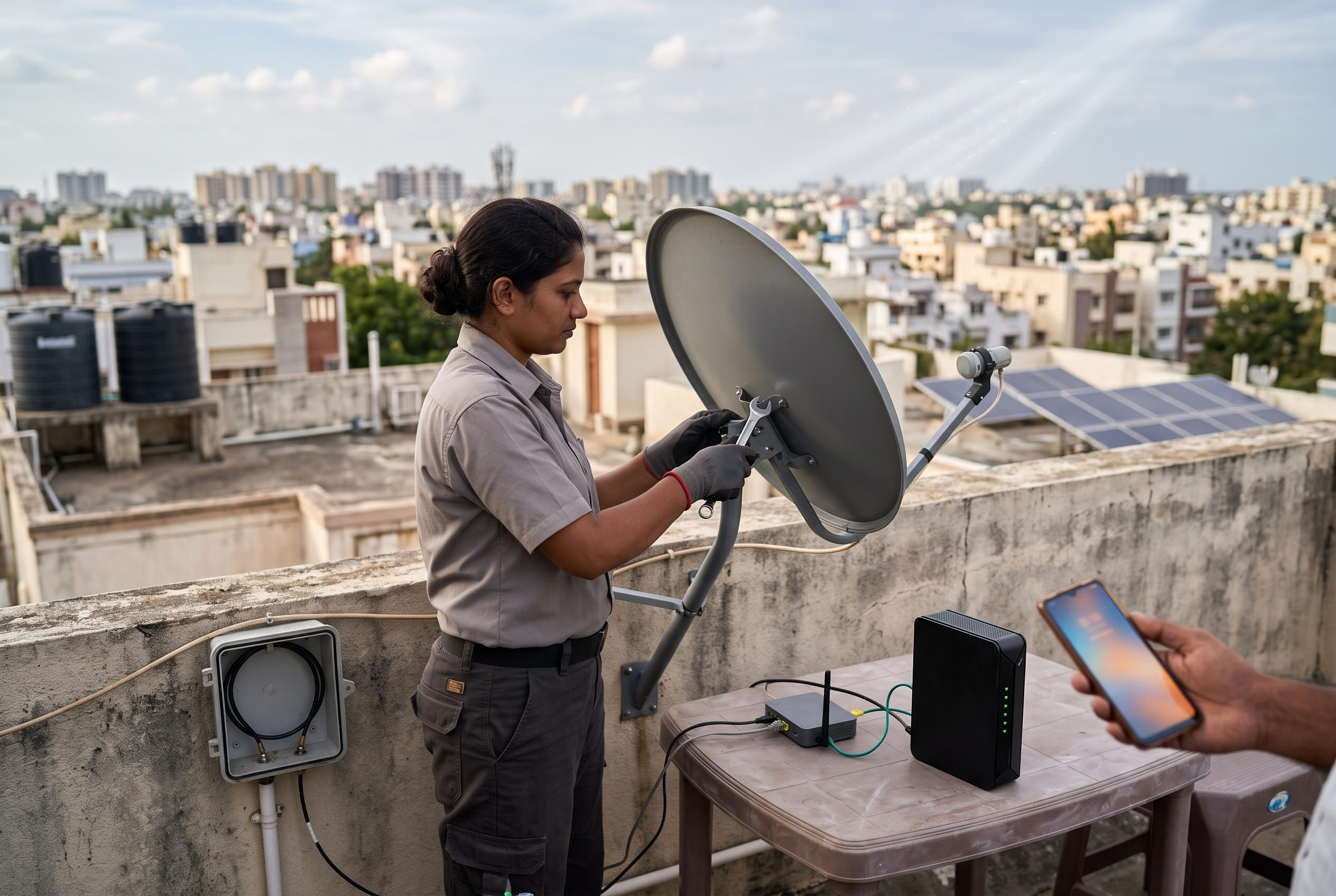

India’s Digital Communications Commission has approved a 5 per cent spectrum usage charge for satellite operators, signalling a significant regulatory shift that could boost services from providers like Starlink, Eutelsat OneWeb, and Jio Satellite Communications.
India has moved a significant step closer to commercial satellite broadband after the Digital Communications Commission approved a 5 per cent spectrum usage charge on adjusted gross revenue for satellite operators. According to The Hindu BusinessLine, the decision ends a long wait for a regulatory framework and could accelerate services from providers such as Starlink, Eutelsat OneWeb and Jio Satellite Communications.
The pricing is slightly above the 4 per cent recommended by the Telecom Regulatory Authority of India, but operators serving government-notified hard-to-reach areas, including border districts, hilly terrain and islands, will effectively pay 4 per cent. The Department of Telecommunications is also understood to favour administrative assignment of spectrum for five years, with a possible two-year extension, rather than auctioning it. That approach reflects the different economics of satellite networks, which can cover wide areas without the dense ground infrastructure required by mobile systems, and reduces the risk that scarce spectrum is fragmented before the market has matured. Reuters has previously noted that the move removes one of the main regulatory barriers to a broader satcom rollout.
The wider policy debate has centred on whether satellite broadband should be treated like terrestrial telecoms. TRAI had proposed an additional annual fee of ₹500 per urban subscriber, intended to stop operators from focusing only on profitable city customers. The government has rejected that idea, a move welcomed by industry because satellite capacity is limited in any case and is unlikely to be wasted on dense urban markets. At the same time, satcom is increasingly being viewed as complementary to fibre and mobile networks rather than a substitute for them, especially where terrain, distance or cost make fixed-line expansion unrealistic.
The larger unanswered question is affordability at the user end. TRAI has said satellite terminals can cost between ₹20,000 and ₹50,000, and had urged support through direct benefit transfers or the Digital Bharat Nidhi for unserved and underserved areas. That issue may prove more important than spectrum pricing in determining adoption, particularly in rural regions where satellite broadband has the greatest practical value. For now, however, the regulatory signal is clear: India is preparing to open the door to a new class of connectivity services, even if the final pace of rollout will depend on equipment costs, approvals and device availability.
Disclaimer: This content is intended for informational purposes only. Readers are advised to exercise their own judgement, conduct due diligence, or consult a qualified expert before acting on any information provided.