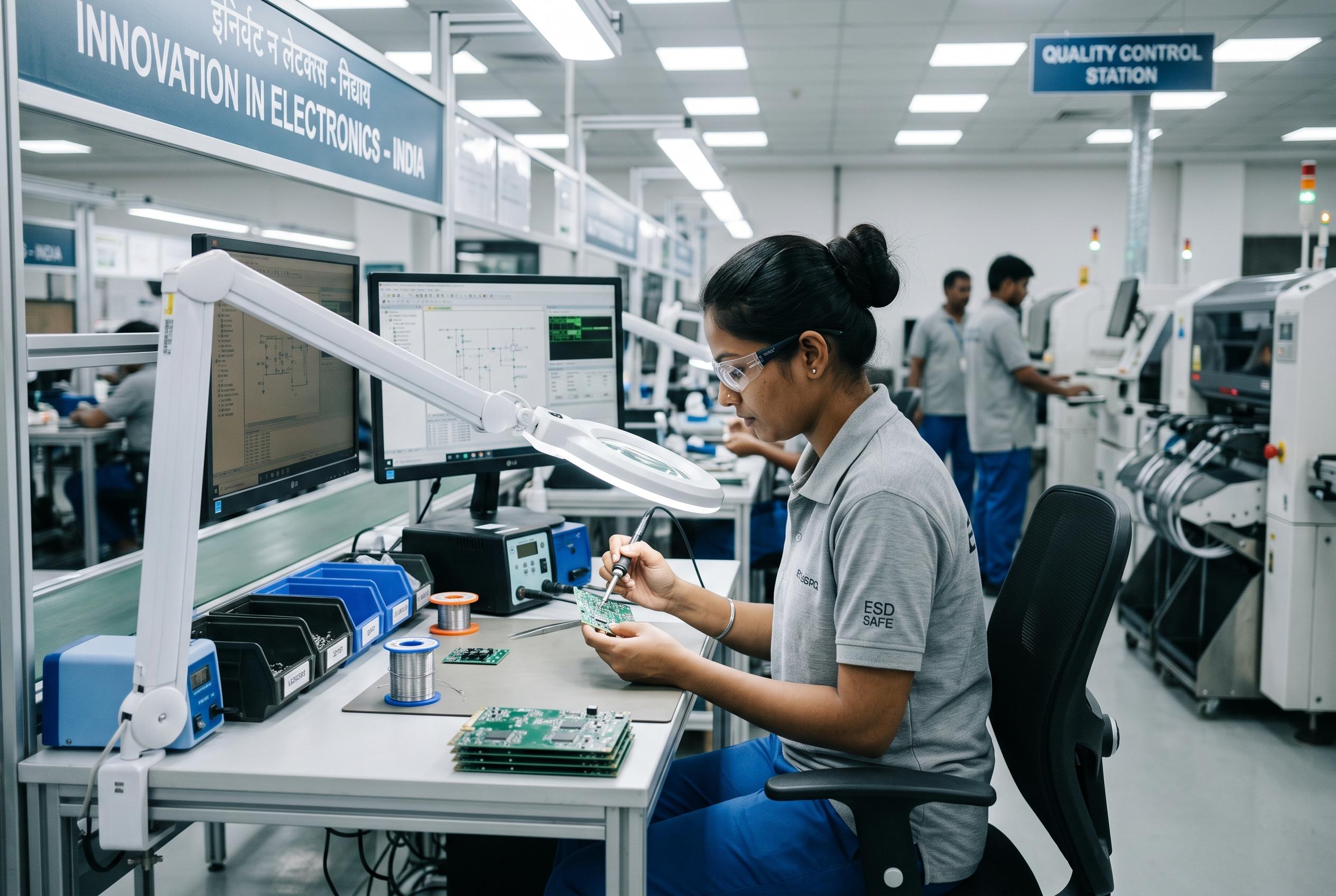

A dozen years after Prime Minister Narendra Modi launched Make in India, the country has transformed into a global electronics manufacturing hub, with increased domestic production, exports, and employment, spearheaded by ambitious policies and strategic investments.
When Narendra Modi launched Make in India in New Delhi on September 25, 2014, he cast the programme as more than an investment pitch. According to the Prime Minister’s Office, the initiative was meant to draw capital, technology and jobs into Indian manufacturing, while the government framed it as a bid to turn the country into a serious industrial base rather than merely a vast consumer market. India Brand Equity Foundation says the broader goal was to improve infrastructure, encourage innovation and strengthen skills across sectors.
A dozen years later, the most visible change has come in electronics, especially mobile phones. India has moved from heavy dependence on imports to making almost all the handsets used at home, while also becoming the world’s second-largest mobile phone manufacturer by volume. The scale-up has been striking: production has risen sharply, exports have soared and mobile phones have emerged as one of India’s biggest export items. That shift has also become a political symbol, given how often opposition leaders once attacked the country’s import dependence.
The main policy engine behind that transition has been the Production Linked Incentive framework. Launched across 14 sectors and expanded over time, the scheme rewards actual output and sales rather than promises on paper. By March 31, 2026, official figures showed actual investment of more than ₹2.40 lakh crore, direct and indirect employment of over 14.15 lakh people and exports above ₹15.2 lakh crore under the PLI umbrella. In electronics, the results are clearest: the sector has grown rapidly, handset imports have fallen and domestic factories have become central to global supply chains.
Much of the early groundwork was laid before the big PLI push began. The government liberalised foreign investment, introduced the Phased Manufacturing Programme for phones and backed production with incentives such as the Modified Special Incentive Package Scheme and SPECS. According to the article’s summary of official data, SPECS alone approved dozens of applications and supported investment, production and skilled employment across component manufacturing and semiconductor-related activity. The number of mobile phone factories climbed from just a handful in 2014 to well over 200.
The next challenge was to move beyond assembly. That is where the component ecosystem came in. The Electronics Component Manufacturing Scheme, approved in 2025 and later expanded in the Union Budget, is designed to deepen local production of items such as printed circuit boards, camera modules, connectors and optical transceivers. The scheme had already attracted investment commitments well above its initial target by early 2026, suggesting industry sees a real opportunity to build higher domestic value into India’s electronics supply chain.
Semiconductors are the most ambitious part of that effort. The India Semiconductor Mission, launched in 2021, has supported fabrication, assembly, testing, marking and packaging projects, with several plants already beginning production in Gujarat. Tata Electronics is building a major fabrication facility in Dholera, while Micron Technology, Kaynes Semicon and CG Semi have started ATMP work in Sanand. In July 2026, the Cabinet approved Semicon 2.0 with a much larger outlay, aiming to widen support for chip design, materials, equipment and advanced manufacturing.
The jobs story is equally important. Electronics manufacturing is now a major employer, with large concentrations of work in Tamil Nadu, Karnataka, Uttar Pradesh and Gujarat. The article says women make up a large share of the assembly workforce in some plants, and that mobile-phone manufacturing alone supports about 12 lakh jobs. It also notes that domestic value addition has improved, though it still remains short of the level needed for a fully mature industrial ecosystem.
The broader lesson is that India’s manufacturing rise has not come from a single policy, but from a sequence: Make in India set the ambition, PLI supplied the scale, component schemes aimed to deepen the base and semiconductor policy pushed the frontier. The result is a country that is no longer just assembling electronics for others, but increasingly building the industrial capacity to compete, export and innovate on its own terms.
Disclaimer: This content is intended for informational purposes only. Readers are advised to exercise their own judgement, conduct due diligence, or consult a qualified expert before acting on any information provided.