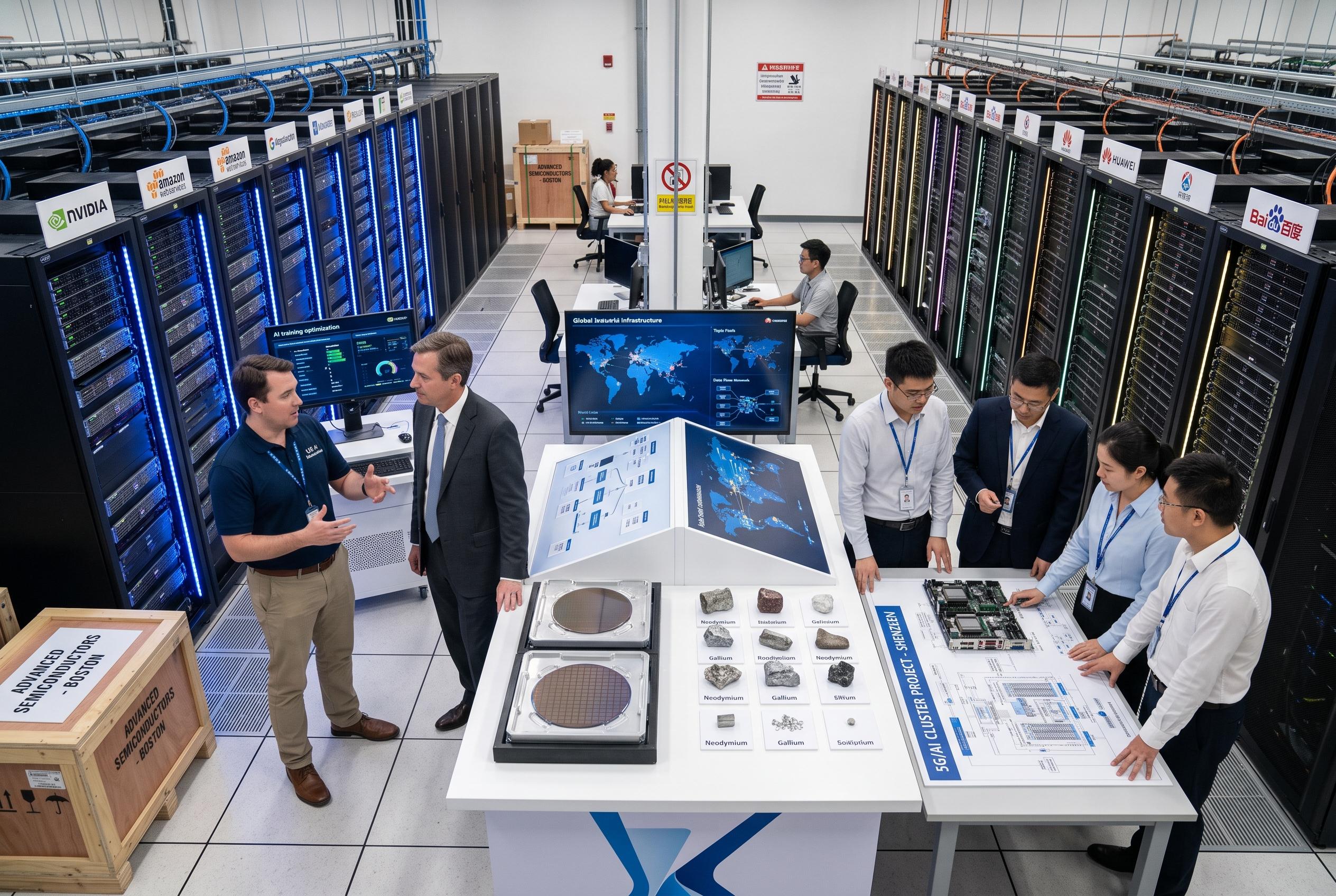

The competition between the United States and China extends beyond software, now centred on dominating the foundational elements of the AI supply chain, including chips, data centres, minerals, and talent, shaping a fragmented future of the digital economy.
The contest between the United States and China over artificial intelligence is no longer just about software. It is increasingly about who controls the underlying industrial base: advanced chips, data centres, electricity, training data, minerals and the talent needed to build and run them. As La Diaria reported, that wider struggle is now shaping expectations for the future of the digital economy, with both powers trying to secure strategic advantage while experts see a world moving towards greater technological fragmentation.
That interpretation is reinforced by recent reporting from Tom’s Hardware and the Council on Foreign Relations, which show how both sides are tightening their positions around the AI supply chain. Washington has used export controls to limit China’s access to leading-edge semiconductors, while Beijing continues to dominate the refining and processing of several critical minerals used in chipmaking, batteries and sensors. The result is a rivalry in which each side can obstruct the other in different parts of the stack.
At the same time, China is also trying to reduce dependence on US technology by building a more self-contained AI ecosystem. According to Tom’s Hardware, Chinese companies have formed alliances to standardise hardware and software interfaces, making models easier to run across domestic accelerator chips. The same reporting says Beijing is also weighing tighter export controls of its own, including possible restrictions on advanced AI models, training data and some foreign manufacturing services. That would make the market even more segmented.
The strategic divide is visible in business models as well as hardware. La Diaria’s interviews highlighted how US firms have largely favoured closed systems with paid access and licensing, while Chinese groups, including DeepSeek, have pushed open-weight models that can be downloaded and run on local infrastructure. Emiliano Chinelli, chief executive and co-founder of Promtior, argued that this model can lower costs and give companies greater autonomy, because they are not tied to a foreign vendor’s pricing or policy decisions. That distinction matters for governments and firms that want more control over sensitive workloads.
The broader debate is not about which country has built the best chatbot. It is about which country sets the rules for the next phase of digital production. Carolina Aguerre, a specialist in digital governance quoted by La Diaria, said the real issue is who controls the infrastructure layer that determines standards, access and dependency. Carla Bonina, an economist at the University of Surrey, described the situation as a multipolar race with no clear final winner, only competing ecosystems and growing uncertainty.
Other analysis points to a similar conclusion. Time has reported that the AI race is shaped by several variables at once, including open and closed models, chips, cloud capacity, energy supply and global partnerships. Boston Consulting Group has likewise warned that the United States and China are forming increasingly incompatible technology stacks, which may force companies and governments to choose where they want to operate. That choice is already affecting investment, trade and product design.
For smaller countries, the consequences are practical. La Diaria reported that experts see Latin America as a region that risks becoming a passive market rather than a rule-maker, with fewer chances to shape standards and more exposure to higher costs and restricted access. For Uruguay, the advice from the specialists was to preserve regulatory credibility, keep data protection strong and build local talent rather than attempt to match the superpowers in chips or large-scale infrastructure.
The likely outcome is not a clean break but a durable split with pockets of cooperation. According to Aguerre and Bonina, the two powers will probably continue to compete fiercely while still relying on one another in parts of the industrial chain. That makes the AI contest less like a winner-takes-all race and more like the foundation of a long period of managed rivalry, in which control over infrastructure may matter as much as the models themselves.
Disclaimer: This content is intended for informational purposes only. Readers are advised to exercise their own judgement, conduct due diligence, or consult a qualified expert before acting on any information provided.