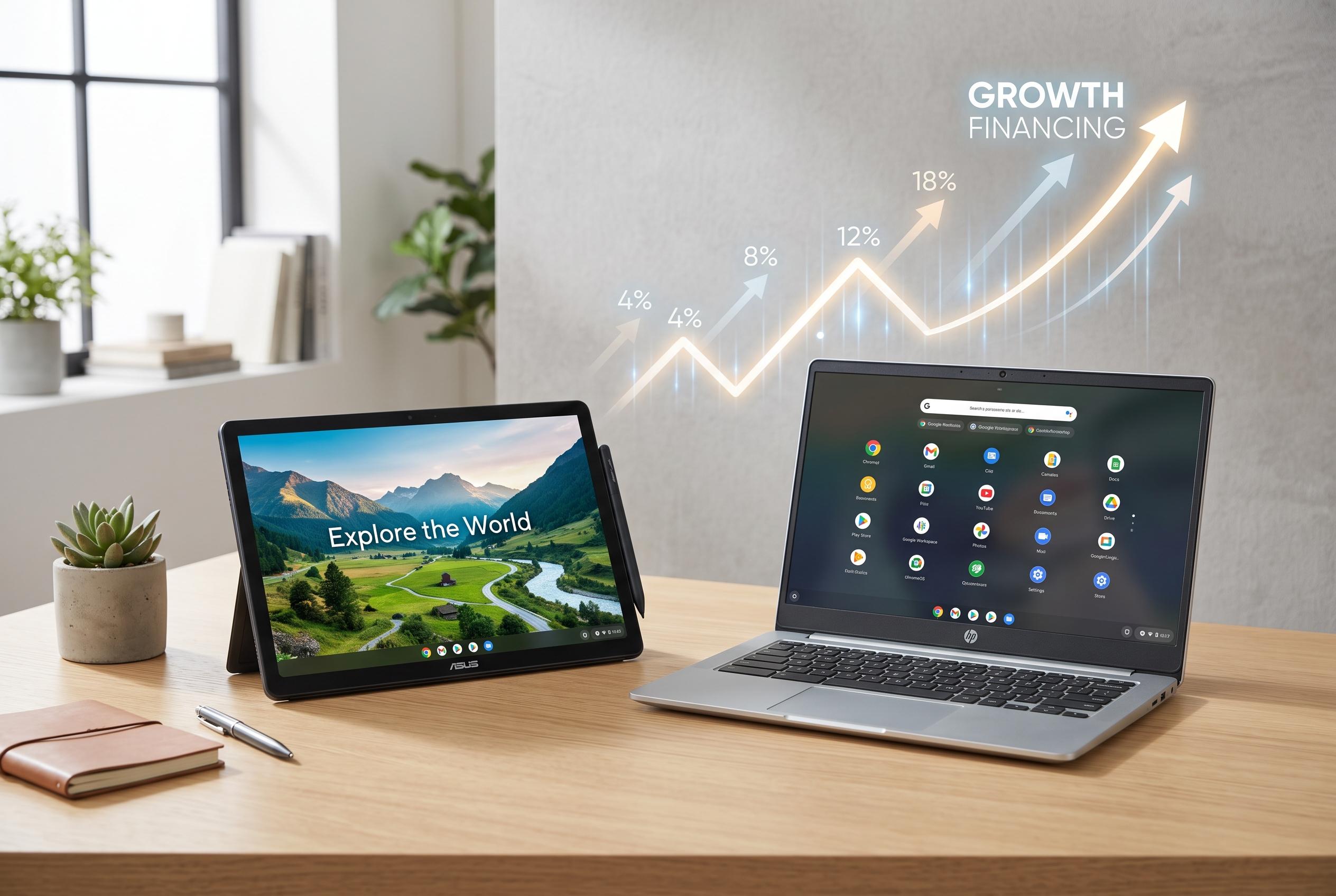

Asus is broadening its Indian offerings beyond laptops, introducing tablets and Chromebooks, while leveraging financing schemes to counteract inflation and boost market share, particularly in smaller towns and gaming segments.
Asus is widening its India playbook beyond conventional laptops, with the company now pairing premium PCs with tablets, Chromebooks and financing schemes designed to blunt the impact of higher component costs. In an interview with Gadgets 360, Arnold Su, vice-president for consumer and gaming PCs at ASUS India, said the company sees tablets as a practical on-the-go device while also using the category to preserve coverage in price bands where Windows laptops are becoming harder to sell profitably.
That shift is not happening in isolation. Asus recently confirmed the return of the Asus Pad T3201 to India, after years out of the Android tablet market. The company says the device will ship with a 12.2-inch dual-layer OLED display, a MediaTek Dimensity 8300 chip and a 9,000mAh battery, with launch plans centred on August 6 and distribution through Flipkart, the Asus eShop and retail partners including Asus and ROG stores and Reliance Digital.
Pricing pressure is also shaping Asus’ product mix. Su said memory and storage parts, once a relatively small share of a notebook’s cost, have become a far larger burden, pushing retail prices higher and making it more difficult to serve entry-level buyers. The company’s answer has been to lean harder into Chromebooks, which it says now have a wider price gap versus Windows machines, and to push finance plans, with Easy Pay adoption rising through 2025 and into 2026 as buyers look for lower monthly commitments rather than upfront discounts.
Gaming remains the clearest engine of growth. Asus said India’s gaming-PC market has expanded sharply in recent years and still offers the strongest demand for premium hardware, but Su argued that a meaningful share of buyers use gaming machines for coding, content creation and other demanding work. That is helping Asus build out its ProArt creator line alongside gaming, rather than relying on one segment to carry the business.
The company is also pressing for share in the mainstream PC market. According to Su, Asus reached 25% market share in India in June 2026 and is now aiming for roughly 30% in the second half of the year, a level it believes could put it in contention for the No. 1 position. Separately, recent launches of AI-ready Zenbook and Vivobook models at prices from ₹98,990 to ₹299,990 show how Asus is trying to keep a premium line-up in place even as component inflation lifts entry prices across the market.
Much of that ambition depends on reaching beyond the big cities. Su said metropolitan areas account for about 35% of Asus’ business, while the rest comes from smaller towns, and the company wants dealer coverage in 2,000 talukas by the end of the year. Asus is also trying to strengthen after-sales support, with more than 200 service centres in India and a growing spare-parts network, while turning some exclusive stores into collection points to reduce turnaround times for repairs.
Disclaimer: This content is intended for informational purposes only. Readers are advised to exercise their own judgement, conduct due diligence, or consult a qualified expert before acting on any information provided.