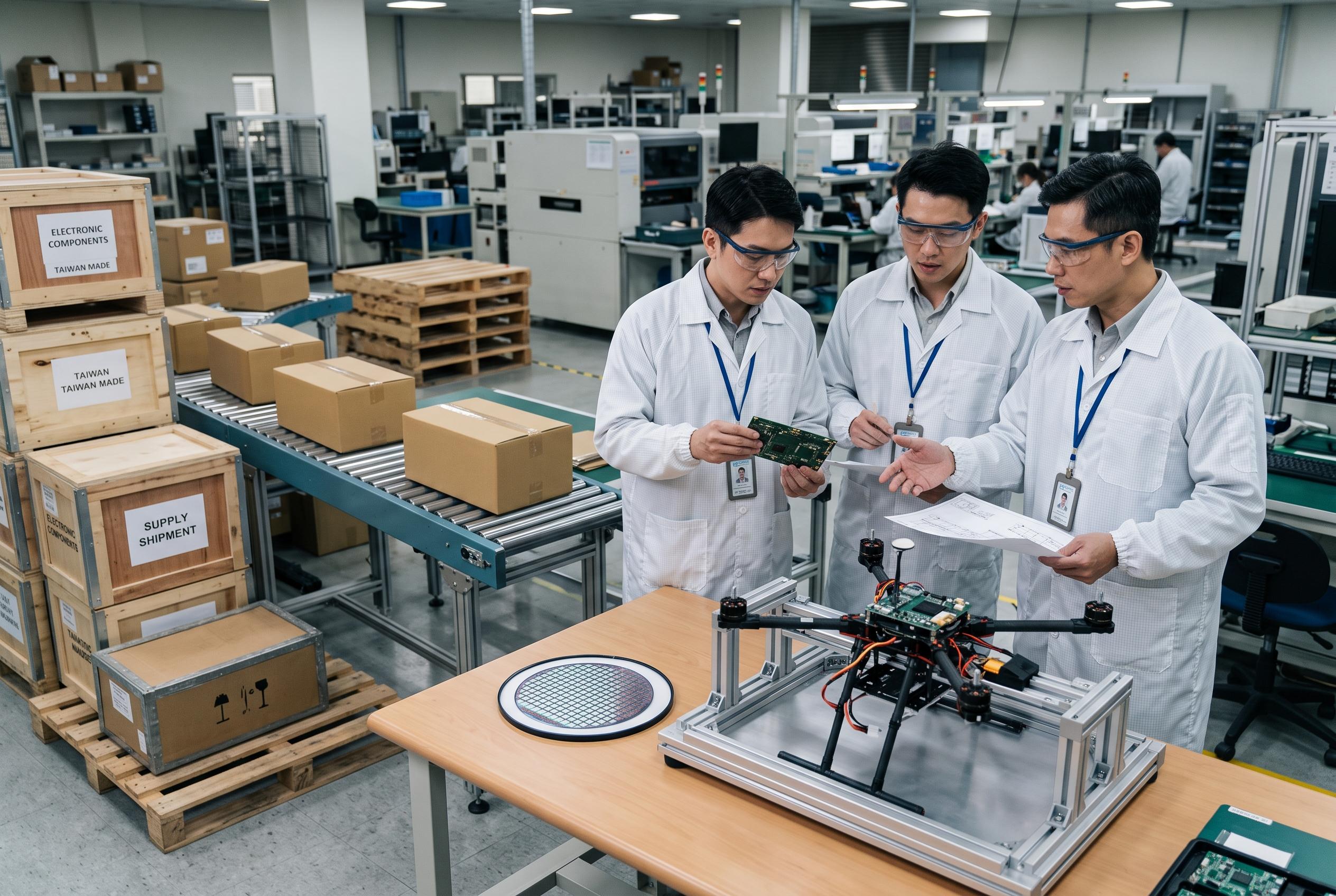

Ongoing political impasse over Taiwan’s central government budget is now endangering critical sectors including semiconductors, drone manufacturing, and start-up innovation, risking Taiwan’s strategic and economic leadership in high-tech industries.
Taiwan’s prolonged stalemate over the central government budget is beginning to affect more than politics. Industry figures and media reports say the freeze is now threatening parts of the island’s technology supply chain, from advanced semiconductor work to drone manufacturing and venture-backed start-ups, at a time when speed and policy support are seen as critical to remaining competitive.
A technology executive told local media that a planned NT$10.1 billion package for an “AI New Ten Major Construction” programme includes work on silicon photonics, quantum computing and related fields, but that the policy measures tied to it cannot move forward while funding remains blocked. The concern is that Taiwan could miss a crucial commercial window for silicon photonics and co-packaged optics, just as TSMC prepares its COUPE platform for mass production and Broadcom has already sent samples to customers for testing, according to the report.
The same budget impasse is also complicating Taiwan’s drone strategy. Taiwan News reported that the Cabinet has warned a Kuomintang proposal to freeze funding for the government’s drone industry programme could weaken Taiwan’s place in the so-called non-red supply chain, meaning a production network without Chinese components. The six-year plan, worth NT$44.2 billion from 2025 to 2030, is meant to expand the domestic market through public procurement, build Chiayi County into a drone hub and establish specialist laboratories in Tainan.
That issue is not simply industrial; it is strategic. Taiwan Plus has reported that the government is trying to build a fully domestic drone sector as part of a wider effort to reduce reliance on Chinese-made systems in both civilian and military use. South China Morning Post has separately said the plan aims to position Taiwan as an Asia-Pacific drone hub and lift annual output to NT$40 billion by the end of the decade. But a recent DSET report said battery production remains a weak point, with technical and supply-chain constraints still making a fully non-red system difficult to achieve.
The budget freeze is also hitting the start-up ecosystem. A venture capital source told local media that research-driven companies often survive only quarter to quarter, and that when the National Development Fund pulls back because of budget uncertainty, private investors tend to follow. That, the source said, can trigger a wave of team collapses that may take two or three years to rebuild. The broader warning from industry is that delayed policy support does not just slow projects; it risks scattering skilled workers just as Taiwan is trying to deepen its technology base.
Disclaimer: This content is intended for informational purposes only. Readers are advised to exercise their own judgement, conduct due diligence, or consult a qualified expert before acting on any information provided.