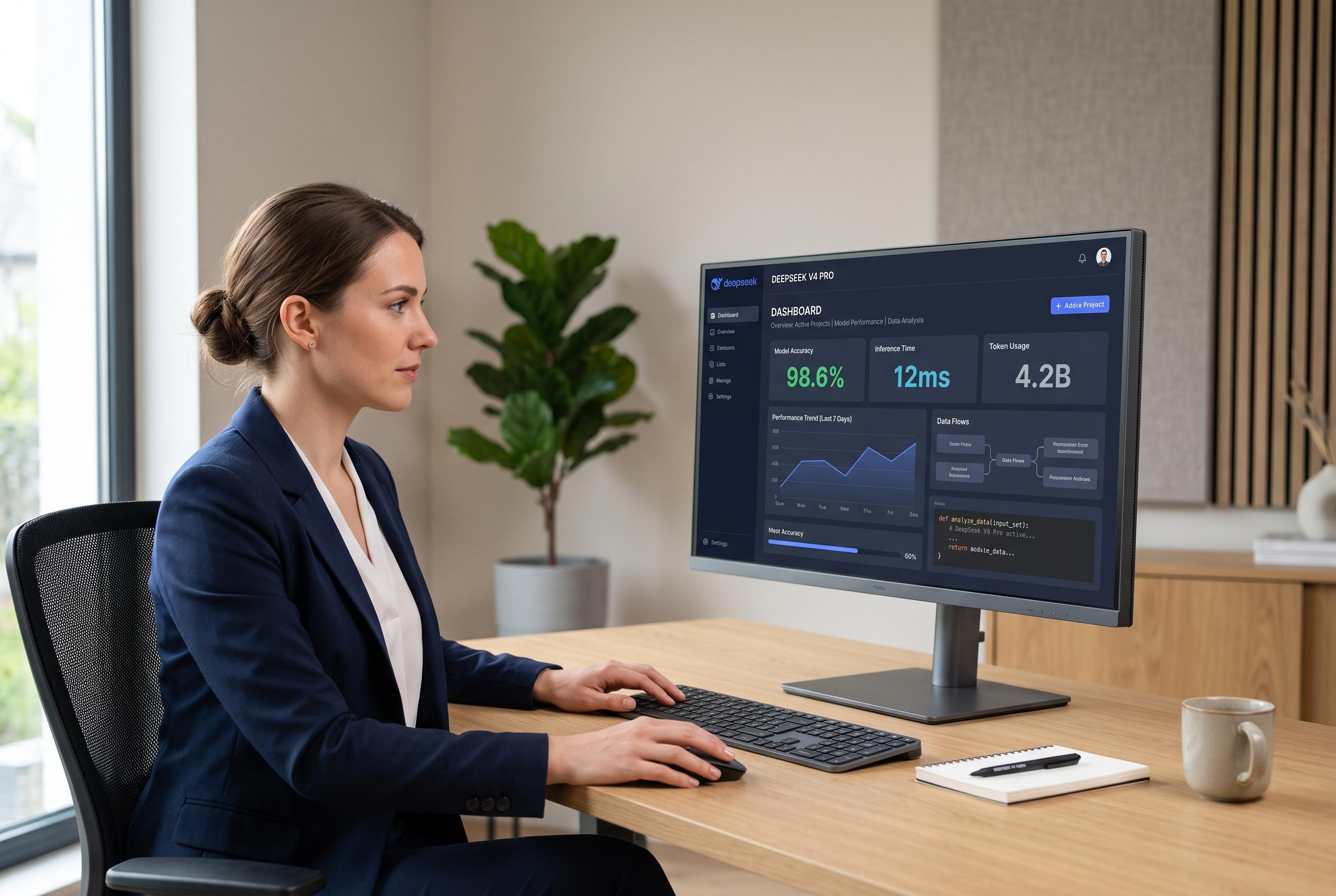

DeepSeek releases V4 Pro, its latest AI model, amid intensifying competition and escalating costs in China’s fast-evolving artificial intelligence landscape, with surprising performance insights and strategic expansion plans.
DeepSeek has formally released V4 Pro, an updated version of its flagship model, as the Chinese artificial intelligence company tries to hold its ground in a fast-moving domestic market. The launch comes as the group expands hiring, adds computing capacity and seeks fresh capital, reflecting the rising cost of competing in advanced AI.
According to the company’s latest pricing information, access to the V4 range is now offered through the API on a pay-as-you-go basis, with V4 Pro priced at $0.435 per million input tokens and $0.87 per million output tokens, while V4 Flash is cheaper at $0.14 and $0.28 respectively. Both models support a 1 million-token context window, which allows them to process very long documents or codebases. DeepSeek has also said that pricing may vary during peak periods, underlining the commercial pressures facing a business that once built its reputation on low-cost access.
The new release is notable because independent testing previously suggested that the lower-priced V4 Flash could outperform the earlier preview version of V4 Pro in some tasks. That is unusual for a product line in which the Pro model is meant to be the more capable option, but it also points to the speed of iteration inside DeepSeek between preview and full launch. TechCrunch reported in April that the preview V4 family included mixture-of-experts models, with V4 Pro carrying 1.6 trillion total parameters and 49 billion active parameters per pass.
DeepSeek first drew global attention in early 2025 with its reasoning model R1, which helped fuel debate over whether frontier AI systems could be built at far lower cost than those from US rivals. Since then, however, its lead in China has faced pressure from Moonshot AI, Zhipu AI, MiniMax, Alibaba and ByteDance. The company is also trying to turn technical prominence into a durable business: reports in June and July pointed to large new funding, an estimated valuation near $71 billion and a plan to double headcount across teams, including data centres and AI agents, while also recruiting more chip designers to reduce dependence on Nvidia and Huawei.
Disclaimer: This content is intended for informational purposes only. Readers are advised to exercise their own judgement, conduct due diligence, or consult a qualified expert before acting on any information provided.