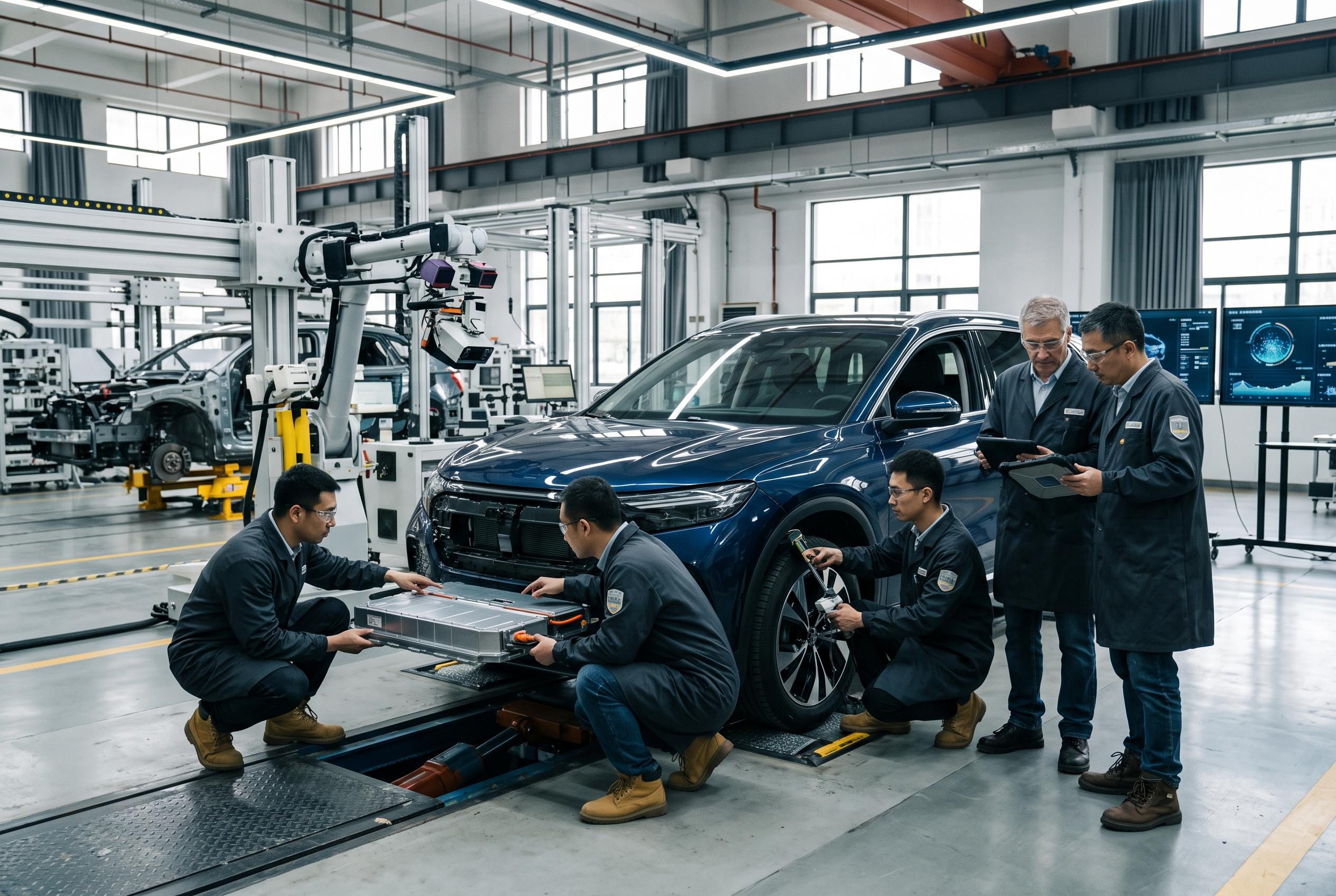

China’s regulators are intensifying their scrutiny of carmakers, enforcing stricter testing standards and launching a record-breaking recall campaign to ensure safety and reliability amid rapid industry growth and overseas expansion.
Beijing has moved beyond warning Chinese carmakers about speed and has begun rewriting the rules around how quickly a vehicle can be designed, validated and sold. In a notice published on 27 August, China’s Ministry of Industry and Information Technology, together with the public security, ecology and market regulators, (miit.gov.cn) launched a one-year national campaign to tackle production conformity, reliability, durability and the testing of new technologies. A separate government guideline on overseas operations, released at the start of September and reported by Xinhua, (english.news.cn) told manufacturers to avoid disruptive pricing abroad and to strengthen safety and quality management as they expand overseas. The message is clear: rapid model turnover remains acceptable only if it can survive tougher scrutiny.
That tightening began well before the latest headlines. Reuters reported on 17 July (marketscreener.com) that the industry ministry had summoned key carmakers and told them to resist “irrational competition”, investigate problems in production consistency, reliability and durability, and fully assess safety risks before launching new designs. The ministry also told them to strengthen checks on combined driver-assistance and autonomous functions and to avoid exaggerated or false advertising, Reuters said. Within a week, according to CnEVPost’s account of the ministry’s site visits, (cnevpost.com) inspectors were already sampling vehicles and power batteries at plants operated by GAC Aion and Xpeng, part of a broader push that later extended to Nio, Chery and JAC.
The most visible sign of that harder line came on 21 August, when regulators triggered what became China’s biggest automotive recall campaign. Reuters reported in its Tesla filing account (investing.com) that the company will recall 2.98 million China-made and imported Model 3, Model Y, Model S and Model X vehicles from 25 September because emergency mechanical door releases may be hard to identify after a severe crash and electrical failure; the remedy combines warning labels with an over-the-air update that lowers the windows after a collision. Reuters also said Tesla is separately recalling 2.74 million China-made Model 3 and Model Y cars immediately to improve driver-attention monitoring when assisted steering and other driver-assistance functions are active. The Associated Press reported (apnews.com) that Xiaomi is recalling more than 390,000 vehicles and Leapmotor more than 370,000, with Geely and XPENG also affected, while People’s Daily described the campaign as “a unified safety upgrade” ahead of China’s 2027 ban on hidden door handles.
The recall wave sits inside a broader attempt to force more real-world validation back into the development process. China Daily reported in August (mobile.chinadaily.com.cn) that China plans to raise mandatory durability road testing for new-energy vehicles to 30,000 kilometres, up from a temporary 15,000-kilometre standard, bringing electric models into line with petrol cars. The same report said 542 models were launched in the first five months of 2026, or 3.6 a day, even as domestic sales fell 20 per cent. It added that some new models had already faced large recalls within 100 days of launch, including more than 30,000 XPeng X9 people carriers over air-spring defects, while Nanning alone logged 1,340 auto complaints in the first half, up 33.6 per cent year on year.
Industry criticism has become blunter as that pace has accelerated. China Daily reported from a mid-July forum (mobile.chinadaily.com.cn) that Li Fenggang, president of Beijing Hyundai, warned: “To accelerate time-to-market, some brands have cut necessary testing procedures, using consumers as test drivers and burying numerous safety hazards.” The same report quoted Wang Xicheng of the Xiangyang Daan Automobile Test Center saying compressed validation was damaging trust, safety and the export reputation of Chinese brands. Even those who credit simulation, modular design and digital engineering with cutting development time still accept that extreme cold, heat, altitude, crash, fatigue and durability testing cannot simply be designed away.
At the same time, officials are not demanding a return to the much slower product cycles once typical of foreign manufacturers. China Daily reported on 4 September (chinadaily.com.cn) that Magna China and Chery brought the DHD Duo hybrid drive system for the JETOUR G700 into series production in 18 months, with engineers identifying hundreds of risks before the prototype design was finalised. The same report said July draft amendments to three recommended national standards would set a minimum reliability-test mileage of 30,000 kilometres for electric, hybrid and fuel-cell vehicles. It also noted that a battery safety standard effective from 1 July requires seven cell-level tests and 17 battery-pack or system tests, and that batteries must not catch fire or explode in thermal-propagation tests or after an external short-circuit test following 300 fast-charging cycles.
Those domestic controls now matter well beyond China because the country’s carmakers are exporting not just vehicles but operating habits. Xinhua reported on the new overseas guideline (english.news.cn) that automakers should use cost-based pricing guided by local supply and demand, avoid frequent or large retail-price swings, and improve overseas production safety, quality management, labour protection and data compliance. Reuters’ July report (marketscreener.com) shows that Beijing is linking export conduct to the same campaign against “irrational competition” at home. A sector that once treated speed as a domestic weapon is being told that weak validation can now damage market access and brand credibility abroad as well.
The likely result is not a gentler market, but a more selective one. Reuters, in coverage carried by The National, quoted analyst Sam Fiorani as saying: “Modern over-the-air updates reduce the costs and downtime associated with major recalls.” (thenationalnews.com) That helps explain why large campaigns can be launched without crippling every manufacturer involved. But taken together, the August recall notices, the one-year inspection drive and the new test standards suggest a firmer boundary: Beijing still wants fast iteration, yet only from companies that can prove their software, hardware and production processes were validated before motorists discover the defects for themselves.
Disclaimer: This content is intended for informational purposes only. Readers are advised to exercise their own judgement, conduct due diligence, or consult a qualified expert before acting on any information provided.