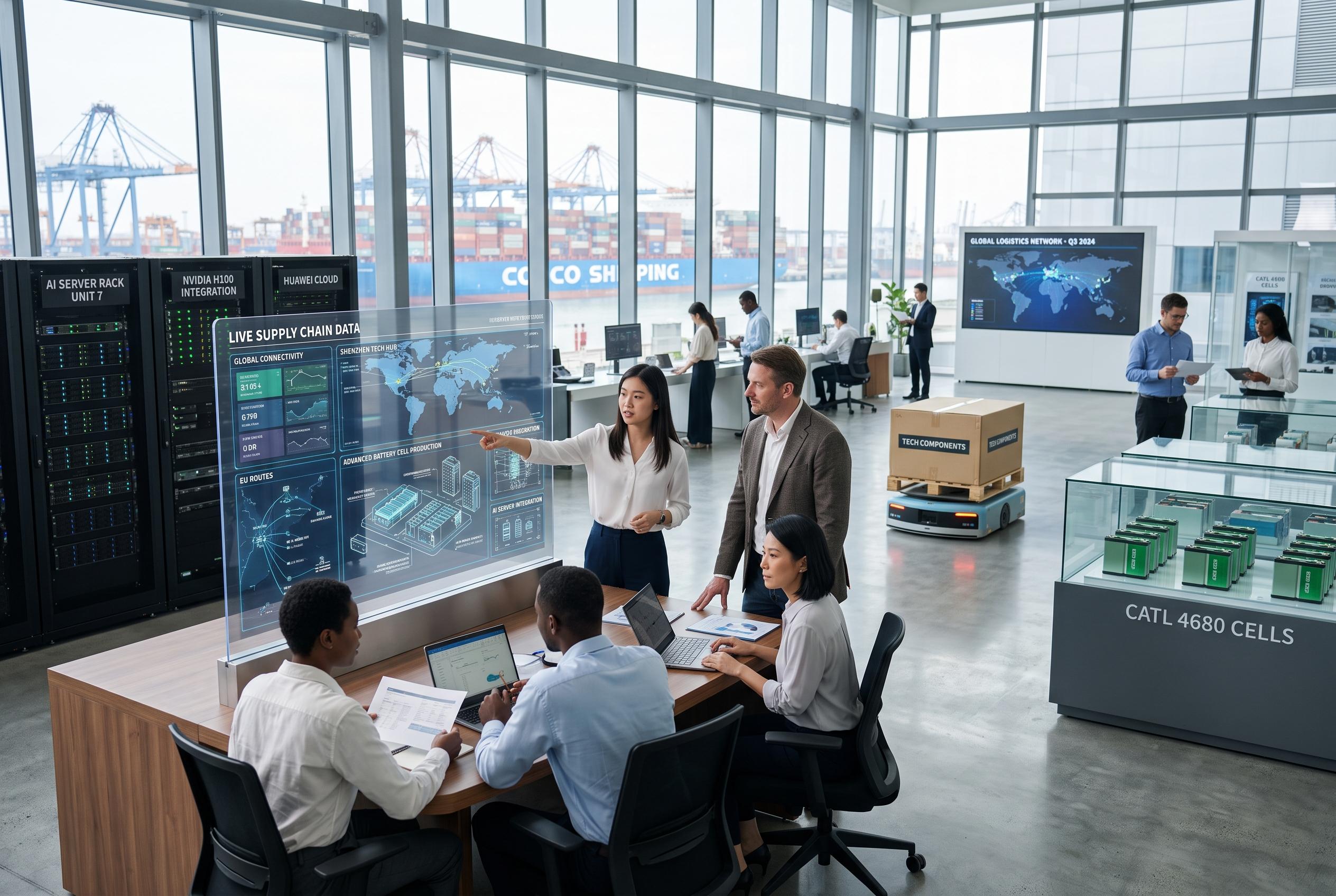

As Washington intensifies restrictions, multinational firms are increasingly leveraging Chinese innovation in AI, batteries, and software, blurring geopolitical boundaries and reshaping global supply chains.
Washington is tightening pressure on Beijing’s technology sector, yet Chinese firms are becoming harder for major global companies to avoid. In fields ranging from AI to electric-vehicle components, multinationals are increasingly drawing on Chinese capabilities not just to sell in China, but to build products and services there and, in some cases, elsewhere.
Apple’s China strategy illustrates the point. According to recent reports, the company has worked with Alibaba on AI features for iPhones sold in China, and Apple Intelligence has now been approved for launch there with Alibaba’s Qwen model integrated into Apple’s software stack. Earlier efforts to adapt Baidu models also ran into difficulty, underscoring how tightly product development in China can be shaped by local technology partners.
The same pattern is visible in automotive manufacturing. Ford’s Michigan battery project is using technology licensed from CATL, the Chinese battery giant, and reports say the plant has already begun production with CATL support in daily operations. The project was originally framed as a way to lower battery costs and strengthen US supply chains, but it has also become a symbol of how deeply Chinese battery know-how is embedded in global car-making.
Analysts say this is no longer just about low-cost manufacturing. They point to scale, engineering depth, supply-chain integration and speed of iteration as reasons Chinese suppliers remain attractive, particularly in batteries, software and applied AI. Counterpoint Research has said Chinese automakers and battery makers accounted for large shares of the global EV and battery markets in 2025, while IDC has argued that, in some sectors, China has shifted from being a sales destination to a source of capability. Even so, the adoption is uneven: resistance remains strongest in areas such as advanced semiconductors, cyber security and defence, where geopolitical risk still outweighs commercial benefit.
Disclaimer: This content is intended for informational purposes only. Readers are advised to exercise their own judgement, conduct due diligence, or consult a qualified expert before acting on any information provided.