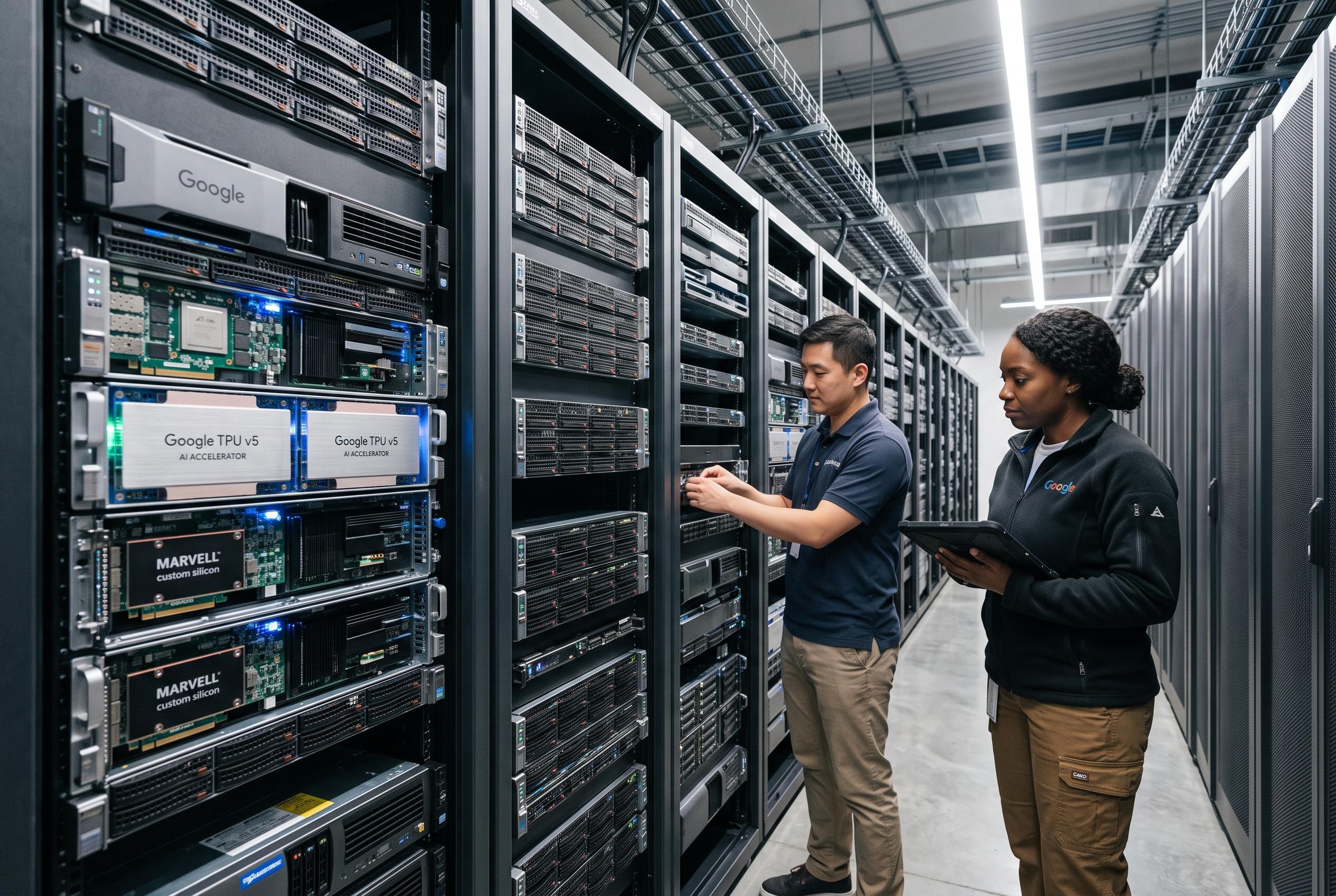

Google deepens collaboration with Marvell in a strategic move to diversify its AI hardware supply chain, blending custom silicon with multiple suppliers amid evolving cloud AI infrastructure demands.
Google’s deeper tie-up with Marvell Technology points to a broader shift in how the largest cloud groups are building AI infrastructure. According to Marvell’s regulatory filing dated August 19, the two companies signed a commercial agreement on July 29 covering custom silicon linked to Google’s Tensor Processing Unit ecosystem, including inference accelerators, storage controllers, network interface controllers, memory interface controllers and near-memory computing products. That places Marvell not just in accelerator design, but across the surrounding plumbing that moves data into and out of AI systems.
The filing does not name the TPU generations that will use the parts, but it does show how Google is widening its supplier base as it scales custom chips alongside Nvidia hardware. Reuters reported that Google also continues to work with Broadcom on future TPU generations and networking components, while Google Cloud still plans to offer Nvidia-based systems, including those built around Nvidia’s Vera Rubin platform. That mix suggests Google is trying to preserve flexibility rather than tie its AI stack to a single silicon partner.
Marvell’s equity warrant makes the scale of the relationship more explicit. The company granted Google the right to buy up to 58.97 million Marvell shares at $206.58 each, with vesting tied partly to purchase volumes. Reuters noted that one tranche vests in the first year, while the rest is linked to revenue from custom products between Marvell’s 2027 fiscal third quarter and the end of fiscal 2033. If all of those purchase-linked tranches are earned, they would correspond to $120 billion of revenue.
That structure fits a wider pattern in AI hardware, where major cloud and model providers are using custom chips to cut dependence on off-the-shelf accelerators. AWS has Trainium, Microsoft has Maia and Meta is expanding MTIA, while still buying Nvidia and AMD hardware where needed. In Google’s case, its TPU 8t is aimed at large-scale training and TPU 8i at inference and reinforcement learning, reflecting the industry’s split between training-heavy systems and cheaper, lower-latency inference infrastructure.
The market read-through was immediate. Reuters said Marvell shares rose almost 8% after the announcement, while Alphabet was little changed and Broadcom fell more than 5%. The reaction underlines how investors are weighing Google’s multi-supplier strategy against the possibility that custom silicon could gradually erode demand for general-purpose GPUs. For Marvell, the agreement offers both a larger role in AI infrastructure and a clearer link between future revenues and Google’s expanding TPU deployment.
Disclaimer: This content is intended for informational purposes only. Readers are advised to exercise their own judgement, conduct due diligence, or consult a qualified expert before acting on any information provided.