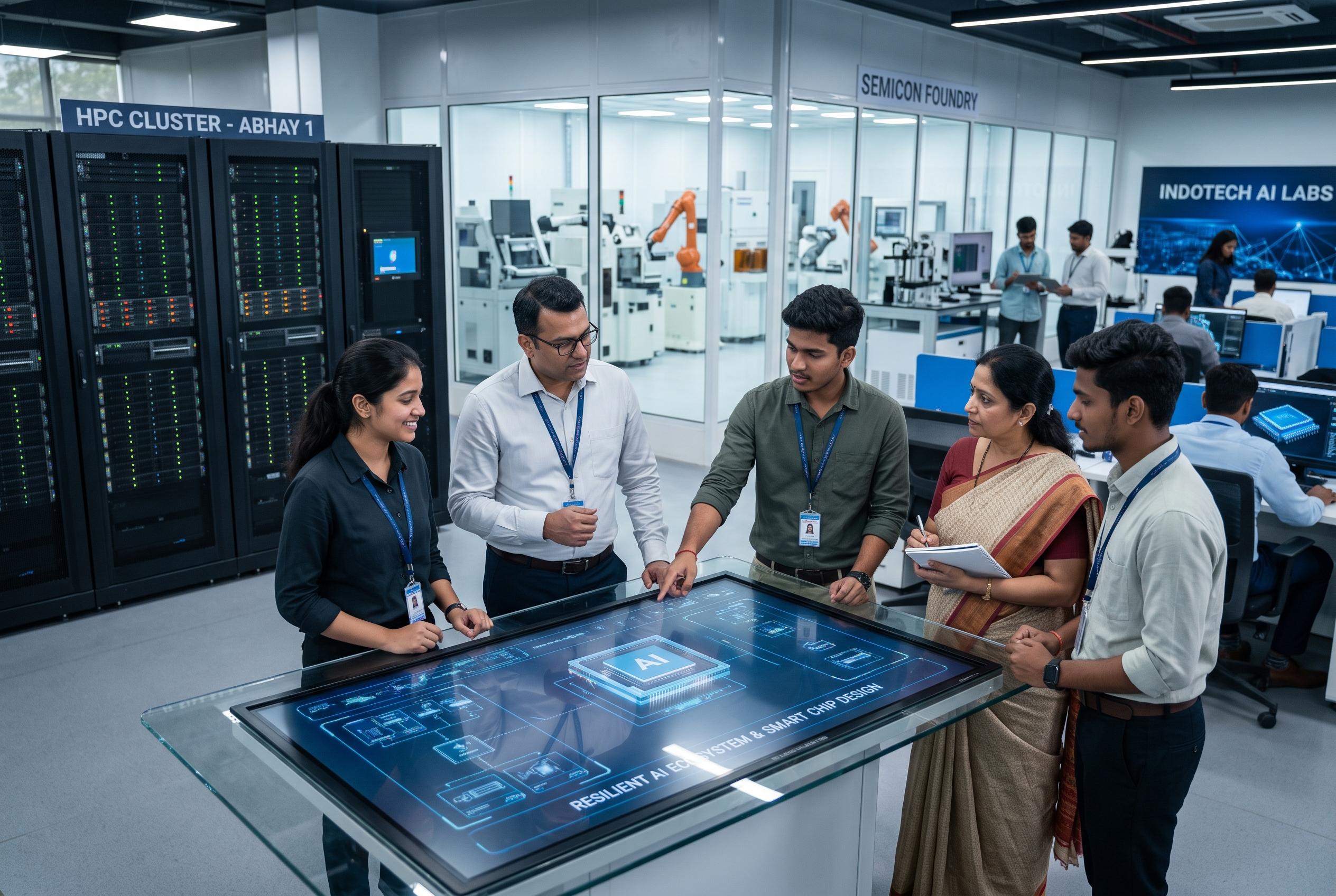

Prime Minister Narendra Modi has linked India’s AI growth to a broad industrial strategy, including training one crore youth, boosting compute capacity, and strengthening semiconductor supply, signalling a major shift towards building a resilient AI ecosystem.
Prime Minister Narendra Modi has tied India’s artificial intelligence ambitions to a much wider industrial strategy, telling the nation on Independence Day that the government will aim to train one crore young people in AI over the next year. The announcement, made from the Red Fort, places skilling at the centre of a technology agenda that also spans compute, semiconductors, data centres, research funding and energy security.
The scale of the pledge is significant, but it also builds on an existing policy base. The Ministry of Electronics and Information Technology launched YUVA AI for ALL under the IndiaAI Mission in November 2025, a free 4.5-hour self-paced course intended to introduce citizens to AI basics. By 8 July 2026, it had attracted 85.27 lakh enrolments. The IndiaAI FutureSkills pillar is also setting up 570 AI and data labs in tier-two and tier-three cities, while supporting fellowships and sector-specific courses in areas such as agriculture, healthcare, manufacturing and education.
That matters because AI capability is not just about literacy. Mass training can help workers use AI tools, but building and running AI systems at enterprise scale requires deeper skills in AI engineering, data engineering, cybersecurity, model operations and systems integration. Modi’s target therefore raises a broader question: whether India is preparing not only more users of AI, but enough people who can actually design, deploy and maintain AI infrastructure.
The government is also expanding the computing layer underneath those ambitions. The ₹10,371.92-crore IndiaAI Mission, approved in March 2024, has lifted shared compute capacity to more than 45,000 GPUs as of June 2026. By August, government data said 237 projects had accessed subsidised AI compute, covering 93.18 lakh GPU hours. The AIKosh platform has likewise grown, with more than 14,000 datasets and 331 AI models listed by July 2026, alongside more than 30 toolkits in an August update. From 506 applications, the government has selected 20 indigenous foundation-model proposals, including large multimodal models and small language models.
That infrastructure push reflects a practical constraint: access to high-end compute remains one of the biggest barriers to AI development for researchers, start-ups and smaller companies. The policy direction is increasingly resembling a full AI stack, with talent, data, compute and domestic model development treated as linked parts of the same programme rather than separate initiatives.
The same logic is now reaching India’s data-centre sector. According to MeitY, installed capacity has risen from 375 MW in 2020 to around 1,575 MW in 2026, with private companies still dominating development, ownership and operations. Growth has spread beyond established hubs such as Mumbai, Chennai, Hyderabad, Bengaluru and Delhi-NCR to states including Andhra Pradesh, Madhya Pradesh, Chhattisgarh and West Bengal. MeitY says the rise of AI and high-performance computing is a key driver of demand.
That has shifted the infrastructure conversation towards cooling, network capacity and power. The government says operators are moving towards direct-to-chip liquid cooling, adiabatic cooling and immersion cooling, while AI workloads are pushing the use of closed-loop liquid cooling systems and high-density racks. Modi’s remarks on energy security sharpened that connection further. He said India aims to operationalise five new nuclear reactors during this decade and referred to the country’s 100 GW nuclear power goal. For AI, the point is simple: compute sovereignty depends on reliable electricity as much as on processors.
Semiconductors form the other major layer of the strategy. India has approved 12 chip manufacturing projects with combined investment of more than ₹1.64 lakh crore, including one silicon fab, one silicon-carbide fab, an integrated gallium-nitride micro-LED display fab and nine packaging units. Three companies , Micron, Kaynes and CG Semi , have started commercial production. But the government says the country’s first front-end fab is still scheduled for commissioning in 2028, underlining that packaging milestones do not yet amount to full fabrication capability.
That distinction matters because semiconductor strength is not just about final assembly. It also depends on design intellectual property, fabrication, equipment, materials, gases, testing and specialised talent. The Union Cabinet approved Semicon 2.0 on 15 July 2026 with an outlay of ₹1,27,500 crore, widening policy support across those layers. Under the design programme, 24 start-up and MSME projects have been cleared for funding, 105 start-ups and MSMEs have been given access to industry-standard electronic design automation tools, and around 68,000 students across 315 universities have been trained in chip design.
The final piece is capital. Modi also referred to the ₹1 lakh crore research and innovation funding framework as part of the government’s pitch to young innovators and start-ups. The Research, Development and Innovation Scheme, approved in July 2025 and launched by Modi on 3 November 2025, is designed to bring in more private investment into high-risk, high-impact research. Its sectors include AI, quantum computing, robotics, space, biotechnology, pharmaceuticals, medical devices and energy transition, with deep-tech funds intended to provide longer-tenure financing.
Taken together, the message from the Red Fort was that India’s AI question is no longer limited to adoption or coding talent. It is about whether the country can build the industrial base that AI now requires: skilled people, affordable compute, trusted datasets, domestic intellectual property, semiconductor supply chains, large data centres, reliable power and patient capital.
Disclaimer: This content is intended for informational purposes only. Readers are advised to exercise their own judgement, conduct due diligence, or consult a qualified expert before acting on any information provided.