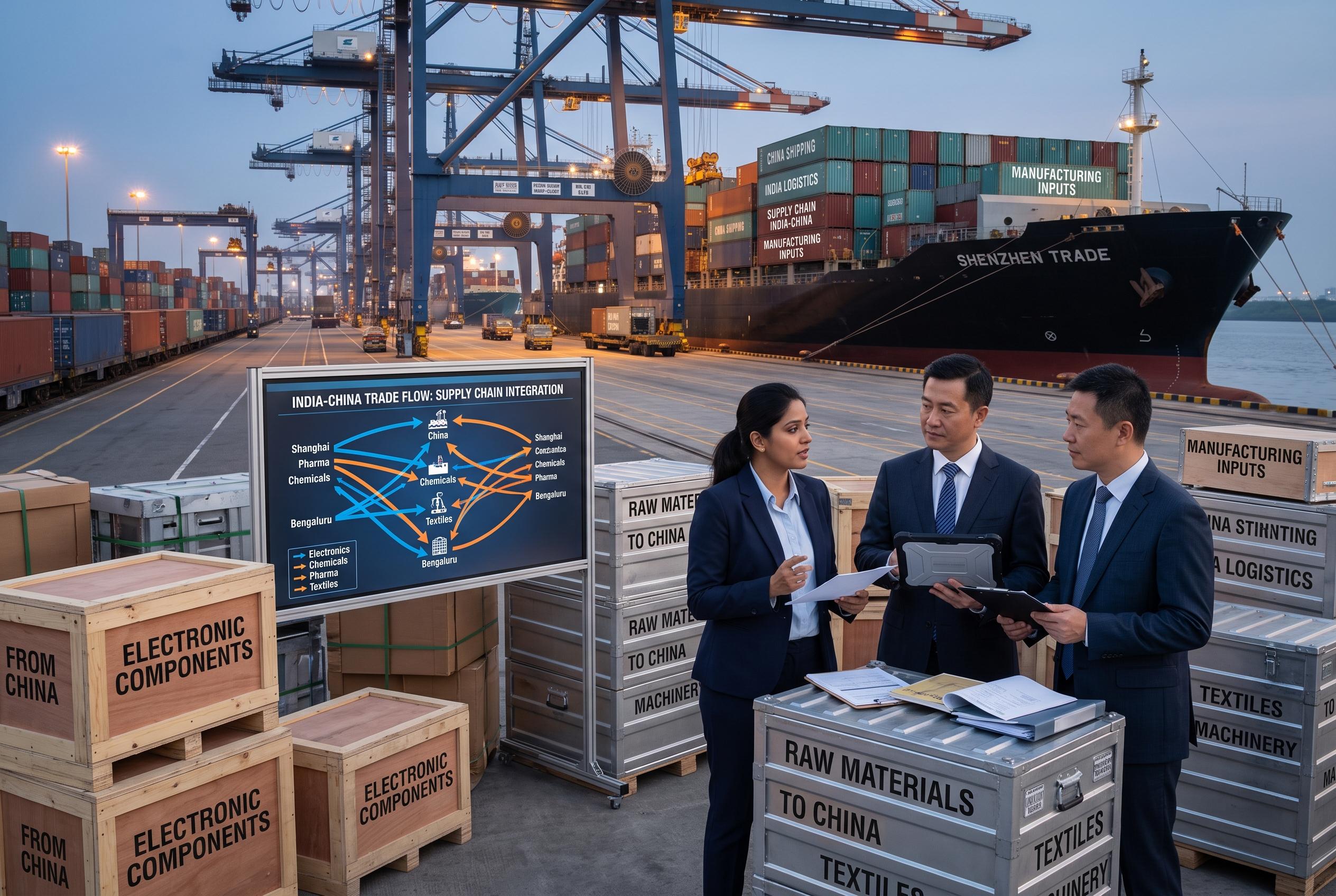

Despite India’s push for self-reliance, trade with China continues to grow, deepening economic dependence amid a record trade deficit driven by reliance on Chinese supply chains for critical raw materials and manufacturing inputs.
India’s drive for self-reliance has not yet altered one of its most persistent trade patterns: dependence on Chinese imports. According to figures cited in a written reply in the Rajya Sabha on 7 August 2026, goods purchases from China rose from $94.57 billion in 2021-22 to $131.63 billion in 2025-26, an increase of about 39%. Over the same period, China’s share of India’s total merchandise imports edged up from 15.43% to 16.96%.
The widening imbalance is even more striking in the trade deficit. Government data cited by Business Standard show that India’s deficit with China climbed from $73.31 billion in 2021-22 to $112.16 billion in 2025-26. That was a record gap, despite a sharp rise in India’s exports to China to $19.47 billion in the same year.
The underlying reason is structural rather than simply commercial. India is not only importing finished consumer goods from China. It also relies heavily on Chinese supply chains for raw materials, intermediate goods, capital equipment and specialised inputs used in manufacturing. The commerce ministry said these include lithium, cobalt, nickel, graphite, rare earth elements and copper, all critical for electric vehicles, electronics, semiconductors, clean energy systems and advanced manufacturing.
That dependence helps explain why efforts such as Make in India, Atmanirbhar Bharat and the production-linked incentive scheme have not yet reduced the import bill in any meaningful way. According to Business Standard and the Economic Times, China has remained India’s largest goods supplier, with total bilateral trade hitting new highs and the deficit still expanding. In the first six months of 2026 alone, trade between the two countries reached $91.72 billion, underscoring how deeply embedded the relationship remains.
For policymakers, the central challenge is therefore less about cutting off trade than rebuilding domestic capacity. India would need stronger local supply chains for critical minerals, components, industrial machinery and advanced technology before it can materially reduce imports from China. Until then, the country is likely to remain caught between industrial expansion and external dependence, with China at the centre of both.
Disclaimer: This content is intended for informational purposes only. Readers are advised to exercise their own judgement, conduct due diligence, or consult a qualified expert before acting on any information provided.