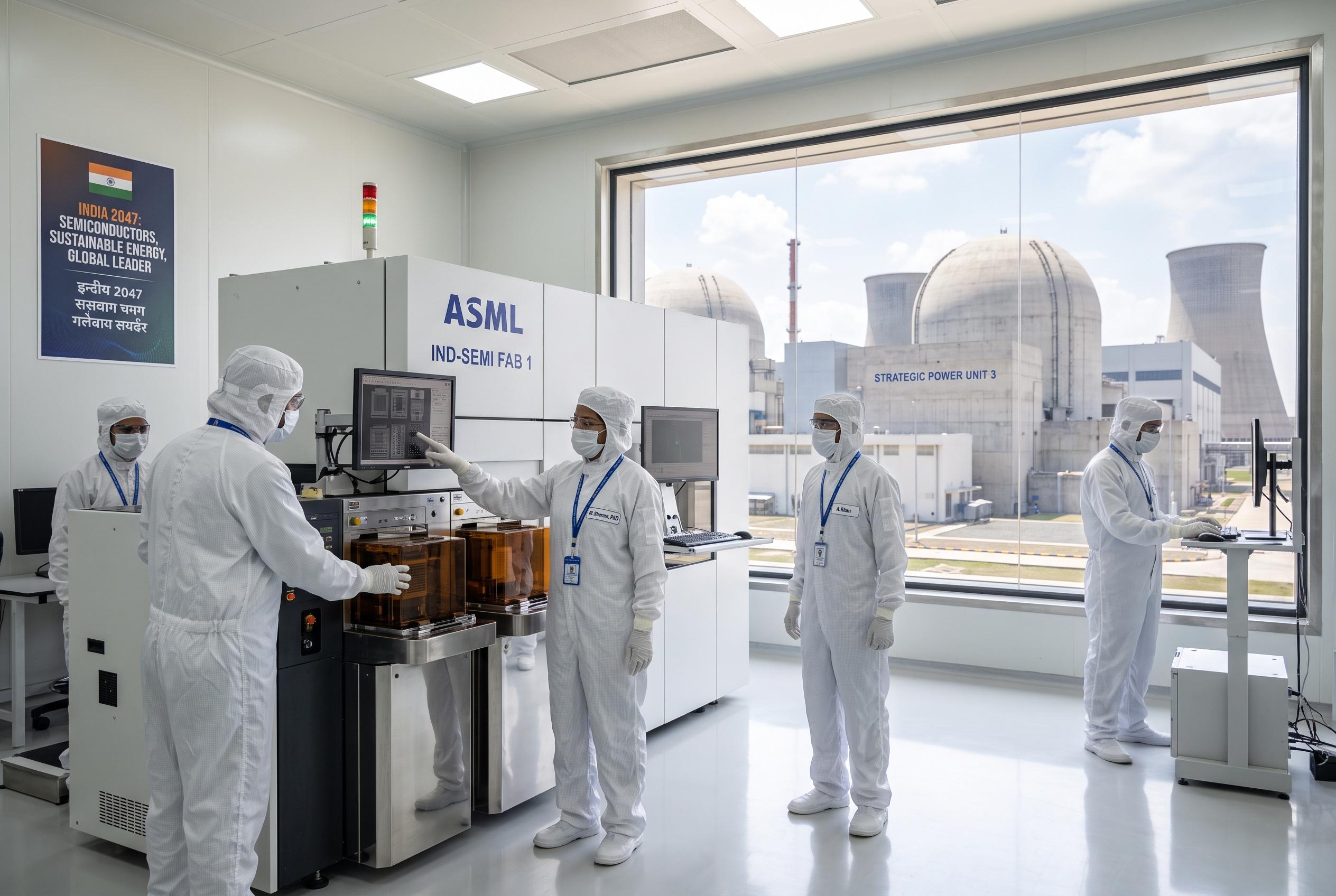

India accelerates its industrial transformation with a ₹1.275 trillion semiconductor programme and a strategic nuclear expansion, aiming to establish a self-reliant and globally competitive tech ecosystem by 2047.
India’s latest industrial push ties two strategic bets together: building a domestic semiconductor industry and securing the power supply needed to sustain it. According to the government’s July approval, Semicon 2.0 is a ₹1.275 trillion programme designed to cover the full chip value chain, including design, fabrication, advanced packaging, equipment, materials, research and workforce training. The scale of the plan suggests New Delhi wants to move beyond assembly and into a deeper manufacturing base. India Briefing and Business Standard both reported that the package is intended to help position the country as a global centre for semiconductor production and design.
The timing matters. Business Standard said the Union Cabinet cleared the programme on 15 July 2026, building on the earlier India Semiconductor Mission launched in 2022. The new phase broadens incentives well beyond fabs alone, signalling a policy shift towards a more complete ecosystem. That matters for investors because chip manufacturing depends on a dense industrial network, not just a single plant. India Briefing said the initiative is also meant to draw in global chipmakers, equipment suppliers, engineering firms and technology investors, while encouraging more localised supply chains.
The industrial case is already taking shape on the ground. The lead article says roughly 12 to 13 semiconductor projects have been approved across six states, with combined investment above ₹1.64 lakh crore. It identifies the Tata-PSMC fab in Dholera, Gujarat, as the flagship project and says it is expected to produce its first silicon by December 2026. If delivered on time, that would give India a high-profile proof point for a sector that has long depended on imported chips and foreign manufacturing capacity.
What sets this drive apart is the parallel expansion of nuclear power. India currently operates 24 reactors with about 8.18 GW to 8.78 GW of capacity, according to the figures cited in the lead article, while eight more reactors are under construction. The government is targeting 22.5 GW of nuclear capacity by 2031-32 and 100 GW by 2047, and plans to commission 21 additional reactors by 2031. On 30 July 2026, Indian power companies announced fresh investment plans after legislative changes opened the nuclear sector to private capital for the first time. The government is also studying Bharat Small Reactors and small modular reactors for industrial users, including semiconductor facilities. Together, the two programmes reflect the broader Viksit Bharat agenda, under which India aims to reach developed-nation status by 2047.
Disclaimer: This content is intended for informational purposes only. Readers are advised to exercise their own judgement, conduct due diligence, or consult a qualified expert before acting on any information provided.