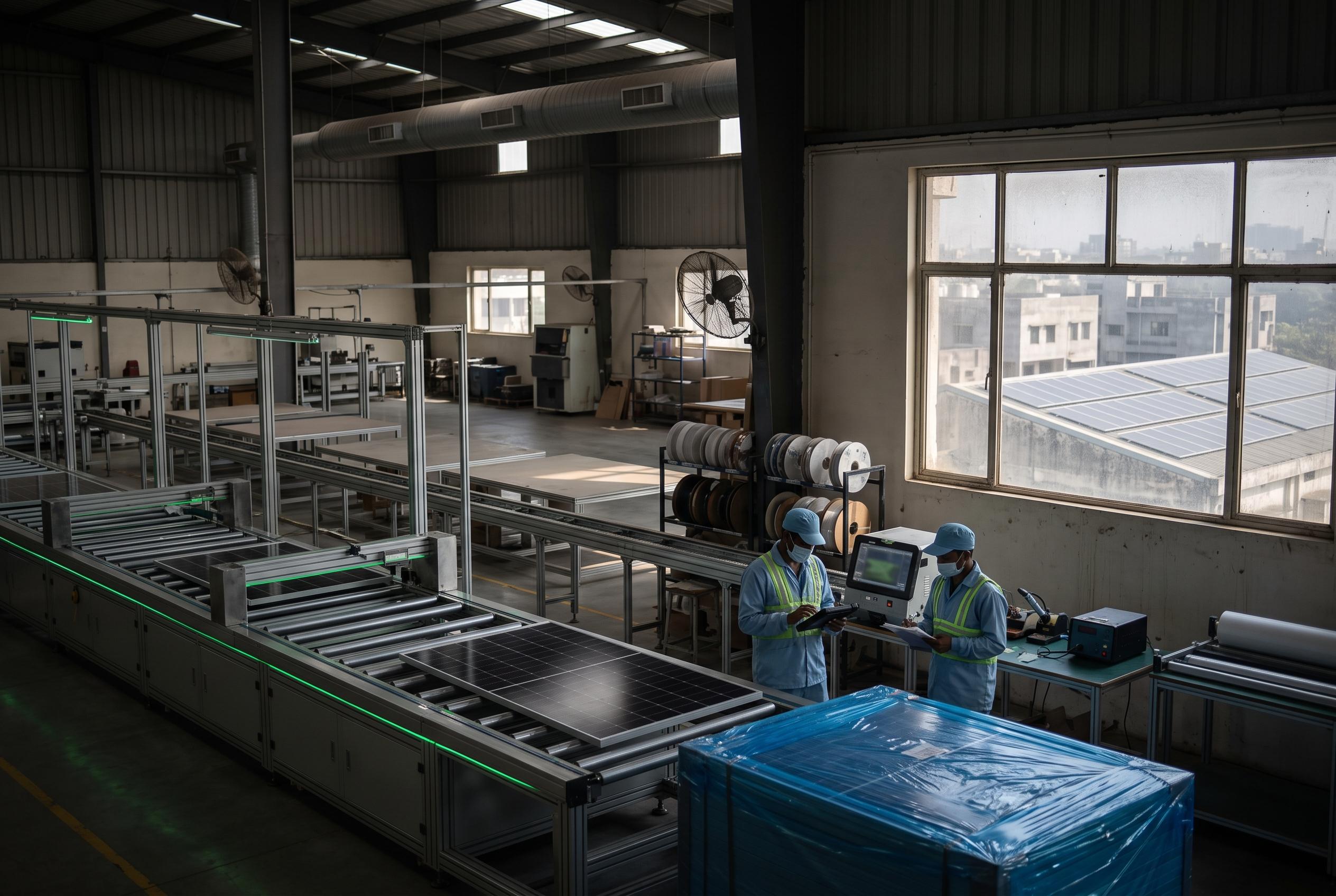

India’s rapid expansion in solar module capacity has outpaced demand, leading to low factory utilisation and raising concerns over the sector’s economic sustainability, according to new reports.
India’s solar manufacturing build-out has reached a scale that is now testing the economics of the sector. A new report by the Institute for Energy Economics and Financial Analysis and JMK Research says module capacity has climbed to about 233GW, while factory utilisation has fallen to 35% to 40%, a level that is well below what producers typically need for sustainable operations. The report argues that the industry has added module lines far faster than demand can absorb them, increasing pressure on margins and raising the risk that some plants will become stranded assets.
The core problem is not simply excess capacity, but how unevenly that capacity is distributed across the supply chain. According to the report, module capacity is now nearly seven times cell capacity and 116 times ingot-wafer capacity, leaving upstream segments such as polysilicon and wafers underdeveloped. That imbalance means India remains dependent on imported inputs, predominantly from China, even as it expands domestic assembly at speed.
The report says this mismatch is unlikely to disappear quickly. India’s solar deployment is expected to continue rising, but not at a pace fast enough to absorb the capacity already committed, including about 135GW that is planned or under construction. Business Standard reported that this scale of expansion will keep utilisation under pressure through 2030 unless demand accelerates sharply or supply growth slows.
Exports are therefore becoming more important, yet the trade picture is less favourable than it once was. The report says the United States took around 97% of India’s module export volume in financial year 2026, but that route has been disrupted by combined US duties of more than 200% on most Indian manufacturers. As a result, exports to the US have fallen sharply from their FY2024 peak, pushing producers to look towards the European Union and other markets.
The longer-term response, the report argues, will have to be structural. Larger, vertically integrated groups are better placed than smaller standalone module makers, while the domestic industry will need to move further upstream into cells, wafers and eventually polysilicon if it is to reduce import dependence. IEEFA and JMK Research also call for broader incentives, faster transmission and right-of-way approvals, and targeted support for exporters if India wants to turn today’s overcapacity into a more balanced industrial base.
Disclaimer: This content is intended for informational purposes only. Readers are advised to exercise their own judgement, conduct due diligence, or consult a qualified expert before acting on any information provided.