
Britain’s IQE reports strong half-year results driven by AI infrastructure growth, but faces supply constraints in indium phosphide substrates as demand accelerates, prompting industry-wide supplier negotiations and capacity expansion plans.
IQE says it is running into bottlenecks in the supply of indium phosphide substrates just as demand from AI data-centre customers is pushing the group to expand output. Jutta Meier, the company’s chief executive, told Reuters that the constraint should not derail second-half targets and said it was being managed through supplier talks across the industry, while IQE prepares to add manufacturing capacity at sites across the business. (boursorama.com)
The immediate backdrop is a sharp improvement in trading. In results for the six months to 30 June 2026, the Cardiff-based compound semiconductor group reported revenue of £64.6m, up from £45.3m a year earlier, while adjusted EBITDA moved to a £6.0m profit from a £0.4m loss. At the reported level, the pre-tax loss narrowed to £12.6m from £18.3m; on an adjusted basis, the loss before tax was £8.2m against £16.0m a year earlier. (investegate.co.uk)
The recovery was led by photonics, the part of the business most exposed to optical links inside AI infrastructure. According to the company’s interim statement, photonics revenue rose 45% to £38.5m, while wireless increased 40% to £26.0m. Meier said performance reflected “strong momentum” across AI-driven data-centre infrastructure, advanced sensing, wireless and defence, and IQE said that momentum had continued into the second half after first-half trading exceeded management expectations. (investegate.co.uk)
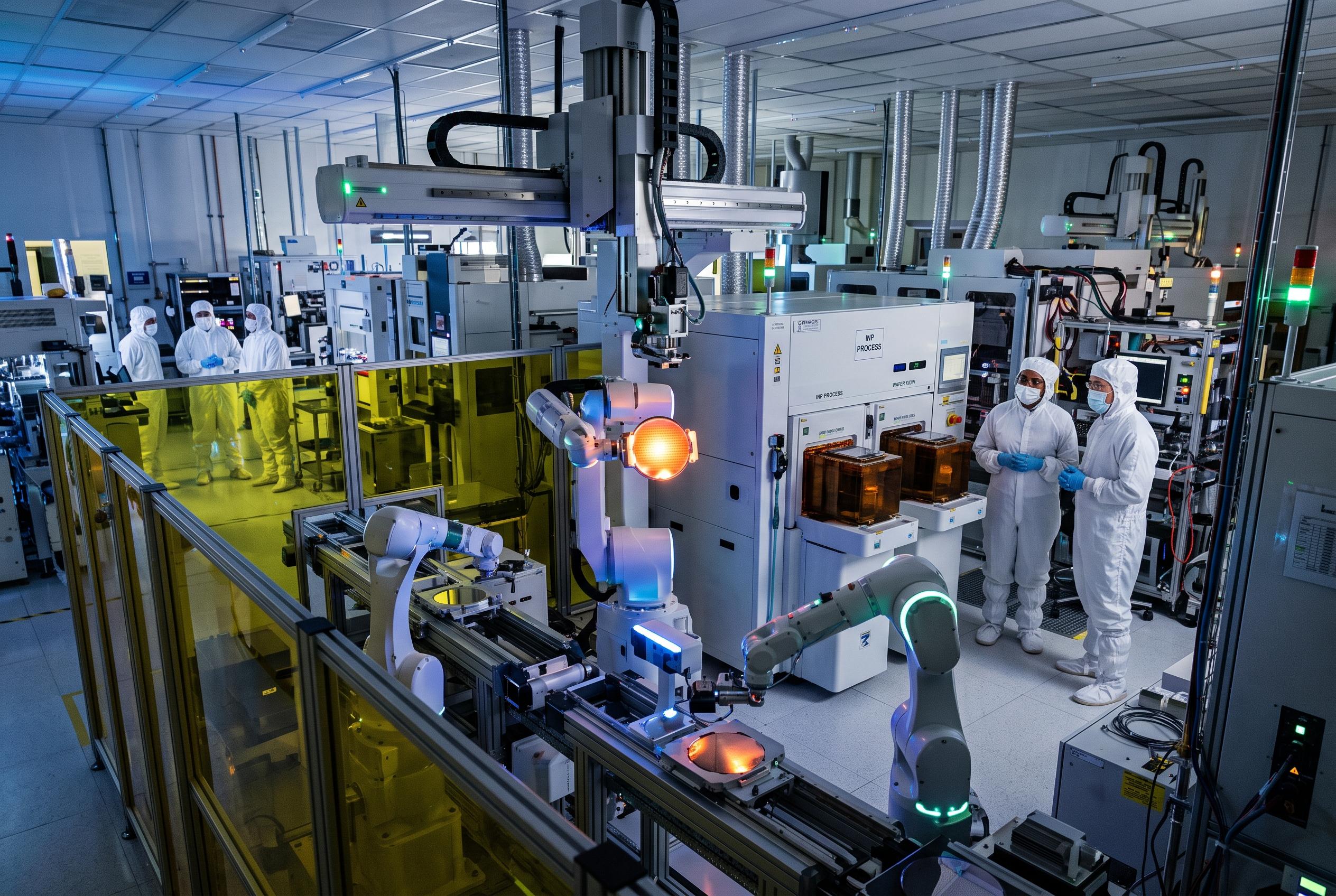
That matters because IQE sits early in the AI hardware chain. Reuters noted that the group supplies epitaxy, the engineered material layers deposited on wafers that are later used to make lasers for data-centre optics. After an electronics downturn and disruption linked to US tariffs, stronger spending on AI infrastructure has fed through to suppliers such as IQE, whose indium phosphide products are used in photonics for next-generation data-centre links. (uk.marketscreener.com)
The stronger demand picture has been reinforced by a much healthier balance sheet and by a move towards longer-duration commercial agreements. IQE ended June with £41.6m in cash and no bank debt, while its adjusted net cash position was £30.2m, versus net debt of £23.5m a year earlier. Investing.com said that improvement followed an £81m strategic fundraise completed earlier in 2026 and anchored by MACOM Technology Solutions, which also secured board representation. Reuters also reported that, under Meier, IQE has shifted away from one-off orders towards long-term agreements with customers including MACOM, Tower Semiconductor and Lumentum. (investegate.co.uk)
Management is therefore holding to the more ambitious outlook first set out in July. In that trading update, IQE said first-half revenue would be at least £64m and lifted full-year guidance to revenue growth of more than 30%, with adjusted EBITDA in the low teens of millions of pounds. Monday’s results kept that forecast in place. Meier said the company was “underpinned by a number of key supply agreements” and that it would convert existing capacity in the second half to support increasing demand for indium phosphide solutions. (tradingview.com)
Alongside the results, IQE said it intended to move from AIM to the London Stock Exchange’s Main Market, targeting admission in the first half of 2027. The company said the switch should improve liquidity, widen access to institutional capital and support possible inclusion in FTSE indices. The share-price reaction varied by the point in the day at which outlets checked the market: Halifax’s Sharecast feed said the stock was up 2.1% at 48.45p by 1451 BST, Investing.com said it had traded 0.9% higher at 47.89p, and Reuters later reported a gain of 0.6%. (investegate.co.uk)
For investors, the more interesting question is whether the company can turn this rebound into a steadier earnings profile. Reuters cited Peel Hunt analyst Damindu Jayaweera as saying the shift towards long-term agreements marked a fundamental change from IQE’s historic revenue model and that more deals with top-tier customers were expected in the coming months. That should improve visibility, but the results also show that supply discipline in a narrow materials market now sits close to the centre of IQE’s growth case. (boursorama.com)
Disclaimer: This content is intended for informational purposes only. Readers are advised to exercise their own judgement, conduct due diligence, or consult a qualified expert before acting on any information provided.