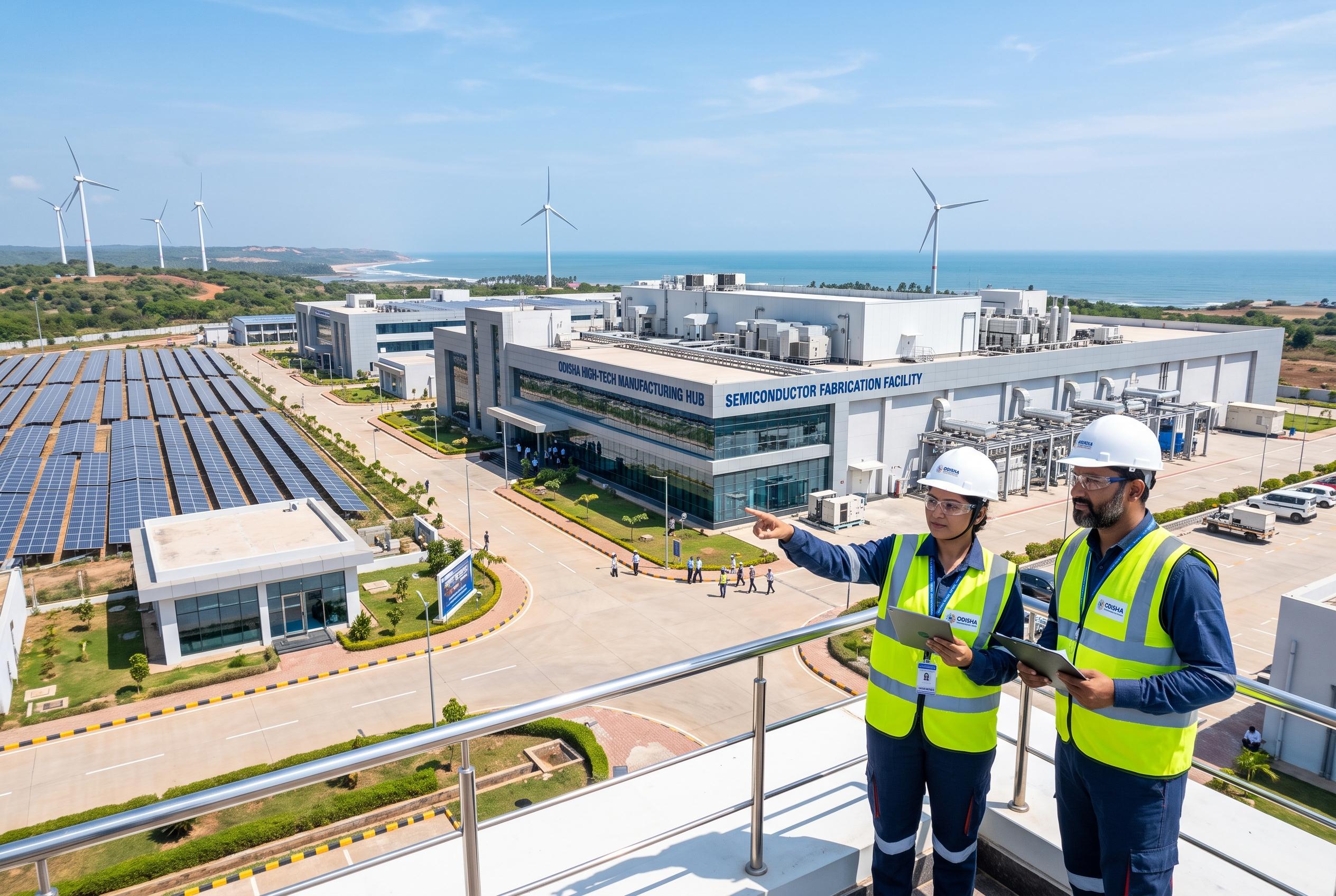

The Indian state of Odisha is scaling up its industrial strategy by reforming policies to attract significant investments in semiconductors and clean energy, aiming to compete as a major high-technology manufacturing hub.
Odisha is preparing a fresh round of policy changes to draw more investment into semiconductors and renewable energy, as the state seeks to move further into advanced manufacturing and lower-carbon industry. The proposed revisions are intended to make projects easier to approve, improve incentives and strengthen the infrastructure needed for capital-intensive facilities, according to the report on Eqmagpro.
The move builds on a semiconductor policy already in place in the state. Odisha’s semiconductor manufacturing and fabless policy sets out fiscal and non-fiscal support, including provisions for mega projects, semiconductor parks and skill development, with the stated aim of building an end-to-end ecosystem for design and manufacturing. In July 2025, the state also amended that policy to make projects more competitive and sustainable, adding measures such as enhanced performance-linked incentives, relocation support and incentives for park developers, according to The New Indian Express and the state’s policy documents.
The latest push comes as Odisha has already secured significant industrial commitments in these sectors. In February 2026, the state approved ₹44,200 crore of investment proposals at the 44th meeting of its High-Level Clearance Authority, with renewable energy accounting for the largest share. That package included pumped storage projects seen as important for grid stability and renewable integration, while the approvals were expected to create nearly 8,700 jobs across eight districts, according to Odisha Samachara. In June 2026, the same clearance body approved 20 more projects worth ₹76,612 crore, with potential employment of more than 50,500 people, The New Indian Express reported.
Semiconductors are also becoming a more visible part of Odisha’s industrial pitch. The Union Cabinet has approved two semiconductor projects in the state under the India Semiconductor Mission, including an integrated silicon carbide compound semiconductor facility in Bhubaneswar. According to the government announcement, the plant is intended to serve applications ranging from defence systems and electric vehicles to fast chargers, data centres and solar inverters. That broader industrial case helps explain why the state is now looking to tighten policy support around the full value chain, rather than focusing only on fabrication.
If implemented, the reforms could help Odisha compete more effectively with other Indian states that are using incentives and faster clearances to attract strategic manufacturing. The practical challenge will be whether policy changes are matched by land, power, water, transport and skills at the scale needed for semiconductors and renewables. For now, the state’s direction is clear: it wants to position itself as a destination for high-technology manufacturing and clean energy investment, not just conventional industry.
Disclaimer: This content is intended for informational purposes only. Readers are advised to exercise their own judgement, conduct due diligence, or consult a qualified expert before acting on any information provided.