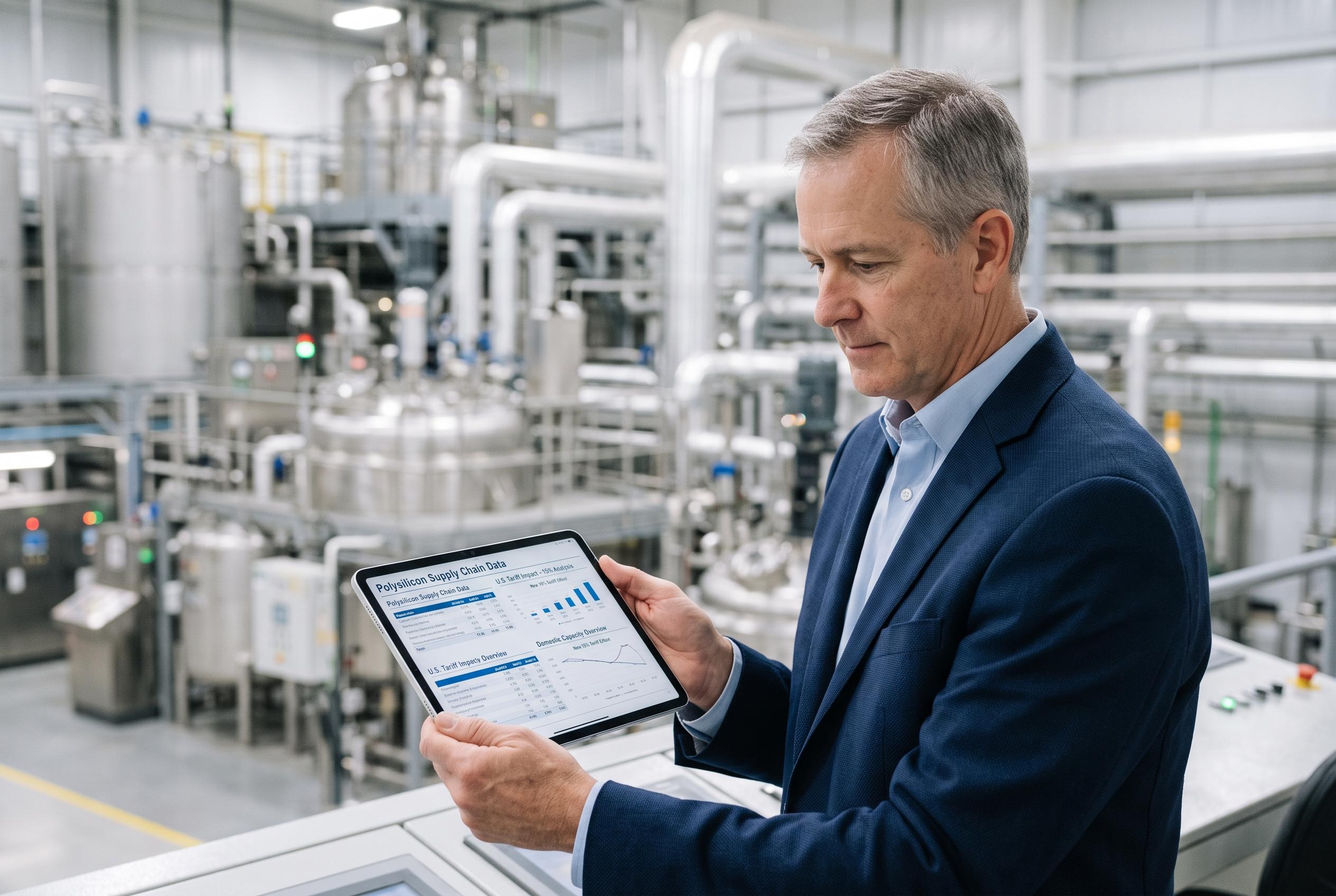

Donald Trump has announced a new 15% tariff on polysilicon, intensifying Washington’s efforts to secure the domestic semiconductor supply chain amid escalating tensions with China and a broader trade offensive targeting Chinese technology exports.
Donald Trump has widened Washington’s trade offensive against China’s chip supply chain with a new 15% tariff on polysilicon, the ultra-pure material used to make semiconductor wafers and solar cells. According to the White House, the measure is intended to address national security risks tied to US reliance on foreign supply and to encourage more domestic production of strategic materials. The policy is due to take effect in December. White House figures cited in the announcement say the US share of global polysilicon capacity has fallen from 50% in 2005 to less than 2% in 2024, while wafer fabrication has dropped from 37% in 1990 to 10% in 2024.
The move builds on a broader tariff and security campaign that has expanded since January 2026. In that month, Trump signed a proclamation using Section 232 of the Trade Expansion Act of 1962 and imposed a 25% tariff on certain advanced computing chips, including Nvidia’s H200 and AMD’s MI325X, while carving out goods tied to US manufacturing build-out. The administration framed the action as part of an effort to reduce dependence on foreign semiconductor supply chains and protect economic security.
The latest step also fits a wider pattern of escalating pressure on Chinese technology exports. Reporting from Tom’s Hardware says the administration has already outlined future tariffs on Chinese semiconductor components, including diodes, transistors and optical couplers, though the final rate has not yet been set and implementation is scheduled for 2027. That report also said the government’s trade actions are based on findings that US electronics still contain substantial Chinese-made legacy chip content.
For Beijing, the new tariff is another sign that semiconductors and their upstream inputs have become a central front in the trade dispute. The Council on Foreign Relations has noted that the US still depends heavily on imported chips, testing and packaging services, even as it tries to rebuild capacity through subsidies under the CHIPS and Science Act. That leaves policymakers trying to balance industrial policy, price pressures and supply security at the same time.
Disclaimer: This content is intended for informational purposes only. Readers are advised to exercise their own judgement, conduct due diligence, or consult a qualified expert before acting on any information provided.