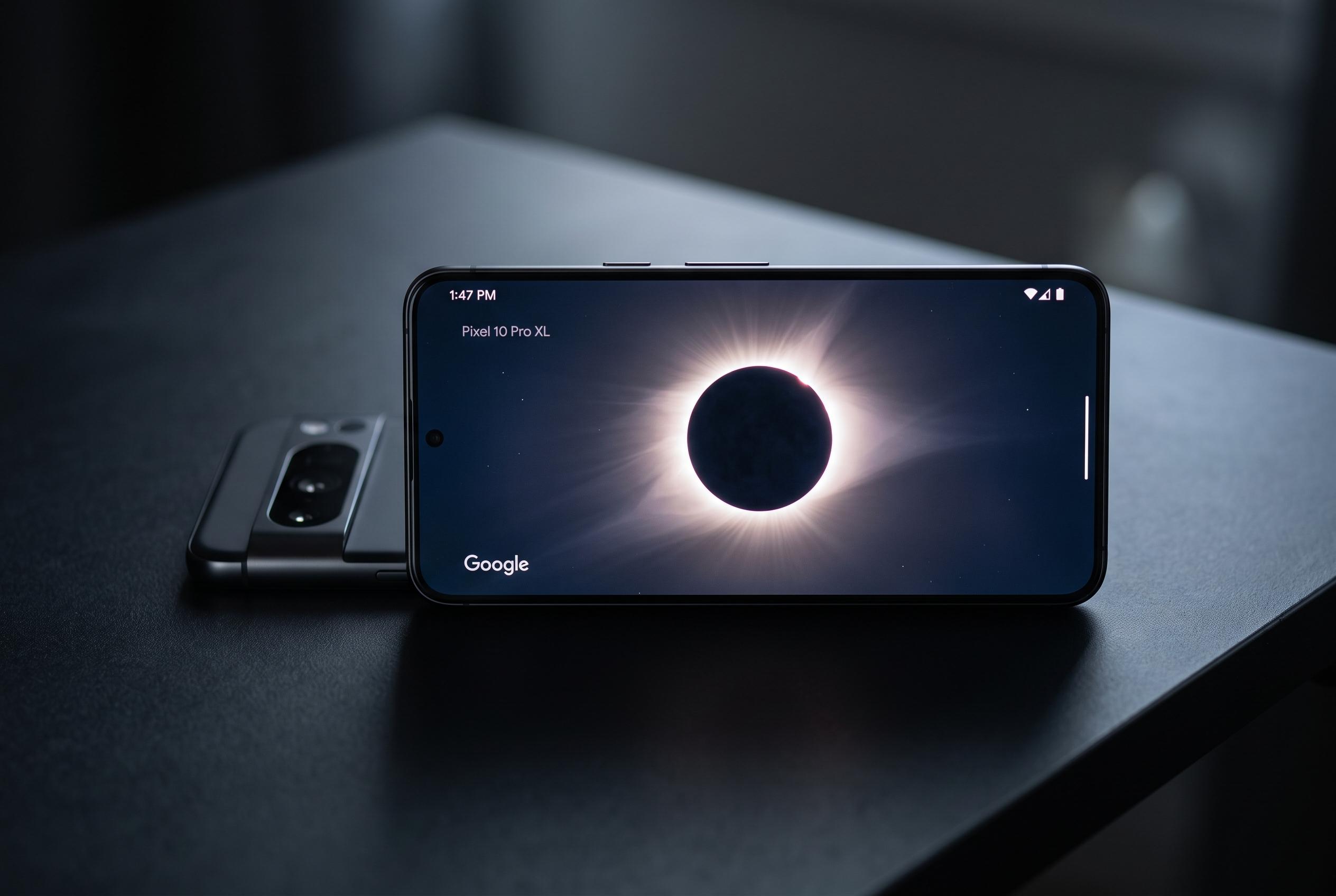

During the August 12 solar eclipse, a smartphone camera test revealed that advanced software processing influences image quality as much as hardware. Google’s Pixel 10 Pro XL emerged as the top performer, highlighting the impact of scene recognition and AI-driven editing techniques in challenging conditions.
The August 12 solar eclipse offered an unusually sharp test of flagship smartphone cameras, and a comparison published by Frandroid suggests that image processing mattered as much as hardware. The site put the Samsung Galaxy S26 Ultra, Oppo Find X9 Ultra, Xiaomi 17 Ultra and Google Pixel 10 Pro XL through the same exercise in Paris, where the eclipse was only partial, and found that each phone interpreted the scene very differently.
Samsung’s Galaxy S26 Ultra struggled most with colour and fine detail. Frandroid said the phone produced an overly saturated orange sun and had difficulty keeping the image sharp, even after a second attempt when the moon covered more of the solar disc. That result is notable because other reviews have described the S26 Ultra as a highly capable all-round camera phone with strong zoom, good low-light performance and broad versatility.
The Xiaomi 17 Ultra produced the most striking error. Frandroid reported that the handset mistakenly applied lunar texture to the sun, apparently because its moon-enhancement system recognised the eclipse scene as if it were a night shot of the moon. That kind of automated embellishment is designed to improve moon photos, but it can become a liability when the subject is only partly visible. By contrast, independent testing by Digital Camera World has credited the Xiaomi 17 Ultra with excellent main-camera detail, strong dynamic range and a distinctive Leica-tuned look, although it also noted some inconsistency between lenses.
Google’s Pixel 10 Pro XL came out on top in Frandroid’s ranking. The publication said Google’s AI-heavy processing made a large difference between the preview and the final image, but the finished shots were close to reality and handled the bright crescent of the partially eclipsed sun particularly well. The Oppo Find X9 Ultra placed second. Frandroid said it initially struggled to combine multiple HDR frames cleanly, but improved on a later shot when the eclipse was further along.
Taken together, the results underline a familiar point in smartphone photography: top-tier camera systems do not automatically produce the best image in unusual conditions. Eclipse photography exposes weaknesses in exposure control, HDR blending and scene recognition, while also rewarding devices whose software can preserve contrast without inventing detail. On Frandroid’s evidence, the Pixel 10 Pro XL was the most convincing overall, followed by the Oppo Find X9 Ultra, the Galaxy S26 Ultra and, last, the Xiaomi 17 Ultra.
Disclaimer: This content is intended for informational purposes only. Readers are advised to exercise their own judgement, conduct due diligence, or consult a qualified expert before acting on any information provided.