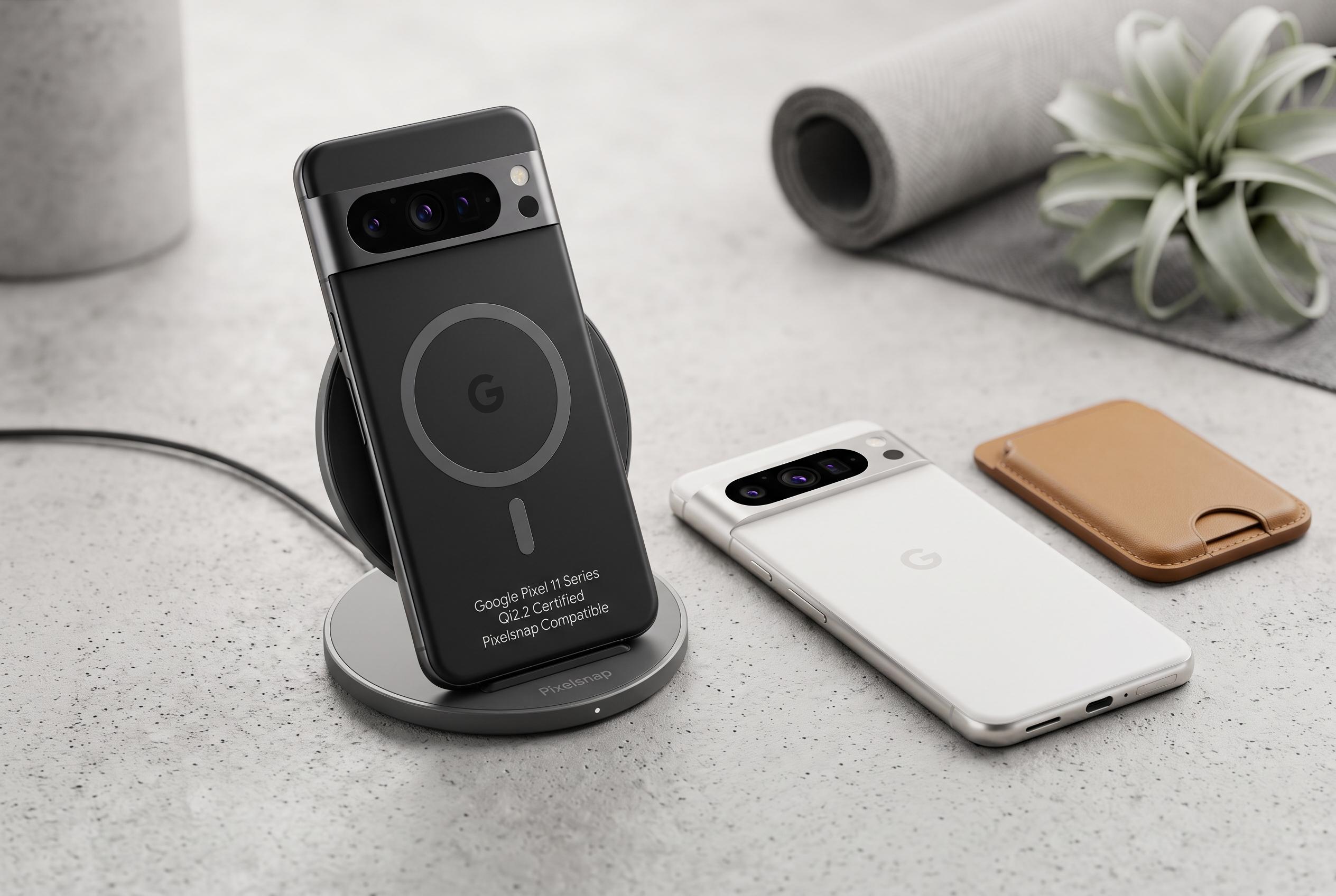

Google’s Pixel 11 phones support faster Qi2.2 wireless charging and feature built-in magnets for Pixelsnap accessories, signalling a renewed focus on long-term hardware platform development amidst a broader ecosystem expansion.
Google may have moved on from making a noise about Pixelsnap, but the underlying feature has not disappeared. According to Android Central, the Pixel 11, Pixel 11 Pro and Pixel 11 Pro XL all support Qi2.2 wireless charging at up to 25W, with built-in magnets for Google’s Pixelsnap accessories and other Qi2-compatible products. That is a meaningful step up from the 15W wireless charging of the Pixel 10 generation.
The shift matters because Google has positioned Pixelsnap as more than a charging standard. In its support material, the company describes the system as a magnetic accessory platform that helps align the phone for wireless charging and allows secure attachment of add-ons such as the Pixelsnap Ring Stand. Google’s own launch material for the Pixel 10 line also showed the original plan: chargers, a stand, cases and a 67W dual-port charger. By contrast, this year’s apparent emphasis on new finishes for the Ring Stand suggests the accessory family has not yet grown as far as the hardware could support.
That looks especially restrained when set against Google’s recent handset upgrades. Android Central says the Pixel 11 series pairs Qi2.2 support with the Tensor G6 chip, which is expected to improve efficiency, while charging changes vary by model: the Pixel 11 and Pixel 11 Pro can reach 55% in 30 minutes with a 30W PPS charger, and the Pixel 11 Pro XL can hit 75% in the same time with a 45W PPS charger. The same reporting says Google has also kept seven years of software support in place, underlining that the company still sees Pixel accessories as part of a broader long-term platform.
There is also a wider market context. PhoneArena reported that Google has quietly enabled manual firmware updates for the Pixelsnap Charger, a sign that the accessory is intended to work beyond Pixel phones and stay current with Qi2 standards. That makes the thinness of Google’s current first-party line-up more noticeable. With MagSafe on iPhone still backed by a far larger accessory ecosystem, Pixelsnap appears less like a finished product range and more like a feature Google has only partly developed.
Disclaimer: This content is intended for informational purposes only. Readers are advised to exercise their own judgement, conduct due diligence, or consult a qualified expert before acting on any information provided.