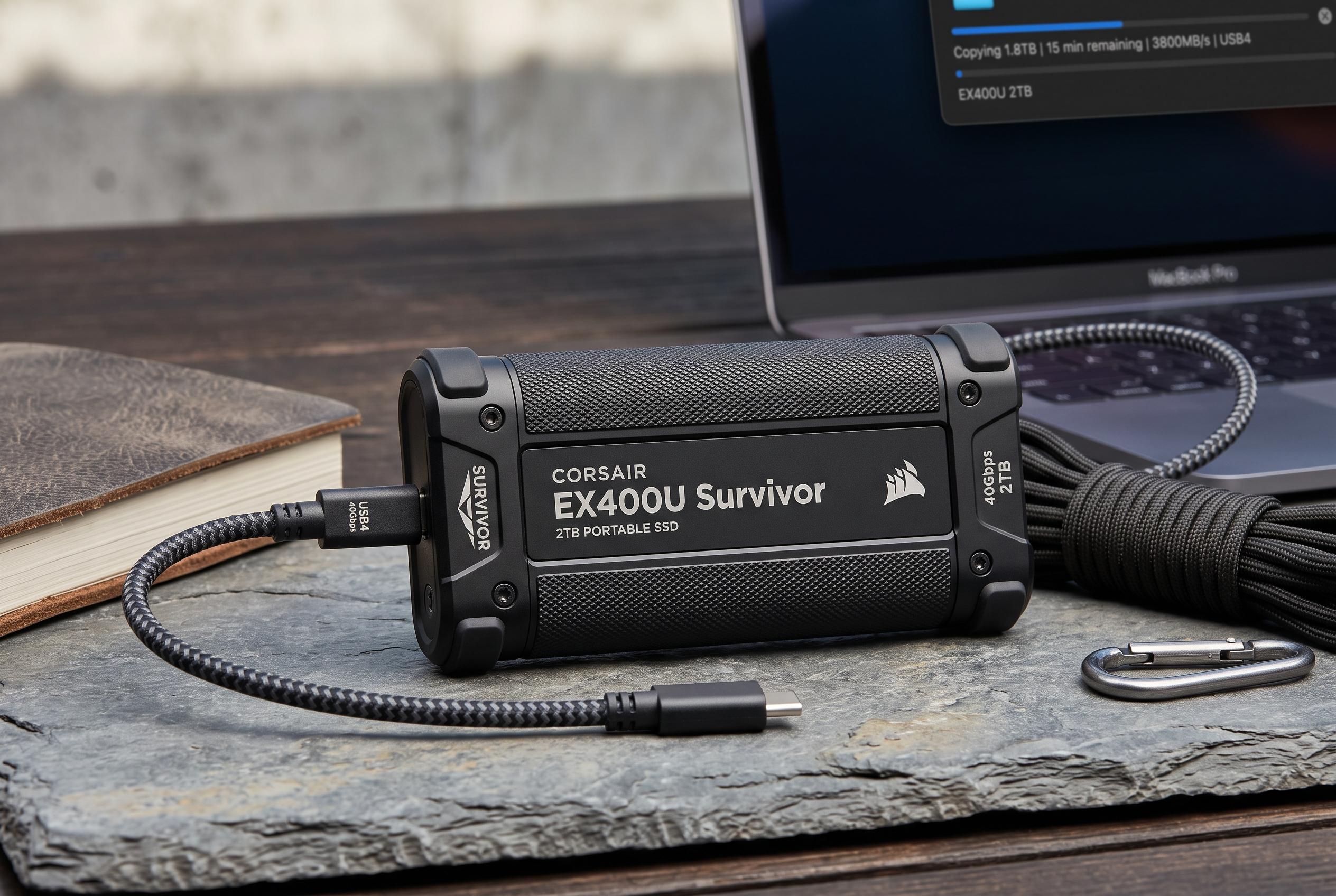

The Corsair EX400U Survivor 2TB emerges as the most versatile portable SSD for film crews, combining USB4 speed, rugged durability, and broad compatibility, according to recent guide. It outperforms competitors in sustained performance and environmental resilience, making it a crucial tool for on-set data management.
The best portable SSD for on-set data offloading is the Corsair EX400U Survivor 2TB, according to the guide, because it combines USB4 speeds, rugged construction and broad compatibility for modern production workflows. The article says the drive sustained 3,400 to 3,600 MB/s in real-world testing on a Thunderbolt 4 MacBook Pro, which can cut a 2TB card offload to under 12 minutes. It also notes IP55 protection, a 5-year warranty and a rubberised shell designed to withstand spills and knocks on a busy set.
That speed advantage matters because offloading on location is not just about peak numbers. The article stresses that sustained write performance, thermal control and the ability to cope with long transfer sessions are more important once cache memory is exhausted. It highlights the Corsair as the best all-round choice for crews using USB4 or Thunderbolt 4, while warning that older USB 3.2 Gen 2 laptops will not unlock its full potential.
For productions working in harsher environments, the guide points to the SanDisk Professional PRO-G40 1TB. It says the drive is built for dust, water and rough handling, with an IP68 rating, Thunderbolt 3 support and real-world sustained writes of around 2,500 MB/s. That makes it a stronger fit for beach shoots, festivals, documentary work and other situations where protection matters as much as speed.
The Samsung T9 2TB is presented as the best balance of speed and convenience for creator-grade workflows. The guide says it sustained 2,000 MB/s across lengthy transfers, stayed cool under load and includes Samsung’s Magician software for health checks and firmware updates. It also notes that the T9 is a practical choice for iPhone ProRes recording, although it lacks formal dust and water protection.
At the high end, the OWC Envoy Ultra 8TB stands apart as the only Thunderbolt 5 drive in the group. According to the article, it can reach sustained writes above 5,000 MB/s on the right host and offers enough capacity for full-day RAW shoots without constant drive rotation. That makes it attractive for large commercial or multi-camera productions, but expensive for smaller crews.
The guide also singles out the LaCie Rugged SSD4 1TB for mixed hardware environments, the Lexar ARMOR 700 2TB as a lower-cost rugged option and the Samsung T7 Shield 1TB as the safest general-purpose buy. Each is positioned around a different balance of speed, sealing and price. The Kingston XS1000 1TB is described as the budget fallback for controlled indoor work, where cost matters more than environmental protection.
Beyond the individual products, the article argues that workflow discipline is what truly protects footage. It recommends a two-drive mirror, checksum verification, clear labelling and matching the cable to the drive’s interface. It also advises buyers to plan capacity around the full shoot day, not just the final deliverable, with 2TB described as the practical sweet spot for most crews.
In short, the article’s central point is that no SSD is universally best. The right choice depends on the host computer, the shooting environment and the amount of footage generated each day. For most professional on-set teams in 2026, the Corsair EX400U Survivor 2TB is the most versatile recommendation, while the SanDisk PRO-G40 is the safer option when the location itself is the main threat.
Disclaimer: This content is intended for informational purposes only. Readers are advised to exercise their own judgement, conduct due diligence, or consult a qualified expert before acting on any information provided.