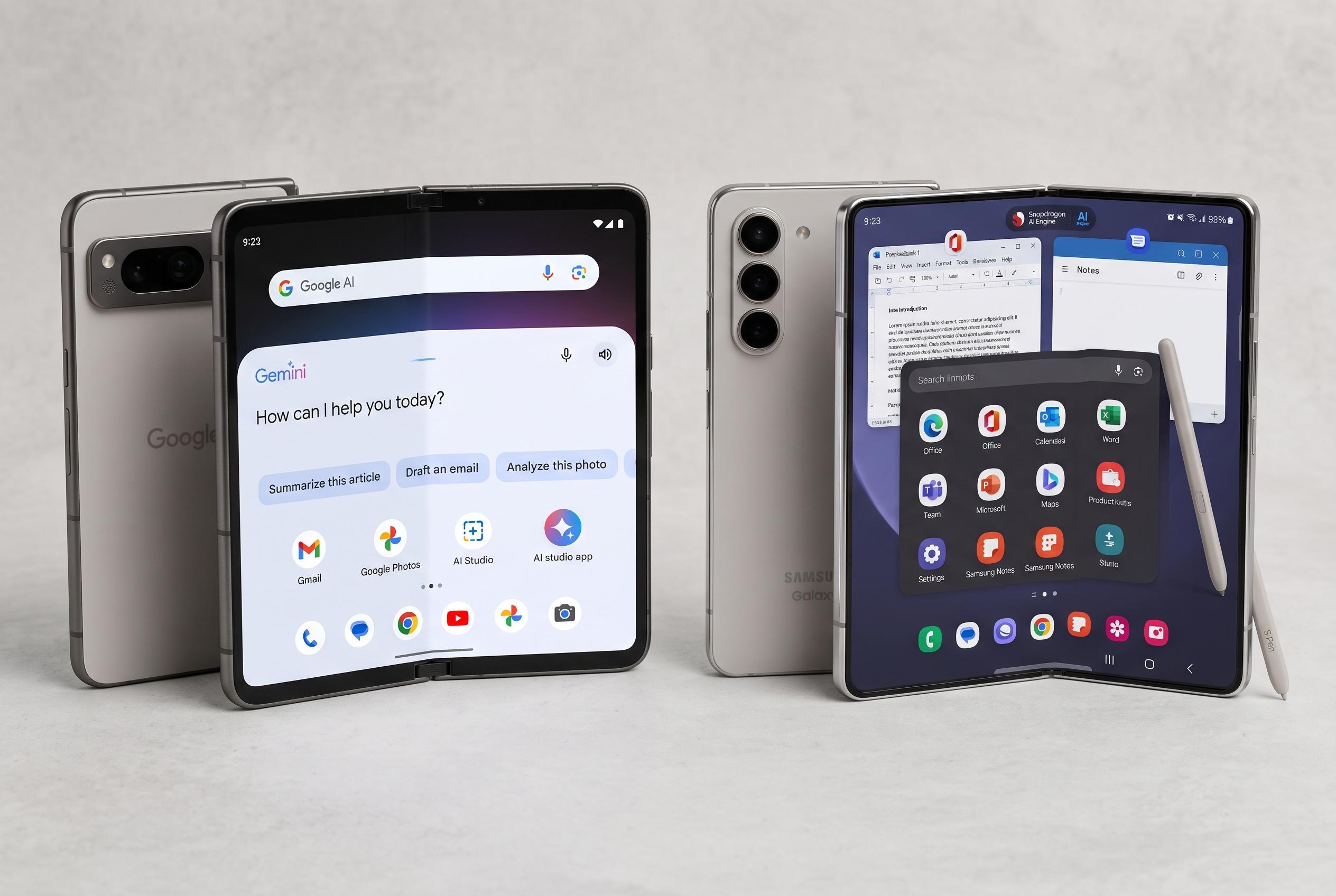

The Pixel 11 Pro Fold and Galaxy Z Fold 8 Ultra exemplify Diverging paths in book-style foldables, with Google emphasizing robustness and AI features, and Samsung focusing on performance and slim design, signalling a new chapter in flagship foldable innovation.
Google’s Pixel 11 Pro Fold and Samsung’s Galaxy Z Fold 8 Ultra show how far book-style foldables have moved beyond novelty. Both are pitched as devices that can stand in for a tablet without giving up flagship phone features, but they take sharply different routes to get there. Google leans on durability, display brightness and software-assisted intelligence, while Samsung pushes lighter hardware, faster charging and the most mature multitasking tools in the category.
On paper, the Pixel has the stronger protection rating. Android Central reported that Google unveiled the Pixel 11 Pro Fold on 12 August 2026 with IP68 dust and water resistance, a 6.5-inch outer display and an 8-inch inner panel, both rated at up to 3,600 nits peak brightness. Samsung’s Fold 8 Ultra, by contrast, carries an IP48 rating, which Samsung says protects against particles larger than 1mm and brief submersion in fresh water, but the company also notes that water resistance can diminish over time. That makes Google’s foldable the more reassuring choice for buyers who worry about wear, spills and everyday abuse.
Memory and software are another area where Google makes a strong case. Every Pixel 11 Pro Fold version comes with 16GB of RAM, whereas Samsung starts the Fold 8 Ultra at 12GB and reserves 16GB for the highest-capacity model. Android Central said Google’s handset also runs Android 17 with seven years of software support and a heavy emphasis on Gemini Intelligence, Magic Capture and other AI tools aimed at automating tasks and improving photography. Google’s larger-screen software features, including split-screen tools and app pairing, are designed to make the inner display feel more purposeful rather than merely bigger.
Samsung’s reply is hardware polish and productivity. The Fold 8 Ultra is lighter at 215g and thinner at 8.9mm folded, which makes a practical difference in daily use. Samsung also equips it with Snapdragon 8 Elite Gen 5 for Galaxy, up to 16GB of RAM and as much as 1TB of storage, according to Samsung’s specifications. The company’s own materials list a 200MP main camera, a 50MP ultrawide lens and a 10MP 3x telephoto camera, while the Fold 8 Ultra’s 5,000mAh battery supports 45W wired charging. Samsung’s One UI 9 remains its biggest software advantage, with split-view multitasking, a persistent taskbar and DeX support for desktop-style use.
The camera and charging trade-offs are more nuanced than the raw specifications suggest. Google’s foldable uses a 48MP main camera and a 10.8MP telephoto lens with 5x optical zoom, which gives it a longer reach than Samsung’s 3x zoom module. Android Central also said the Pixel’s front and inner cameras use autofocus, while Samsung’s are fixed-focus. Yet Samsung’s larger main sensor and faster charging will matter more to users who prioritise speed and flexibility. The Pixel starts at $1,899 and includes 25W wireless charging through Pixelsnap, while Samsung’s device costs about $200 more at the entry level but offers a faster 45W wired top-up.
For most buyers, the choice is less about which foldable is objectively better and more about what kind of compromise feels acceptable. The Pixel 11 Pro Fold is the safer pick if durability, brighter screens and Google’s AI features are the priority. The Galaxy Z Fold 8 Ultra is the more compelling machine for people who want the slimmest design, stronger raw performance and the best productivity software Samsung has put into a foldable yet. In a market where both phones remain expensive, each is trying to justify its price in a different way.
Disclaimer: This content is intended for informational purposes only. Readers are advised to exercise their own judgement, conduct due diligence, or consult a qualified expert before acting on any information provided.