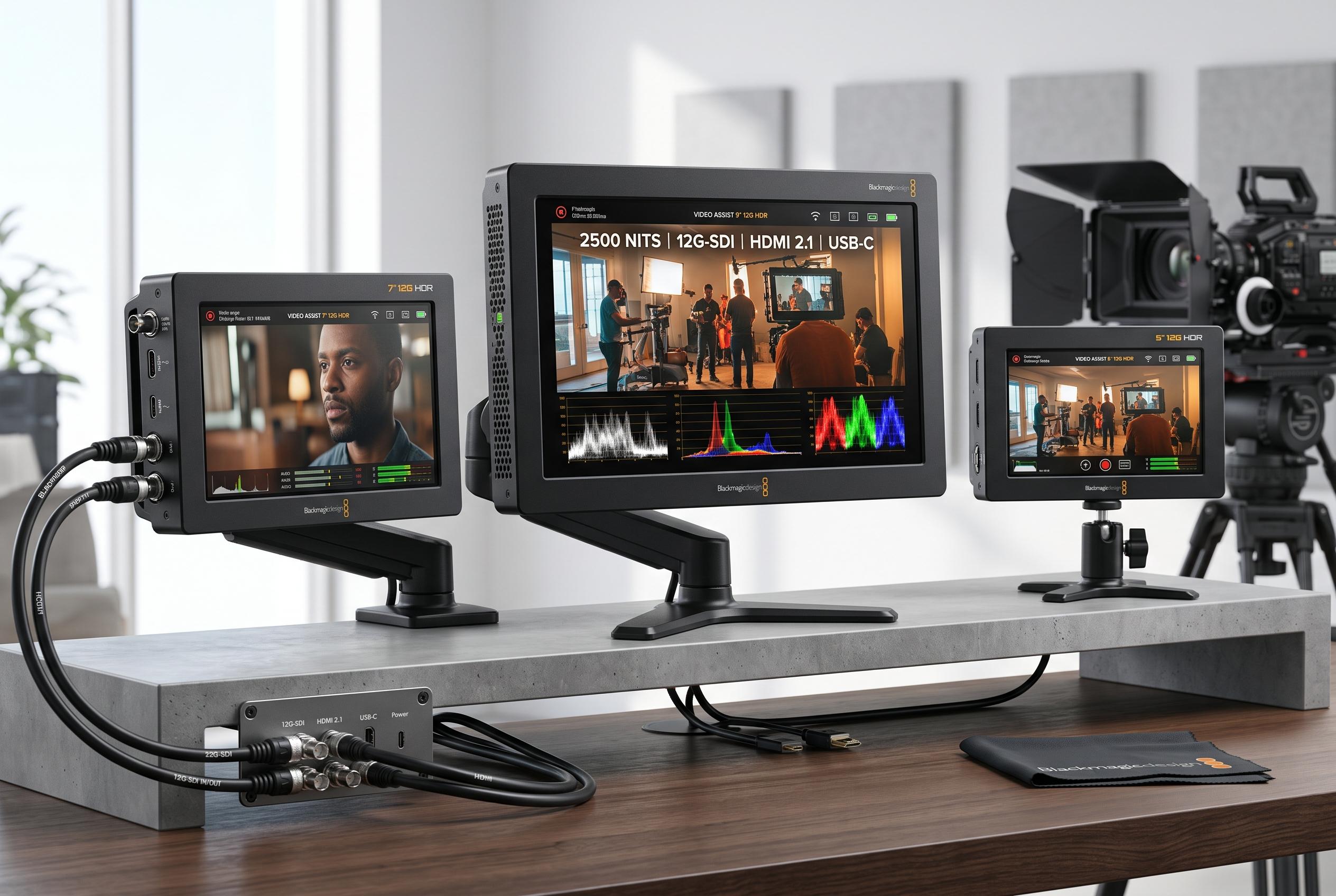

As Blackmagic shooters face diverse shooting conditions, the 2026 range of external monitors offers improved brightness, connectivity, and customisation, catering to everything from daylight shoots to lightweight gimbal work.
Blackmagic cameras reward careful monitoring, but their built-in displays can make that harder than it should be. For shooters working on the Pocket 4K, Pocket 6K or URSA Mini line, an external field monitor is often the difference between guessing and judging exposure, focus and colour with confidence. In 2026, the strongest options split into three groups: premium recorder-monitors, bright daylight screens and lighter budget models for rigs where every gram matters.
Atomos’ Ninja remains the most capable compact option for users who want monitoring and recording in one unit. According to Atomos, the 5.2-inch model pairs a 1920 x 1080 touchscreen with 1000 cd/m² brightness, AtomOS 11 tools such as focus peaking, false colour and zoom, and ProRes RAW capture up to 6K with compatible cameras. That makes it especially relevant for Blackmagic shooters who want a clean HDMI workflow with recording flexibility, though the smaller panel is less comfortable for critical focus than a 7-inch display. B&H lists the Shinobi 7 at 2200 cd/m² with HDMI 2.0, 3G-SDI and dual L-series battery slots, which explains why it is a stronger daylight choice for narrative and commercial work.
For most Blackmagic users, brightness and connection type matter more than headline features. Blackmagic Pocket cameras output over HDMI, while URSA Mini Pro and some studio models rely on SDI, so the right monitor depends on the body, not just the budget. That is why the Shinobi 7 is such a practical top pick: it combines strong daylight visibility, broad input support and a large enough screen to judge focus without constantly zooming in. The NEEWER F700 follows as a value option for shooters who want a 7-inch, 2000-nit monitor without paying for recorder functions they may never use.
Budget buyers do not have to settle for unusable screens either. The Feelworld F5 ProX stands out for gimbal and run-and-gun work because its 5.5-inch panel keeps rigs compact while still offering 1600 nits of brightness and touch control. The trade-off is durability and battery life: lighter housings are less reassuring than the metal builds on pricier Atomos or SmallHD units, and high-brightness operation drains NP-F batteries quickly. For handheld documentary work, however, that compromise is often acceptable.
The same logic applies to SDI users. Feelworld’s FW279S and Atomos’ Shinobi 7 are the most sensible choices when a Blackmagic rig needs longer cable runs or a more robust studio-style connection. Digital Camera World notes that modern on-camera monitors now routinely add waveform, LUT support and HDR tools, which means the real question is no longer whether to use one, but which feature set fits the shoot. For Blackmagic RAW workflows, custom LUT loading is particularly important because it restores contrast and colour on set without changing the recorded image.
For crews that value software as much as hardware, SmallHD remains the premium reference point. Its PageBuilder OS allows custom layouts that can place waveform, focus assist and LUT tools on the same page, which is useful when different operators need different information at a glance. The extra cost and weight are harder to justify on gimbals, but on tripod, shoulder or cinema rigs it can be a worthwhile investment for teams that want a highly configurable interface.
The safest buying rule is simple. Match the monitor to the camera output, choose 1,500 nits or more for regular daylight use, and make sure the LUT engine can handle your Blackmagic RAW conversion workflow. In that context, the Shinobi 7 is the most balanced all-rounder, the NEEWER F700 is the best value and the F5 ProX is the most practical low-weight option. For shooters who need recording built in, the Ninja remains the most versatile compact choice, even if the smaller display is less convenient for precision focus.
Disclaimer: This content is intended for informational purposes only. Readers are advised to exercise their own judgement, conduct due diligence, or consult a qualified expert before acting on any information provided.