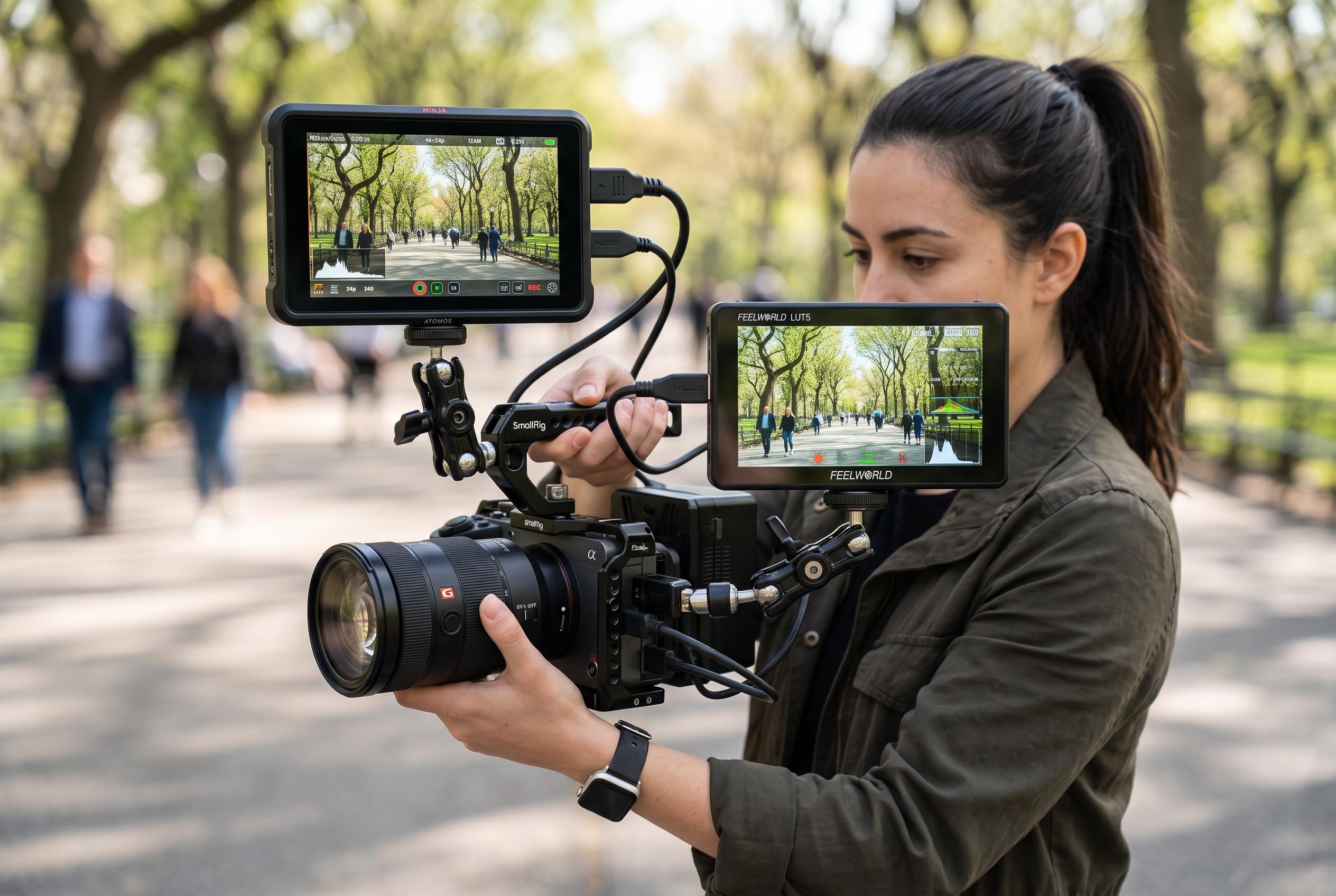

With new high-brightness, compact monitors such as FeelWorld’s LUT5 and Atomos’ Ninja RAW, filmmakers are enhancing handheld workflows by combining portability with professional monitoring tools tailored for challenging shooting conditions.
For filmmakers working fast, a 5-inch on-camera monitor can matter more than a larger, heavier display. It gives enough screen area for focus, exposure and framing tools without turning a compact rig into a cumbersome one. Industry guides and product listings consistently point to the same practical trade-off: the best choice depends on brightness, weight, power options and the kind of camera output the user actually needs.
Among the brighter options, FeelWorld’s LUT5 stands out with a 5.5-inch touchscreen panel rated at 3,000 cd/m², a level that is well suited to harsh daylight. B&H Photo says it supports 4K HDMI input and output, offers a 160-degree viewing angle and is aimed at professional shooting environments. That kind of brightness gives run-and-gun operators a clearer image when sunshades are not enough.
Atomos has also continued to push the category towards more capable compact monitors and recorder-combos. Digital Camera World reported on the Ninja RAW as a 5.2-inch Full HD monitor-recorder with a 1,500-nit HDR touchscreen, built-in focus peaking, false colour, zebras, waveforms and framing aids. The same publication noted support for recording up to 6K at 30fps, 4K at 60fps and 1080p at 120fps, with capture to CFexpress Type B cards and USB-C support for external SSDs or power.
Lightness remains a major advantage for gimbal and handheld work. Atomos’ Shinobi Go, reviewed by Digital Camera World, weighs 210g and combines that low mass with a 1,500-nit 5.2-inch HDR touchscreen. The review said it is designed for creators who need a portable monitor with waveform, histogram, vectorscope, false colour and focus peaking, although accessories must be bought separately. Independent monitor guides also stress that 5-inch and 5.5-inch screens are often the sweet spot for keeping DSLR and mirrorless rigs compact and balanced.
For users who need more professional connectivity, SmallHD’s Indie 5 remains a useful reference point. Macstar Camera describes it as a 5-inch, 1,920 x 1,080 touchscreen with 1,000 cd/m² brightness, 10-bit colour and both HDMI and 3G-SDI inputs and outputs. It runs SmallHD’s PageOS 5, which adds tools such as pixel zoom, focus assist and peaking. That combination makes it better suited to productions that still value compact size but cannot compromise on signal flexibility.
The overall direction of the market is clear. Compact monitors are no longer just secondary screens; they are now workflow tools that help shooters judge exposure, maintain focus and manage colour in real time. For run-and-gun work, the most useful monitor is usually not the one with the biggest panel, but the one that stays visible in the light, stays manageable on the rig and offers the right set of monitoring aids for the job.
Disclaimer: This content is intended for informational purposes only. Readers are advised to exercise their own judgement, conduct due diligence, or consult a qualified expert before acting on any information provided.