
As the number of devices travellers carry skyrockets, hotels, airports, and cruise ships are battling a widespread charging gap , prompting a surge in portable solutions and infrastructure upgrades to meet modern demands.
Hotels, holiday rentals, airports and cruise cabins all expose the same modern travel flaw: far more devices now need charging than many spaces were built to handle. A bedside lamp once shared a socket with an alarm clock; today a traveller may need to power a phone, watch, earbuds, tablet and laptop at the same time. Industry guides for hotels and shared spaces say this mismatch is now a routine design problem, with guest satisfaction increasingly tied to whether charging points are easy to find and use.
Part of the issue is legacy infrastructure. Older hotels were wired for a much simpler load, and even renovated properties often keep outlet layouts that do not suit current habits. Recent hotel-industry guidance says operators are moving towards more visible bedside and desk charging, with a shift from basic USB-A ports to USB-C, while some properties are also adding wireless charging. That reflects a wider expectation that power should be available where guests naturally place their devices, not hidden behind furniture.
For travellers, the practical answer is to create one charging hub rather than hunting for several sockets. A compact power strip can turn a single accessible outlet into a more usable station, especially in US hotel rooms where the nearest socket may be behind a bed or across the room. Products such as the TESSAN Small Flat Plug Power Strip are marketed on that basis, combining multiple AC outlets with USB ports and a low-profile plug, though travellers should still check voltage compatibility before using any accessory outside the US.
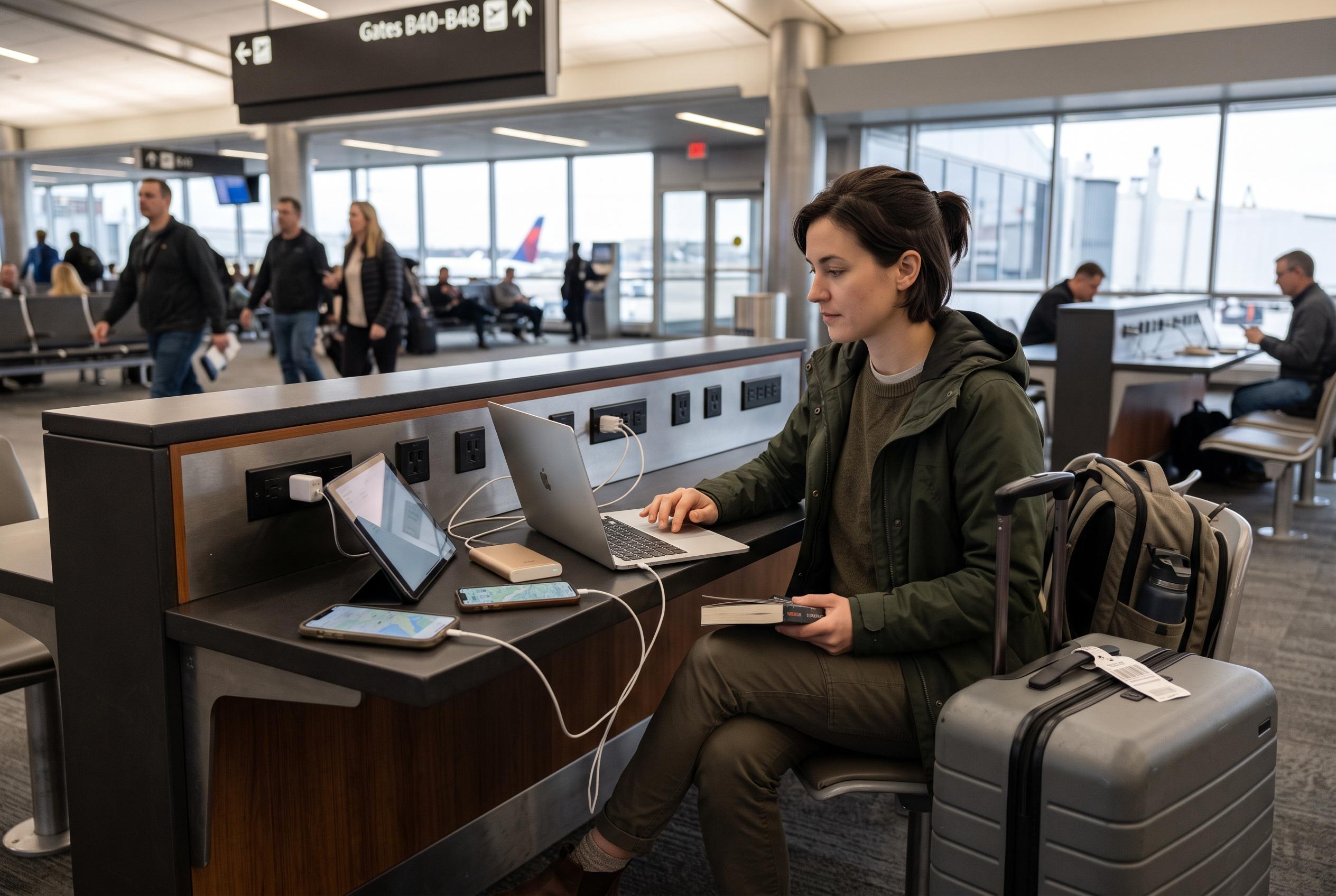
The same logic applies in other settings, but the constraints change. Vacation rentals can be especially unpredictable because outlet placement may reflect an older household rather than a guest’s needs. Airports raise a different problem: even where charging points exist, demand often exceeds supply at busy gates. In those cases, a charged power bank is the safer fallback, because it reduces reliance on public sockets and avoids the etiquette problem of occupying outlets for too long.
Cruises require the most caution. Cruise lines set their own rules on surge protectors, extension cords and multi-plug devices, and those policies can change by sailing, so travellers should check the official prohibited-items list before packing anything intended to expand a cabin’s limited power supply. The same basic warning applies internationally: a plug adapter only changes the shape of the connection, not the voltage, so device labels and charger specifications matter. That distinction is especially important for laptops and other higher-draw equipment.
The broader lesson is simple. Modern travel now assumes constant charging, but the built environment has not fully caught up. Hotel operators are responding with better room layouts, USB-C ports and even wireless pads, yet travellers cannot rely on that being universal. A small, well-chosen charging kit, plus the right cables, remains one of the most effective ways to avoid the nightly search for a free socket.
Disclaimer: This content is intended for informational purposes only. Readers are advised to exercise their own judgement, conduct due diligence, or consult a qualified expert before acting on any information provided.