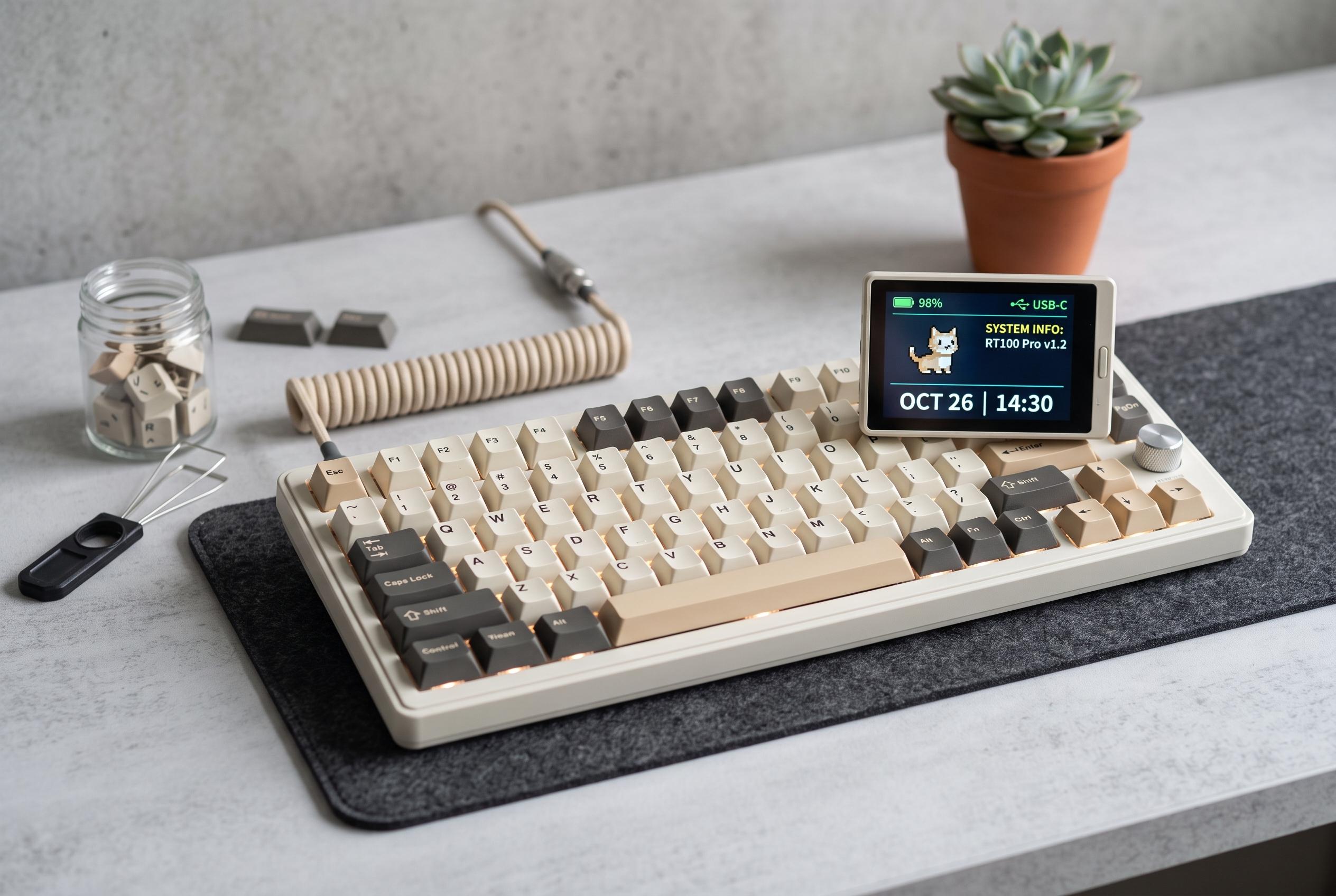

The Epomaker RT100 Pro combines retro design with enhanced build quality and customisation options, introducing a TFT screen and wireless modes, though software stability remains an issue, questioning its readiness as a reliable daily driver.
Epomaker’s RT100 Pro is a refined full-size mechanical keyboard that builds on the original RT100 with a sturdier feel, a more polished finish and a clearer focus on everyday use. Tom’s Guide said the new model replaces the all-plastic construction with an aluminium alloy top plate, while keeping gasket mounting for a softer typing experience and less vibration. Other reviews from KitGuru, APH Networks, Decaf Journal and CT.nl similarly describe the board as retro in design but more substantial in hand, with a characterful look that stands out among current mechanical keyboards.
The strongest case for the RT100 Pro is its typing feel. Tom’s Guide praised the pre-lubed linear switches, double-shot PBT keycaps and layered sound damping, saying the board delivers a smooth, muted and pleasing acoustic profile. That is a consistent theme across the other reviews, which also point to the keyboard’s sound and build quality as major strengths. For users who want a tactile switch option, though, there is a catch: the RT100 Pro ships only with linear switches, so anyone who prefers a bump will need to swap in their own.
The keyboard also tries to do more than a standard 100% layout. Tom’s Guide notes the detachable 1.54-inch TFT screen, which can show status information by default or be customised with GIFs and images through the company’s web-based Epomaker Hub. If the screen is removed, four extra switch sockets become available, adding some flexibility. KitGuru, APH Networks, Decaf Journal and CT.nl all highlight the same idea: the screen and tri-mode wireless connectivity give the RT100 Pro more personality and versatility than a typical office or gaming board.
Where the RT100 Pro loses a little ground is reliability. Tom’s Guide reported that the screen occasionally failed after being reattached, sometimes showing the wrong time or going blank. The other reviews also point to software and screen stability as the main weak points, suggesting the hardware concept is stronger than the execution. Even so, the keyboard’s 1,000Hz polling rate over wired and 2.4GHz connections makes it capable enough for casual gaming, and its hot-swappable design means owners can change switches without soldering.
At $119 in the US and £129 in the UK, the RT100 Pro sits in a crowded mid-range bracket, but Tom’s Guide concludes that it offers enough quality to justify consideration as a daily driver. The verdict across the review set is broadly similar: this is a well-made, good-sounding keyboard with useful customisation and a welcome retro identity, but one that still needs better software and more dependable screen behaviour to become truly polished.
Disclaimer: This content is intended for informational purposes only. Readers are advised to exercise their own judgement, conduct due diligence, or consult a qualified expert before acting on any information provided.