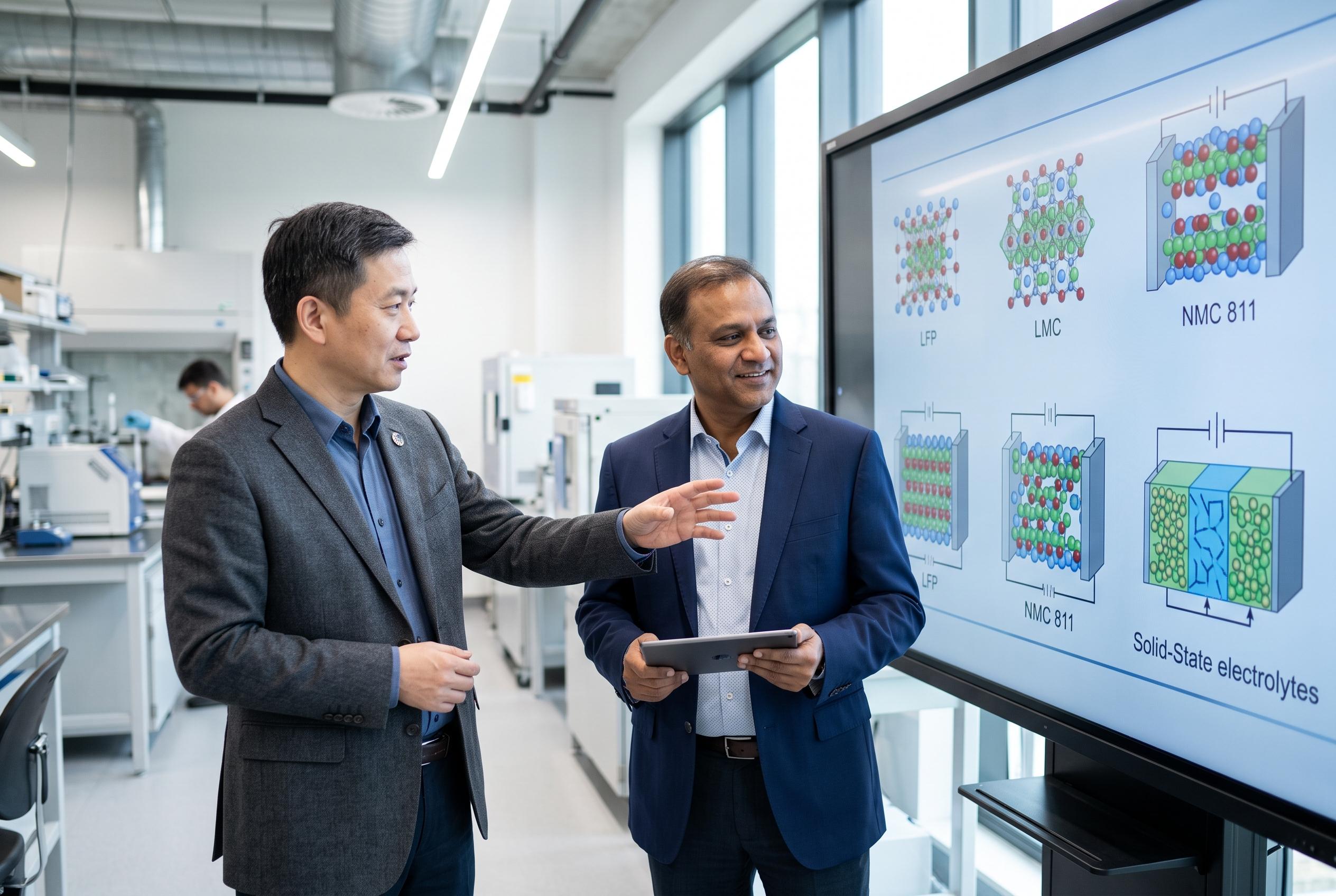

A discussion with Chinese industry leaders highlights the need for India to prioritise battery chemistry, manufacturing scale, and local supply chains over simply producing electric vehicles, signalling a broader industrial strategy amid safety, cost, and supply chain debates.
Nikhil Kamath’s latest conversation with Chinese battery executives lands on a question that is increasingly central for India’s clean-energy ambitions: should the country prioritise electric vehicles or batteries? The answer from EnerVenue chief executive Henning Rath and HiNa Battery executive chairman Kun Tang points away from a simple car-versus-cell choice and towards a broader industrial strategy built around battery chemistry, manufacturing scale and domestic supply chains.
The discussion, on the latest episode of People by WTF, begins with lithium iron phosphate, or LFP, the battery type now widely used by manufacturers including Tesla and BYD. Rath explains the risk of thermal runaway, the chain reaction that can cause a battery to overheat uncontrollably. Tang says more than 14,000 LFP battery fires were recorded worldwide in 2025, arguing that safety problems are often concentrated among lower-tier producers rather than the largest names in Chinese battery manufacturing.
From there, the conversation turns to sodium-ion technology, which Tang presents as a practical alternative for some uses. He says his company has already supplied what it describes as the world’s first 100 megawatt-hour sodium-ion storage project and argues that sodium is far cheaper than lithium. Sodium-ion batteries also use materials such as sodium, iron and phosphate that are easier to source domestically, which is one reason Indian analysts and industry groups have increasingly framed the chemistry as a chance to reduce import dependence. A report linked to the UK-India ASPIRE programme said sodium-ion batteries could help India build a more indigenous energy-storage ecosystem, while KPIT Technologies has separately said its sodium-ion work is aimed at cutting EV costs and supporting storage applications.
The limitations are just as important. Sodium-ion batteries still have lower energy density than lithium-based cells, so they are better suited to grid storage, short-range vehicles, scooters and three-wheelers than to long-range passenger cars. Recent industry developments suggest the technology is moving closer to commercial use: Live Science reported that Changan Automobile and CATL have put a sodium-ion battery into a production EV, while researchers have also described new solid-state sodium-ion designs that could improve safety and durability. Even so, the technology is still emerging, and Tang’s caution about solid-state batteries being early in the commercial cycle reflects that reality.
Rath’s EnerVenue is pursuing a different route altogether, using a nickel-based battery with a water electrolyte derived from NASA-era technology. The aim is to reduce fire risk, and the company says the batteries can withstand 30,000 charge cycles. But the system is designed for stationary storage rather than vehicles, underscoring the wider point of the discussion: there is unlikely to be a single battery chemistry that fits every use case.
That is the logic Kamath confronts when he asks whether he should build an electric car business or a battery company. Rath’s view is blunt: build the battery business, not the car company. His reasoning is that India’s scooters and three-wheelers could be a better starting point for sodium-ion deployment, especially if the goal is to build an industry with fewer dependencies on lithium and rare earths.
The exchange also draws a comparison with China’s industrial model. Rath describes it as a form of state-backed venture capital, in which many companies are funded in the expectation that only a few will become dominant. BYD’s rise from a phone-battery maker to a vertically integrated EV and battery giant shows how quickly that model can scale once capital, manufacturing and policy align. For India, the lesson is less about copying China than about recognising that battery production is as much about supply chains and industrial policy as it is about chemistry.
Disclaimer: This content is intended for informational purposes only. Readers are advised to exercise their own judgement, conduct due diligence, or consult a qualified expert before acting on any information provided.