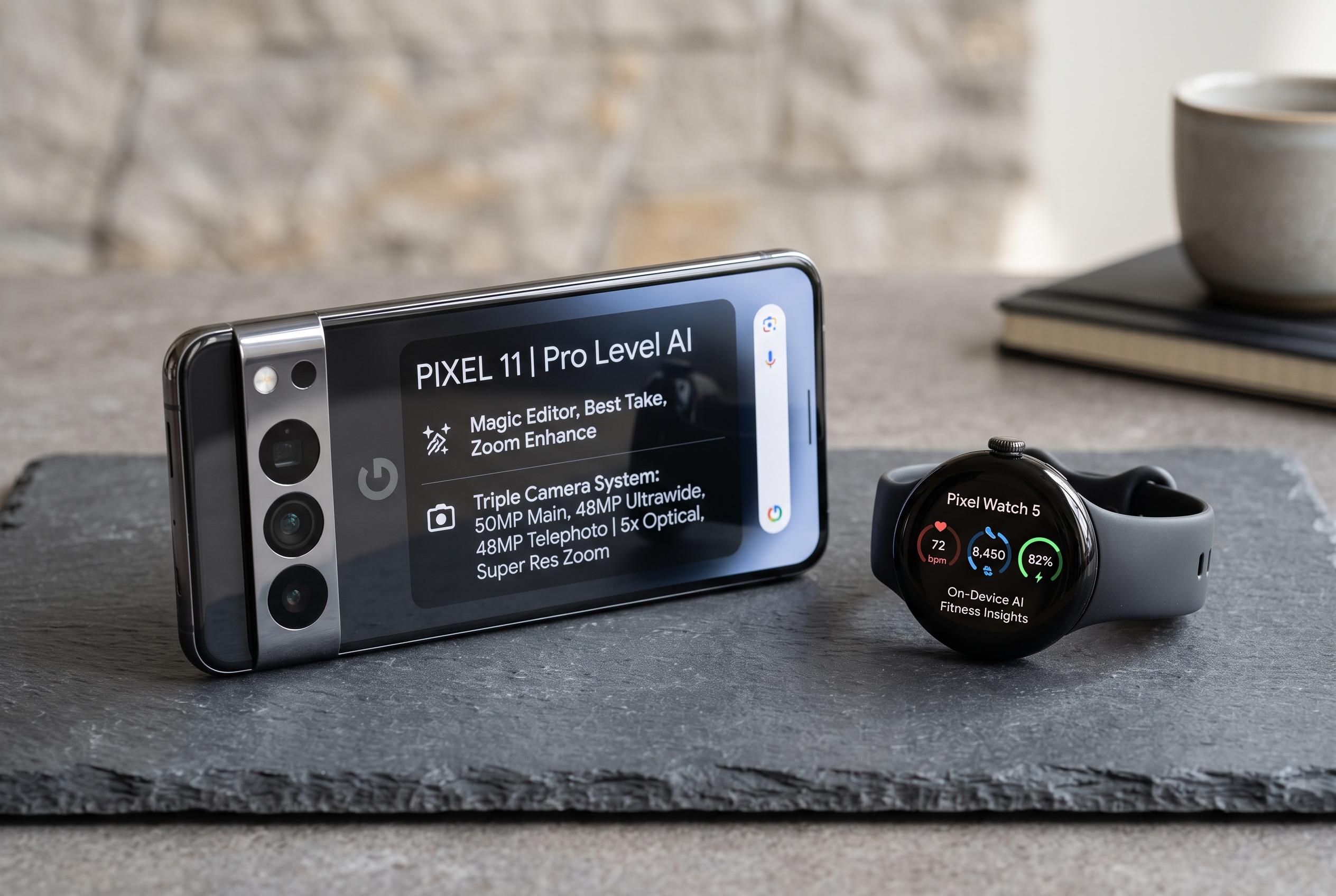

Google has unveiled its Pixel 11 family in Australia, featuring Gemini-powered AI, enhanced cameras, and new devices including the Pixel Watch 5, amid regional restrictions and competitive market challenges.
Google has unveiled its Pixel 11 family in Australia, with pre-orders open and store availability set for August 20, as the company leans heavily on Gemini-powered automation, upgraded cameras and a stronger pitch around on-device AI. The launch also brings the Pixel Watch 5, new earbuds and a foldable model, but not every headline feature is arriving in Australia at once.
The range now starts at 256GB across all phones. According to Google’s Australian pricing, the Pixel 11 begins at A$1,499, the Pixel 11 Pro at A$1,849, the Pro XL at A$2,099 and the Pixel 11 Pro Fold at A$2,799. Google has also pushed higher storage tiers across the line, while the base Pro and Pro XL models ship with 12GB of RAM rather than 16GB, a cut the company has linked to a supplier-driven memory shortage.
At the centre of the launch is Gemini Intelligence, which Google says is meant to make the phone act more like an assistant than a passive device. Senior vice-president Rick Osterloh said on stage that the company sees the current generation as a rare shift in how hardware behaves, while Google also claimed the Gemini app now has more than a billion users. The pitch is that the phone should complete more tasks on the user’s behalf, with agent-like features built into calling, messaging and booking flows.
The hardware is built around Tensor G6, which Google says delivers faster browsing, quicker app launches and more efficient AI processing. The company also claims seven years of security updates, which remains one of the most practically important parts of the proposition for buyers and enterprise teams alike. For security and scam protection, Google is highlighting on-device detection that can flag suspicious calls and messages in real time, a feature with obvious relevance in Australia, where scam losses remain a major problem.
Camera upgrades remain central to the Pixel appeal. Google has added a new main sensor to the standard Pixel 11 and expanded telephoto and zoom capabilities across the Pro models, with the top-end handsets getting stronger low-light performance and longer-range zoom. A new burst-based feature called Magic Capture is designed to sift through hundreds of frames and recover the best stills and clips from fast-moving scenes, while HiLight uses the rear camera ring as a notification cue for calls and selected alerts on the Pro, Pro XL and Fold.
Several of the most publicised software additions are more uneven in their Australian availability. Google’s Sign to Text feature launches in American Sign Language only, which means it is not immediately useful for Auslan users. Likewise, some of the more advanced health and emergency functions in the Pixel Watch 5 launch are either region-limited or not yet cleared for Australia. Google is positioning the watch as a major health product, with insulin resistance trends, blood pressure trends and improved GPS accuracy among the headline claims, but the regulatory picture is narrower than the stage presentation suggested.
The launch pricing in Australia is being softened by a wide set of pre-order bundles and carrier offers, with Google Store credits, trade-in deals and retailer bonuses changing the effective cost substantially depending on the model and term length. That matters because Google is entering a tougher local market than it faces in the United States, with Apple and Samsung still dominant in Australian mobile usage and foldables already well established. Even so, Android Central’s live coverage of the event and related launch reporting suggest Google has sharpened its hardware story this year, especially where AI, battery claims and camera software are concerned.
Disclaimer: This content is intended for informational purposes only. Readers are advised to exercise their own judgement, conduct due diligence, or consult a qualified expert before acting on any information provided.