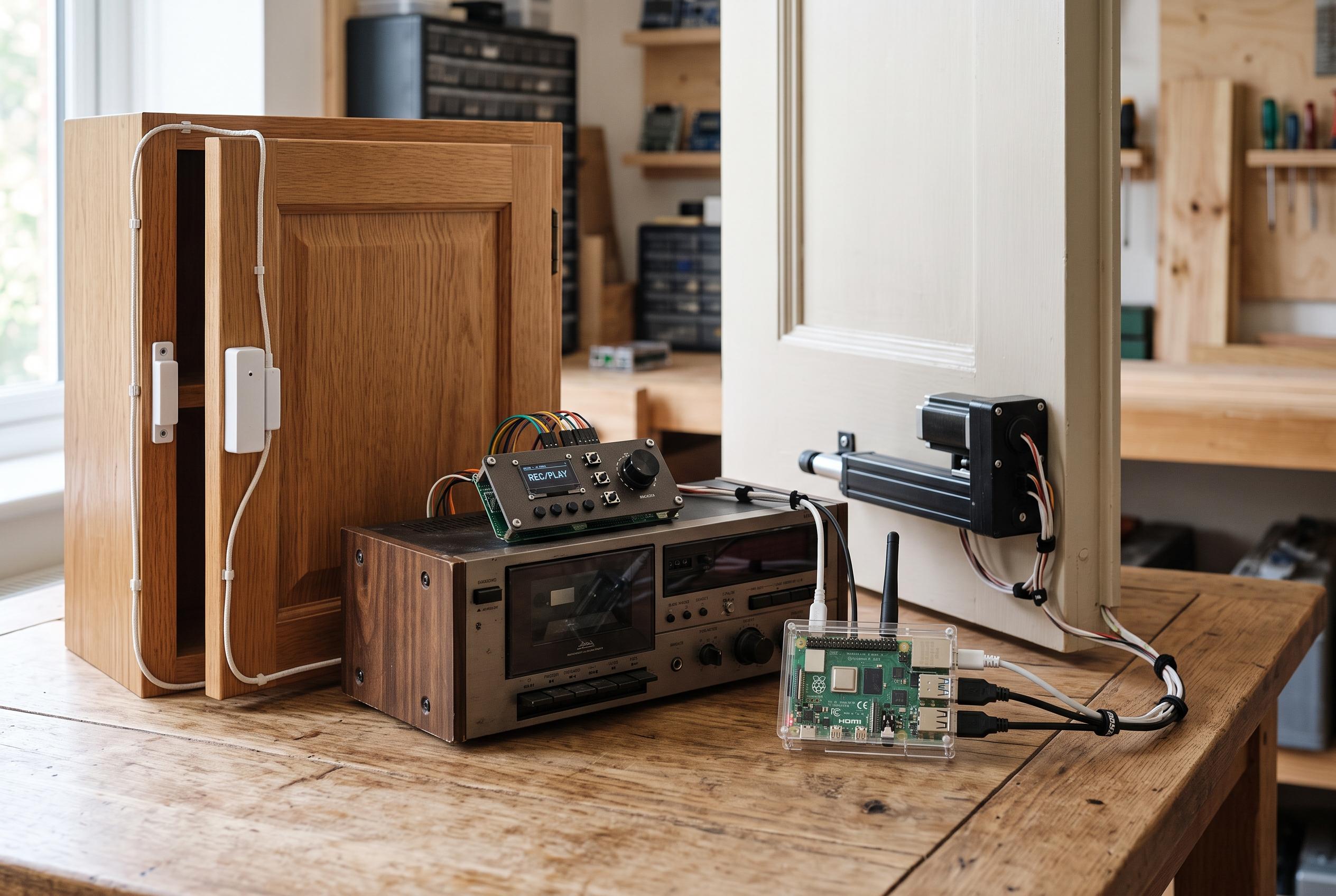

Creative enthusiasts are transforming everyday household hardware into functional smart home devices, from slim contact sensors to vintage tape deck controllers and door-shutting motors, highlighting low-cost, inventive upgrades.
Smart home gear often looks specialised, but many of the most useful upgrades come from reusing what is already in the house. A recent How-To Geek roundup highlighted three Home Assistant builds that take that idea seriously: a slimmer way to mount contact sensors, a restored tape deck turned into a controller, and a blind motor repurposed to help shut a door.
The simplest of the three is also the most practical. Contact sensors rely on a reed switch and a magnet, but the magnet does not have to be the one that came in the box. As the article notes, any suitably strong magnet can trigger the sensor, which means the bulky factory magnet can be replaced with a thinner part that fits where space is tight. In some homes, that can make the difference between a sensor installation being impossible and becoming neat enough to sit flush inside a frame.
The more ambitious project came from a broken 1980s Technics tape deck bought for $40 and rebuilt as a Sonos controller. Using ESP32 hardware and Home Assistant integration, the creator mapped the deck’s buttons, toggles and rotary controls to music functions, while the tape counter and VU metres were made to work again. It is not the sort of job most people will finish in a weekend, but it shows how old audio hardware can be given a new purpose without losing its appeal.
Another builder took a roller blind motor and used it to nudge a door shut far enough for a smart lock to engage. Instead of winding blinds, the motor was fitted with a paintbrush and later a 3D-printed lever to push the door into the closed position. That same article pointed out that the principle could be extended further with a rack-and-pinion arrangement to convert rotation into sideways movement, widening the range of tasks such motors could handle. A separate Reddit post also showed the same broader trend, with a compact Home Assistant control panel built around a $15 yellow display and ESPHome, underlining how inexpensive parts can still produce polished results.
Disclaimer: This content is intended for informational purposes only. Readers are advised to exercise their own judgement, conduct due diligence, or consult a qualified expert before acting on any information provided.