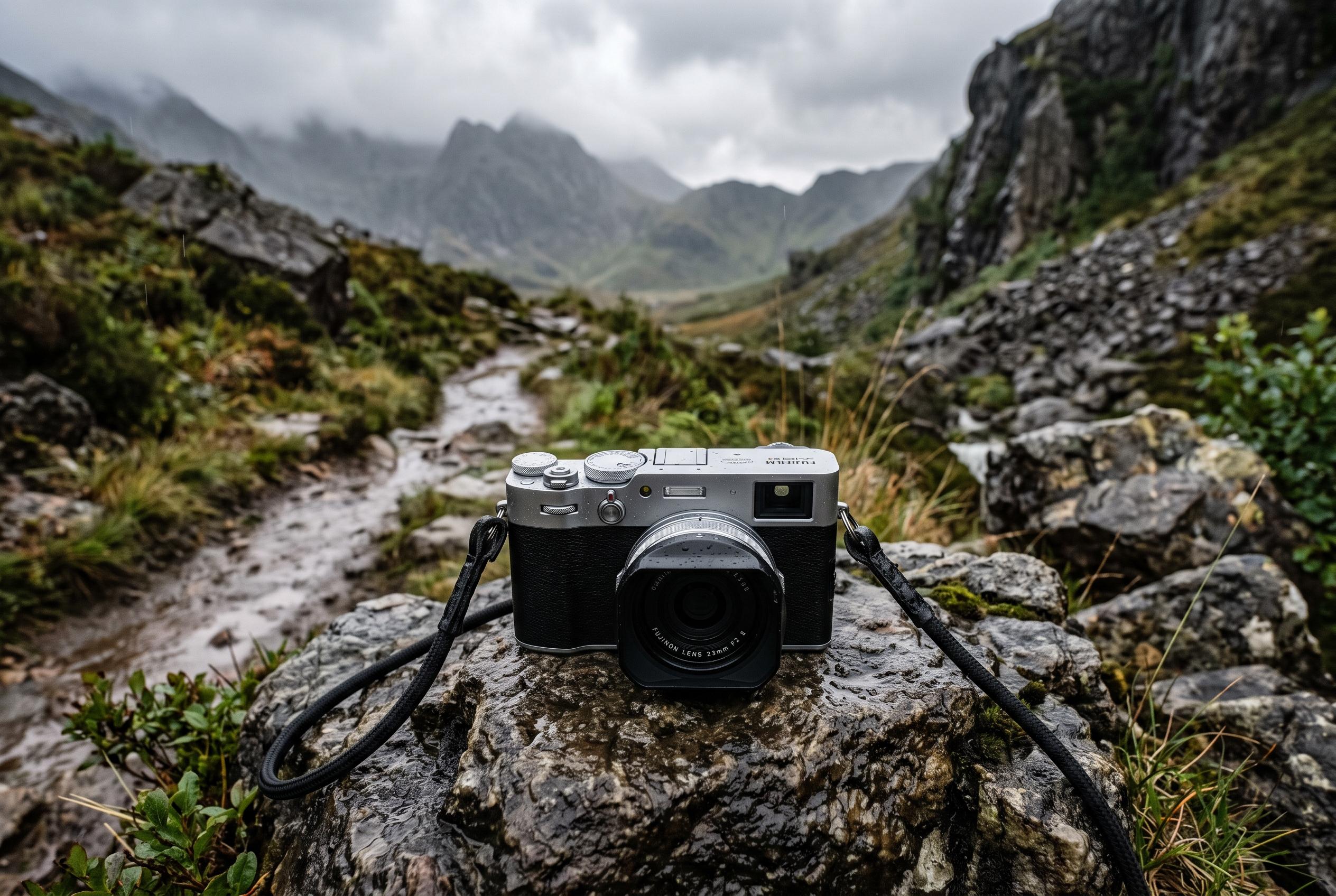

The Fujifilm X100VI, heralded for its compact size and powerful sensor, demonstrates strong outdoor performance during a challenging hike, revealing its strengths and limitations for serious photographers on the move.
Fujifilm’s X100VI has become one of the most talked-about compact cameras of recent years, and not just because of its retro styling. The camera combines a 40.2-megapixel APS-C sensor, in-body image stabilisation and a fixed 23mm f/2 lens in a body that is small enough for daily carry but serious enough for demanding work. Reviews from RTINGS, Tom’s Guide, TechRadar and Cameralabs all point to the same conclusion: this is a premium compact with unusually strong capability for its size. The real question, though, is whether that promise survives away from a desk and into rougher terrain.
A three-day hike through Saxon Switzerland outside Dresden offered a useful answer. The route involved steep stone steps, exposed ridges, sudden changes in light and one proper rain shower. In that kind of setting, the X100VI’s appeal becomes clearer. It is not simply a fashionable street camera. It is a fixed-lens tool that encourages a more deliberate way of shooting, while still remaining light enough to carry all day and discreet enough to use without drawing attention.
Part of that appeal comes from its fixed 35mm-equivalent perspective. There is no lens swapping, no debate over focal length and no temptation to build a kit around the camera. That constraint can be a strength. On the trail, it pushed the photographer to work closer to subjects and to rely on composition rather than gear choice. The quiet leaf shutter adds to that effect, making the camera less intrusive in public spaces and more comfortable for candid work.
The hybrid viewfinder is another feature that matters more in practice than in specification sheets. Fujifilm gives users the choice of an optical finder or an electronic preview, and each has advantages depending on the light. In bright sun, the optical option is easier to read. In darker woodland or shifting shadow, the electronic view is more useful because it reflects exposure more accurately. The trade-off is a small amount of friction when switching between the two.
The biggest hardware advance over the previous generation is the addition of in-body image stabilisation. In practical terms, that means steadier handheld shooting at lower shutter speeds, which is valuable when tripods are inconvenient or impossible. Camera reviews have repeatedly singled out IBIS as one of the X100VI’s most important upgrades, and that judgement is easy to understand. For travel and hiking photography, it extends the camera’s usable range in a meaningful way.
Weather protection remains more limited than some buyers may assume. TechRadar notes that the X100VI requires Fujifilm’s adapter ring and protective filter before it can claim any serious sealing, and even then it is not a fully sealed body in the way some larger cameras are. In wet conditions, that distinction matters. The camera can cope with rough treatment, but it is still a compact with practical limits, not a rugged expedition model.
Battery life is the other clear compromise. The X100VI uses Fujifilm’s smaller NP-W126S cell, and real-world use will not match the endurance of larger mirrorless bodies with bigger batteries. For a full day of active shooting, spares are sensible. For a multi-day trip, they are essential. That is the cost of keeping the camera small, and buyers should factor it in before assuming the compact form brings compact compromises only in size.
Then there is the question of price and availability. Coverage from Tom’s Guide and Digital Camera World has highlighted how hard the X100VI remains to find, even well after launch. Many buyers still encounter backorders or elevated resale pricing rather than simple retail availability. That scarcity has become part of the camera’s identity, and it changes the buying equation. It is easier to admire the X100VI than to actually obtain one at the intended price.
Even so, the broader verdict is strong. For photographers who want a fixed-lens camera that is small, discreet and genuinely capable, the X100VI justifies much of the attention around it. It is not the most flexible option, and it is not the cheapest. But for street, travel and documentary work, it combines image quality, handling and character in a way few rivals match.
Disclaimer: This content is intended for informational purposes only. Readers are advised to exercise their own judgement, conduct due diligence, or consult a qualified expert before acting on any information provided.