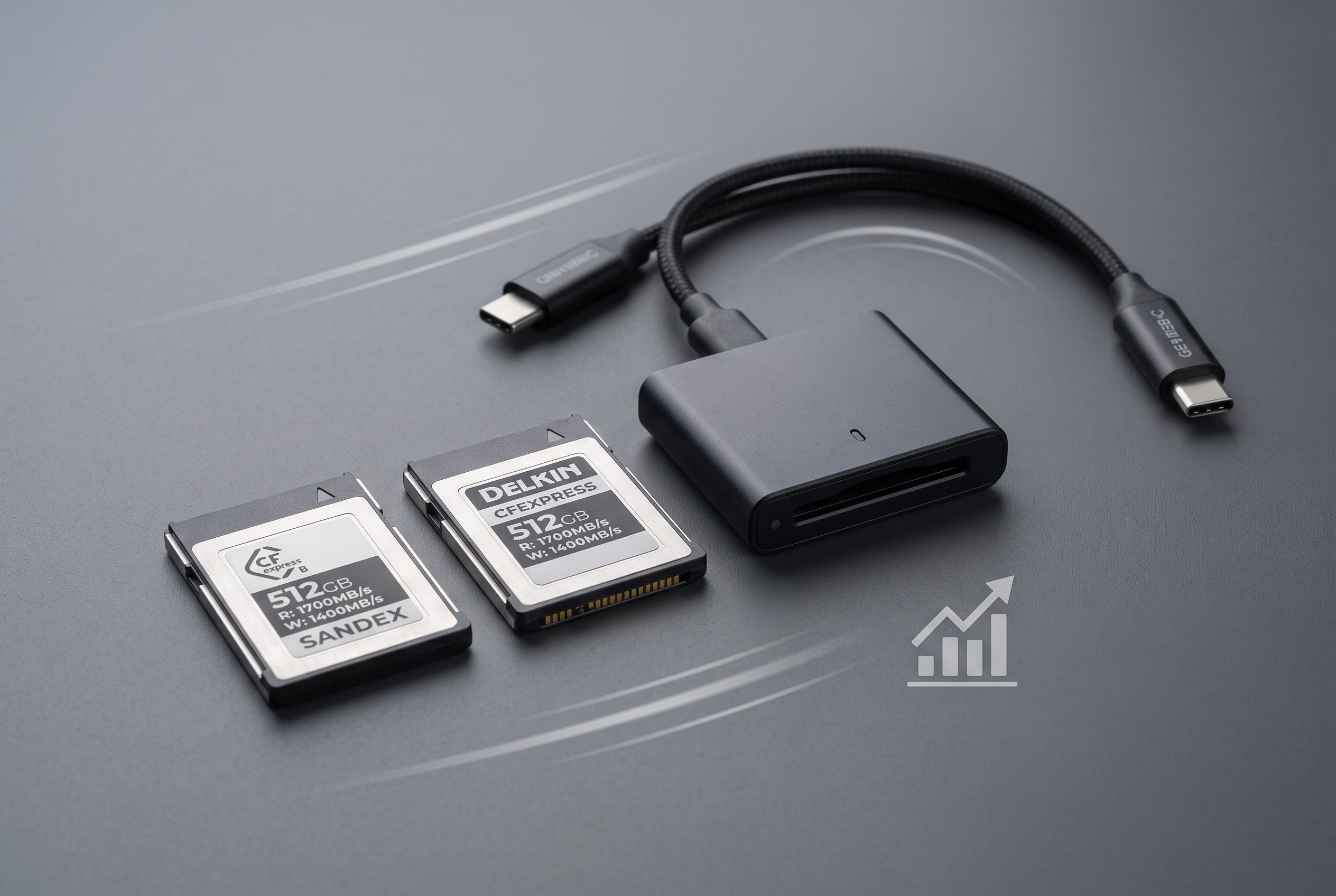

While SanDisk remains the most recognised choice for versatility and value, Delkin’s higher sustained performance offers a compelling advantage for demanding cinematic workflows, signalling an evolution in high-speed storage solutions for filmmakers.
In filmmaking circles, the SanDisk versus Delkin question is less about brand loyalty than about workflow. The cards compete in the same professional CFexpress Type B class, but they are aimed at slightly different users: SanDisk tends to emphasise broad compatibility and established value, while Delkin leans into higher sustained performance and a more production-focused feature set. For shooters working with 4K, 6K or 8K recording, the choice can affect transfer times, card changes and how much headroom is available on longer takes.
For entry-level professional use, the SanDisk 128GB Extreme PRO remains a familiar benchmark. B&H Photo lists it at 1,700MB/s read and 1,200MB/s write, while Best Buy’s product page describes write speeds of up to 1,400MB/s, illustrating the kind of specification drift that often appears across retail listings. In practical terms, the card is pitched at high-resolution RAW stills and 4K or 8K video, and external reviews have generally pointed to strong performance and good value for money, although smaller capacities still bring the usual trade-off of limited recording time.
Delkin’s 128GB POWER CFexpress Type B card takes a more performance-led approach. B&H Photo lists its PCIe 3.0 interface and maximum speeds of 1,780MB/s read and 1,700MB/s write, which gives it a clear paper advantage over SanDisk’s 128GB model. That makes it better suited to sustained professional video work, especially where quicker buffer clearing and faster offloads matter more than brand familiarity. Customer reviews on the retailer page suggest the card is being used in demanding shooting environments, which supports its positioning as a serious production tool.
For filmmakers choosing between the two brands, the dividing line is straightforward. SanDisk is the safer all-purpose option for buyers who want a widely recognised card at a comparatively accessible price, while Delkin appears better suited to users who prioritise write performance and more aggressive video workloads. Independent reviews of the SanDisk Extreme PRO also note that larger capacities remain expensive, which can matter for crews planning to buy multiple cards rather than a single high-capacity unit. In short, SanDisk is the more established mainstream choice; Delkin is the more speed-focused one.
Disclaimer: This content is intended for informational purposes only. Readers are advised to exercise their own judgement, conduct due diligence, or consult a qualified expert before acting on any information provided.