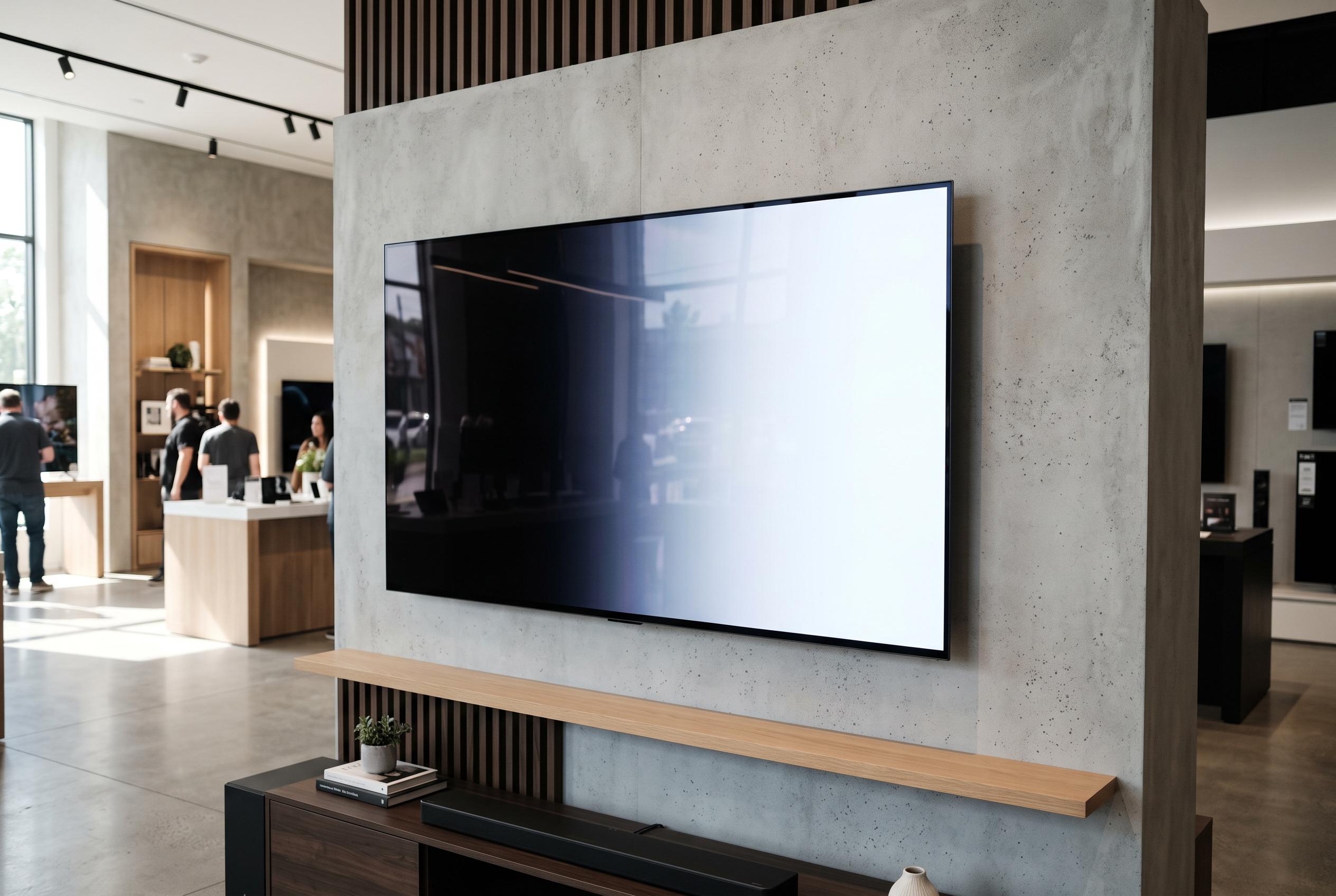

While OLED televisions continue to deliver superior contrast and black levels, recent advancements have pushed their peak brightness levels closer to Mini-LED rivals, though glare remains a critical factor for bright room viewing.
OLED televisions still offer some of the best picture quality available, but brightness remains the key variable that decides whether one will suit a given room. Tom’s Guide says the gap between OLED and LCD/LED sets is narrowing, yet the right choice still depends heavily on how much daylight or lamp light reaches the screen.
At the budget end, OLED remains the most vulnerable to bright surroundings. Tom’s Guide points to LG’s entry-level B6 as a good example: even though it delivers the contrast and black levels that define the technology, its peak highlight brightness is far lower than that of many Mini-LED rivals. The site notes that the B6 reaches around 800 nits in testing, which is enough for dark or dim rooms but less convincing when the living space is flooded with ambient light. By contrast, a mid-range Mini-LED set such as TCL’s QM7L can reach roughly 2,300 nits in highlight measurements and maintain far higher full-screen brightness, although it cannot match OLED for black depth or the absence of haloing.
The brightest OLEDs are now much more capable. In Tom’s Guide’s testing, Samsung’s S95H reached about 2,700 to 2,800 nits in HDR highlights, placing it among the most luminous OLED televisions measured by the publication. A separate review of the S95H reported a peak HDR result of 2,721 nits, along with strong colour coverage and low input lag, reinforcing its appeal for both film viewing and gaming. Even so, the site stresses that these figures describe highlight output rather than the average brightness of the entire screen, so a high-end OLED still does not behave exactly like a premium LCD set in a sunlit room.
For most households, a mid-range OLED is the more practical compromise. Tom’s Guide says models such as the LG C6 and Samsung S90H sit between entry-level and flagship OLEDs in both peak and full-screen brightness, which is usually enough for everyday viewing unless the room is consistently bright during the day. Samsung’s S90H also adds a glare-free screen, which the publication says can be especially useful where reflections from windows or lamps are a concern. Samsung’s own product information says its OLEDs also carry independently verified “Glare Free” performance and “Real Black” validation, indicating a stronger push to improve usability in difficult lighting.
That glare-free finish is not without trade-offs. Tom’s Guide says Samsung’s matte-style screen reduces direct reflections very effectively, but can also lift black levels when there is ambient light in the room, making dark scenes look less inky than on glossy OLED panels from LG and Sony. Its recent testing of the S95D also found that the anti-reflective treatment works well in bright rooms, though the altered look of the image will not suit every viewer. The practical rule remains simple: if the television will sit below a skylight, beside large windows or in a room used mainly during the day, a high-end OLED may be acceptable, but an LCD or Mini-LED set is still the safer choice for consistently bright conditions.
Disclaimer: This content is intended for informational purposes only. Readers are advised to exercise their own judgement, conduct due diligence, or consult a qualified expert before acting on any information provided.