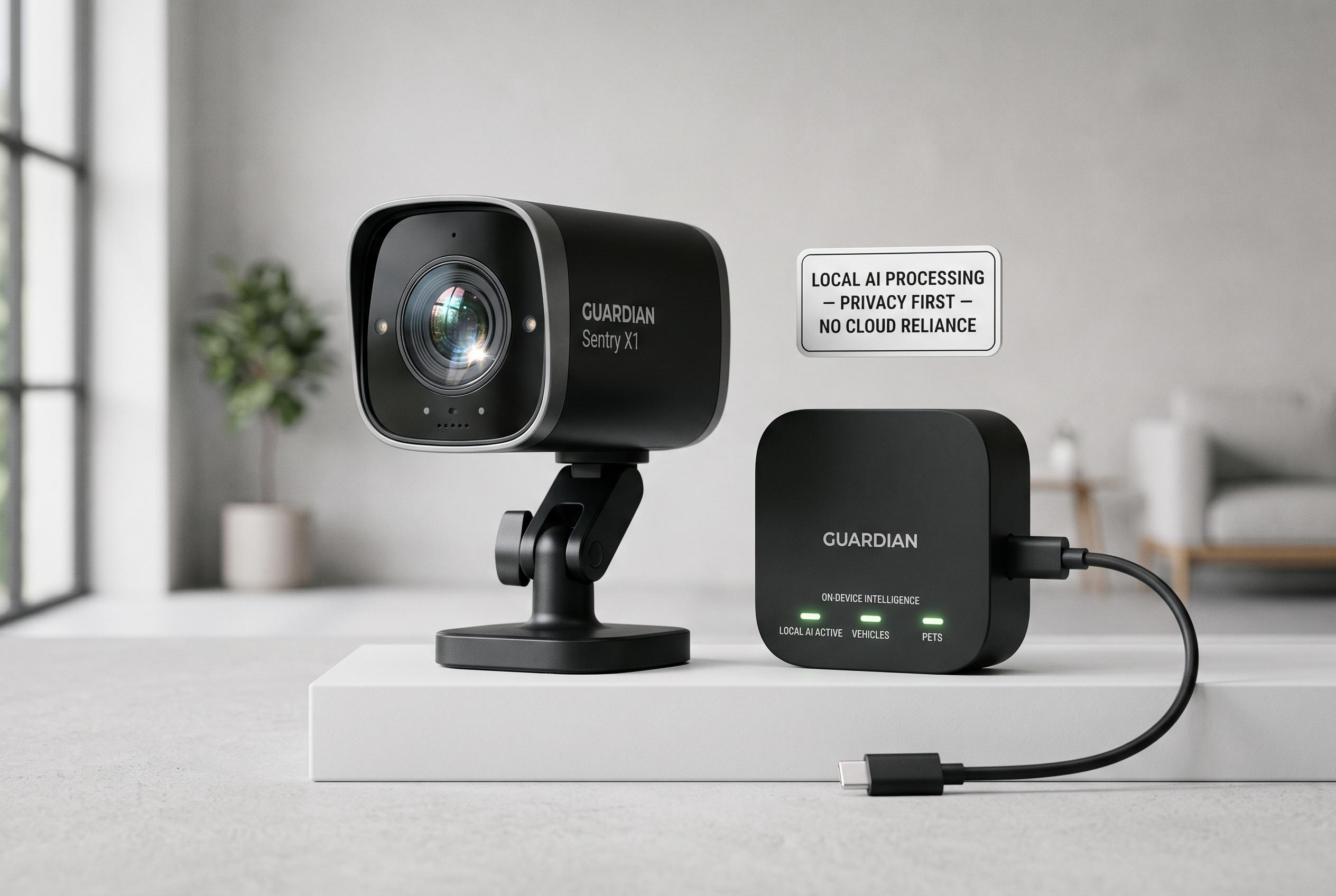

A new approach to home security cameras utilises local AI pipelines to generate detailed activity descriptions, prioritising privacy and responsiveness without sending footage to the cloud.
Home security cameras are increasingly useful when they do more than record. In this case, the focus is on a local AI pipeline that turns motion events into short descriptions, without sending footage to the cloud. The setup combines Home Assistant, Frigate, MotionEye and local vision-capable language models to keep analysis on in-house hardware while still producing alerts that are far more informative than a basic motion ping. Frigate is designed for local AI object detection, and its integration with Home Assistant is built to feed those events straight into a smart home workflow.
The core surveillance layer is Frigate, running as the network video recorder on a Raspberry Pi 5, with a Raspberry Pi AI HAT used to improve detection performance. Motion masks are applied to cut down unnecessary processing in noisy parts of the image, while MQTT links Frigate and Home Assistant so events can be passed cleanly between the systems. The same home can also use MotionEye, which Home Assistant supports for motion alerts and camera management, although Frigate remains the stronger option for AI detection when separate hardware is available.
On top of that, the notification layer is driven by an AI Event Summary blueprint in Home Assistant. This takes motion-triggered events from Frigate and hands them to a vision-enabled local model through LLM Vision, then forwards the results to a tablet running the Home Assistant Companion App. The result is a notification that can summarise what the camera actually saw, rather than merely saying that movement occurred. The system also connects to a local voice assistant stack, so the user can ask about camera feeds and trigger image analysis on demand.
A key part of the design is that all of it runs on local machines. The first test used a Qwen3.6-35B-A3B model on an RTX 3080 Ti, but the analysis was slow enough to be impractical for routine camera use. The workload was then shifted to a GTX 1080 running Gemma 4 E4B through llama.cpp’s server component, which delivered faster token output and better responsiveness for surveillance summaries. That trade-off reflects the broader appeal of this approach: the footage stays at home, the processing stays at home, and the system avoids the privacy risk of sending domestic video to external cloud services.
Disclaimer: This content is intended for informational purposes only. Readers are advised to exercise their own judgement, conduct due diligence, or consult a qualified expert before acting on any information provided.