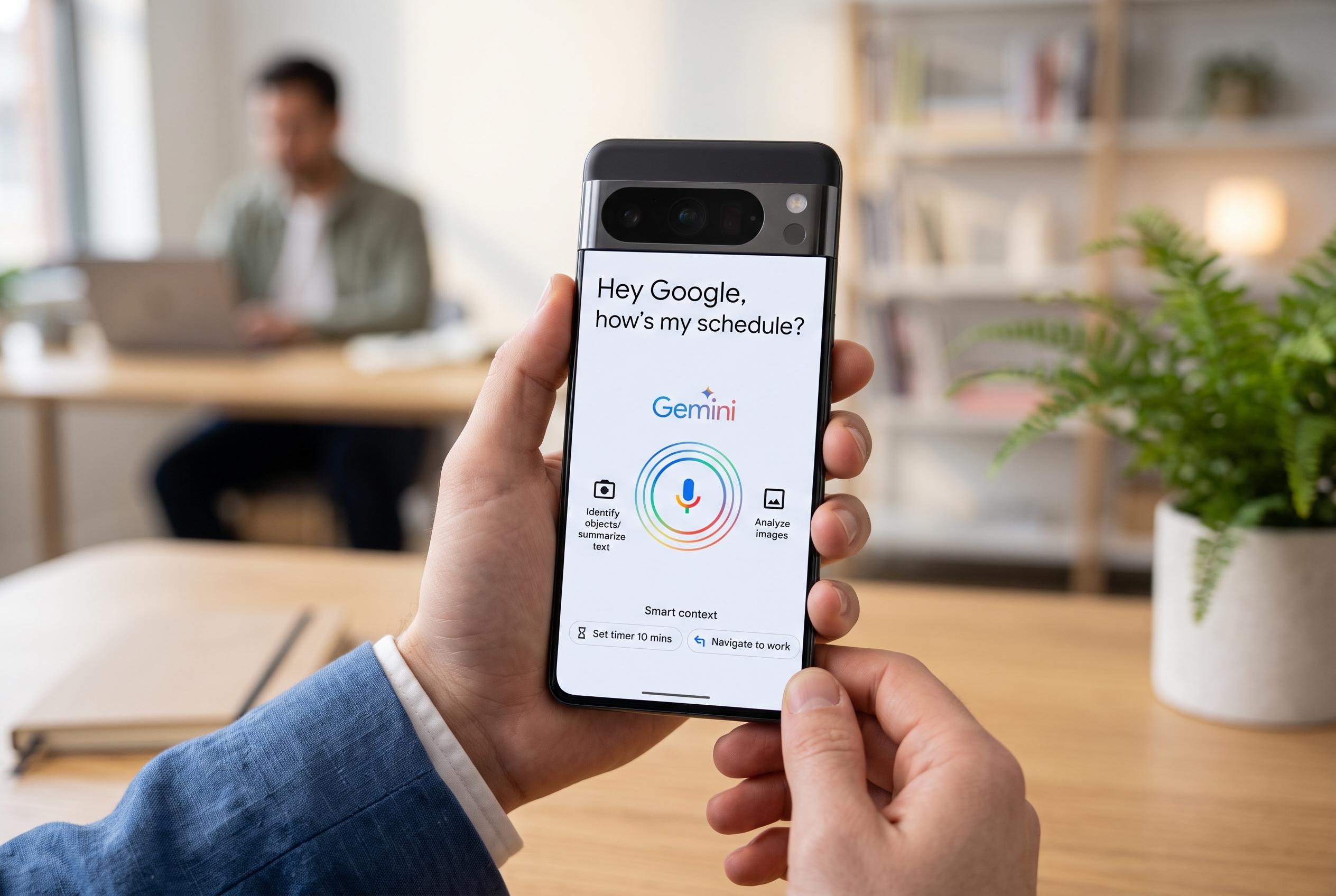

Google is expanding its AI capabilities on Pixel devices, embedding Gemini across more apps to enable voice-first interactions and smarter visual features, as industry rivals accelerate their push towards smarter, assistant-powered mobile experiences.
Google is pushing a familiar idea further: that smartphones should do more of the routine work for users and require less direct management. In comments to CNN, Sameer Samat, president of Google’s Android ecosystem, said the company is designing Android around a future in which people state what they want to achieve and the system carries it out. The latest Pixel devices are meant to preview that direction, with visual signals showing when Gemini is working and new tools intended to make voice-first interaction feel more natural.
The clearest sign of that shift is the growing prominence of Gemini across Google’s hardware and software. At Google’s Made by Google event on 12 August 2026, the company unveiled the Pixel 11 range with Gemini Intelligence integrated into more than 40 apps, alongside features such as Rambler, which removes filler words from speech before turning it into text or email, and sign-to-text support for sign language users, according to Android Central. The same reporting says Gemini can also surface context-sensitive information, including restaurant details on the lock screen, while Google is using a new HiLight LED on Pro models to show when the assistant is processing a command.
Google is also leaning heavily on photography and live media features to make the phones feel more capable than previous generations. Android Central reported that the Pixel 11 family includes Magic Capture for better still images of moving subjects, real-time video translation, improved Circle to Search, and faster Night Sight performance. Hands-on coverage said the design is broadly similar to earlier Pixel models, but the software layer is doing most of the heavy lifting. The wider line-up includes the Pixel 11, Pixel 11 Pro, Pixel 11 Pro XL and the Pixel 11 Pro Fold, all powered by Tensor G6 chips.
The strategy reflects a wider contest across the smartphone market. Google is not alone in betting that AI agents will become a central part of mobile computing. Samsung continues to work closely with Google on Gemini integration, while Apple is preparing a redesigned Siri that it says will be able to work across apps and use personal context in responses later this year, according to the material cited by CNN. OpenAI has also recently made ChatGPT feel more conversational, adding pressure on the phone makers to keep users inside their own ecosystems.
But the commercial case for all this remains uncertain. Pew Research said in June 2026 that many Americans are still wary of chatbots, citing concerns about trust, privacy and accuracy. A separate Pew study found men are more likely than women to use AI chatbots such as Gemini, Copilot and Grok, underlining that adoption is uneven. Samat’s argument is that the real test is not the technology itself but whether it produces a clear practical gain. For Google, that means proving that AI can save time on small tasks without adding confusion, friction or doubt.
Disclaimer: This content is intended for informational purposes only. Readers are advised to exercise their own judgement, conduct due diligence, or consult a qualified expert before acting on any information provided.