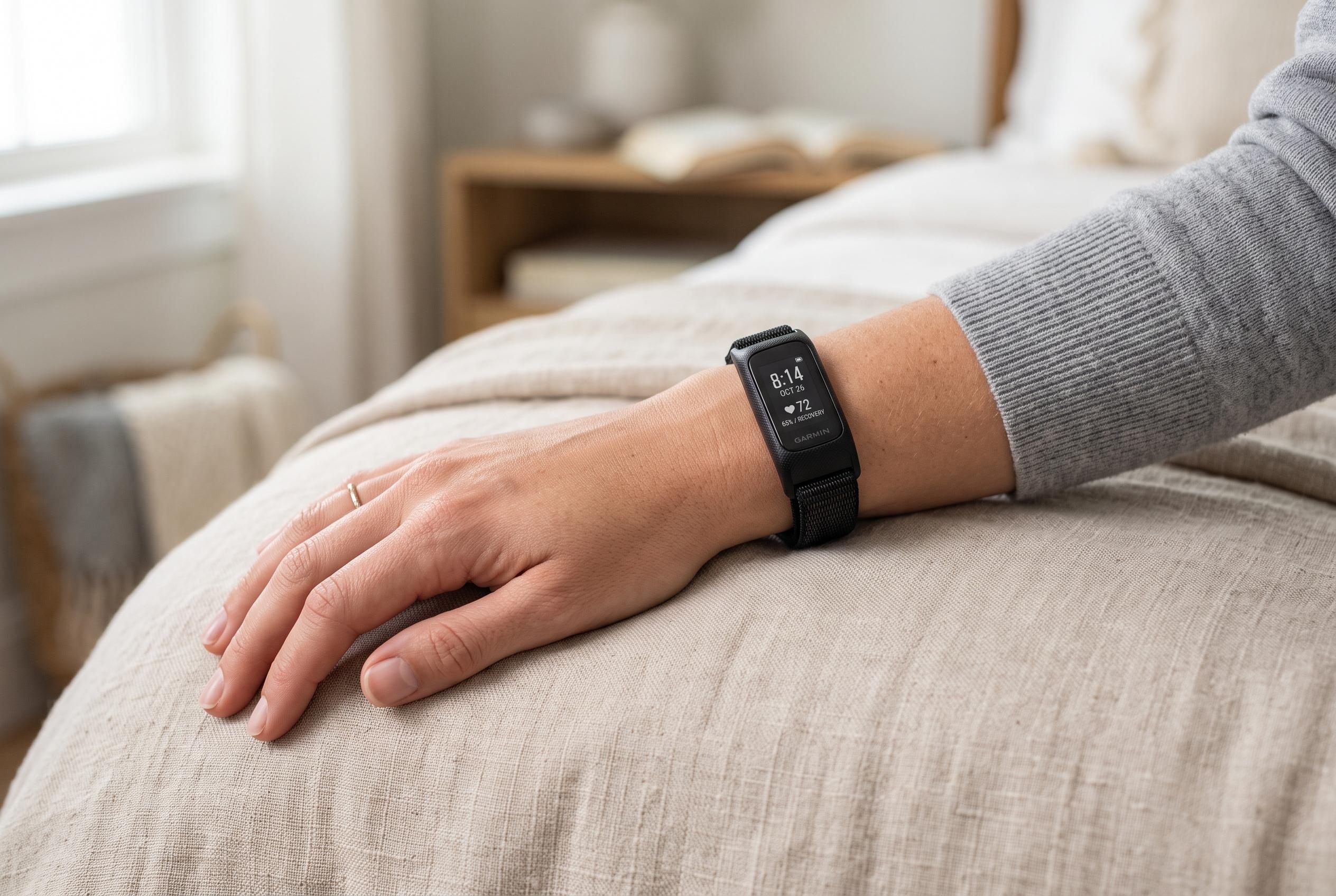

Garmin’s Cirqa sleep tracker performs well at estimating sleep duration and trends but falls short on accurately distinguishing sleep stages, highlighting its suitability for general recovery monitoring rather than clinical analysis.
Garmin’s Cirqa appears to be a competent sleep tracker for broad trends, but not a precise sleep-stage instrument. In recent testing by the5krunner, the band lined up well with other consumer devices on total sleep time, resting heart rate and breathing rate, while diverging sharply on the balance between REM, deep and light sleep. That mirrors a wider pattern seen across wearable trackers: the closer a device gets to estimating when you slept and how your body was behaving, the less reliable it becomes when assigning sleep stages.
The comparison covered 15 nights and pitted the Cirqa against five other products, including Eight Sleep, Whoop, Fitbit, Polar and Amazfit. The tester wore the Cirqa correctly on the wrist throughout, while Whoop was worn on the bicep and Fitbit sat beside the Garmin in an inverted position. That matters, because different wearing positions can change what a sensor sees, and the comparison was not run against a laboratory polysomnography reference. Even so, the pattern was consistent enough to suggest Garmin’s device is solid at identifying sleep duration and the rough shape of the night.
The strongest results were in the physiological measures. According to the5krunner’s analysis, Cirqa stayed within about a point or two of Eight Sleep for resting heart rate and breathing rate, and its sleep timing broadly matched the other trackers. That is in line with separate Tom’s Guide testing, which found Garmin’s Cirqa heart-rate sensor tracked closely against a Polar H10 chest strap benchmark, with only a small average difference. In practical terms, that makes the band more useful for day-to-day trend tracking than for arguing over the exact score from one night to the next.
The less stable part of the picture is sleep staging. The5krunner found that Cirqa usually reported less awake time and more REM sleep than Eight Sleep, while deep sleep swung around without a consistent pattern. That is not unusual. Science-insights.org says Garmin sleep tracking is generally better at telling asleep from awake than at splitting sleep into stages, and a Terra research summary based on thousands of real-world nights found Garmin strongest on duration consistency rather than on stage precision. Tom’s Guide’s Cirqa-versus-Oura comparison also found the two devices often told similar stories overall, but differed on awake time, which is one of the easiest parts of the night to misclassify.
That leaves the Cirqa in a familiar place for consumer sleep wearables: useful, but bounded. The band seems well suited to tracking sleep length, bedtime, wake time and broad recovery trends, especially for users who care more about consistency than clinical precision. It is less persuasive as a tool for comparing REM, deep or light sleep against another brand, because those numbers are shaped heavily by each company’s algorithm. For readers deciding whether the device is “accurate”, the fairest answer is that it is accurate enough for trends, but not a substitute for laboratory sleep measurement.
Disclaimer: This content is intended for informational purposes only. Readers are advised to exercise their own judgement, conduct due diligence, or consult a qualified expert before acting on any information provided.