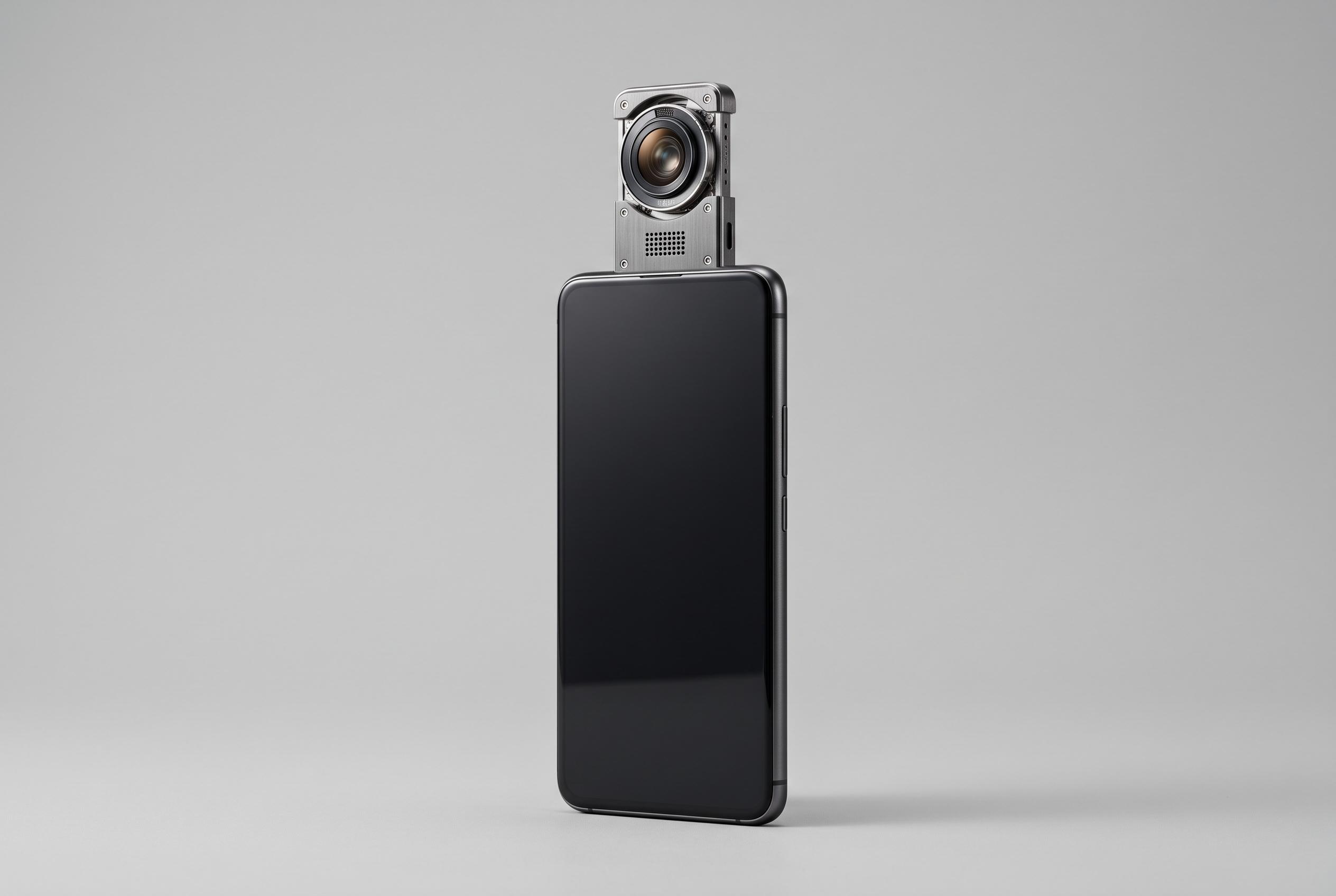

Honor launches a groundbreaking Rocket Phone featuring a motorised, retractable camera module, advanced filming capabilities, and AI-driven interaction, signalling a potential new category for premium smartphones.
Honor has turned its Robot Phone from an early concept into a Chinese market product, and the result is one of the most unconventional handsets the company has ever shipped. The device combines a flagship Android phone with a motorised camera module mounted on a titanium-alloy arm, giving it physical movement for panning, tilting, rotating and tracking subjects in a way that ordinary software stabilisation cannot match, according to the company’s launch details and hands-on reports from Android Central.
At the centre of the design is a 200-megapixel main camera on a retractable gimbal system that Honor says sits inside a 9.6mm body and extends when needed. Android Central and TechNode reported that the mechanism supports four degrees of freedom, while GizmoChina said it can deploy rapidly from within the chassis and is intended to provide mechanical stabilisation as well as automated tracking for solo filming. The phone also carries a 200-megapixel periscope telephoto camera with 2.7x optical zoom and a 50-megapixel ultrawide lens, giving it an unusually large imaging stack for a handset focused so heavily on motion.
Honor has also leaned on its partnership with ARRI to position the Robot Phone as a creator tool rather than a novelty. The company says the device supports ARRI Image Science, LogC3 recording, ARRI Wide Gamut 3 colour space and on-device LUT grading through a Cinema Mode feature. Android Central noted that the approach is aimed at users who want more controlled colour and a more film-like capture workflow without carrying separate equipment.
The other distinctive element is Honor’s Yoyo assistant, which the company has tied to the moving camera module as a physical expression system. According to the launch material cited by GizmoChina, the handset uses on-device AI for emotion recognition and proactive task execution, while the gimbal can behave as a kind of animated interface, reacting to voice commands and changing position to follow people or objects. That makes the Robot Phone more than a camera phone with a trick hinge; it is an attempt to turn the phone itself into an interactive device.
Under the unusual camera hardware, the specification sheet is closer to a conventional premium flagship. Honor says the phone runs on Qualcomm’s Snapdragon 8 Elite Gen 5, paired with up to 16GB of RAM and 1TB of storage, and uses a 6.3-inch LTPO OLED display with a 1-120Hz refresh rate and peak brightness of 6,800 nits. It is powered by a 7,060mAh silicon-carbon battery with 120W wired charging and 50W wireless charging, and it ships with MagicOS 10 based on Android 16. In China, prices start at RMB 9,999 for the 12GB/512GB model and rise to RMB 12,999 for the 16GB/1TB version, with sales due to begin on August 18.
Honor has not yet confirmed broader availability outside China, but earlier reporting from TechNode said the company had already signalled a global launch window at WAIC 2026. That leaves the Chinese release as the first concrete step in a wider rollout, with international pricing and timing still to be disclosed. For now, the Robot Phone stands out less for raw specifications than for the question it raises: whether a moving camera and AI-driven interaction can become a meaningful new category, or remain an expensive demonstration of engineering ambition.
Disclaimer: This content is intended for informational purposes only. Readers are advised to exercise their own judgement, conduct due diligence, or consult a qualified expert before acting on any information provided.