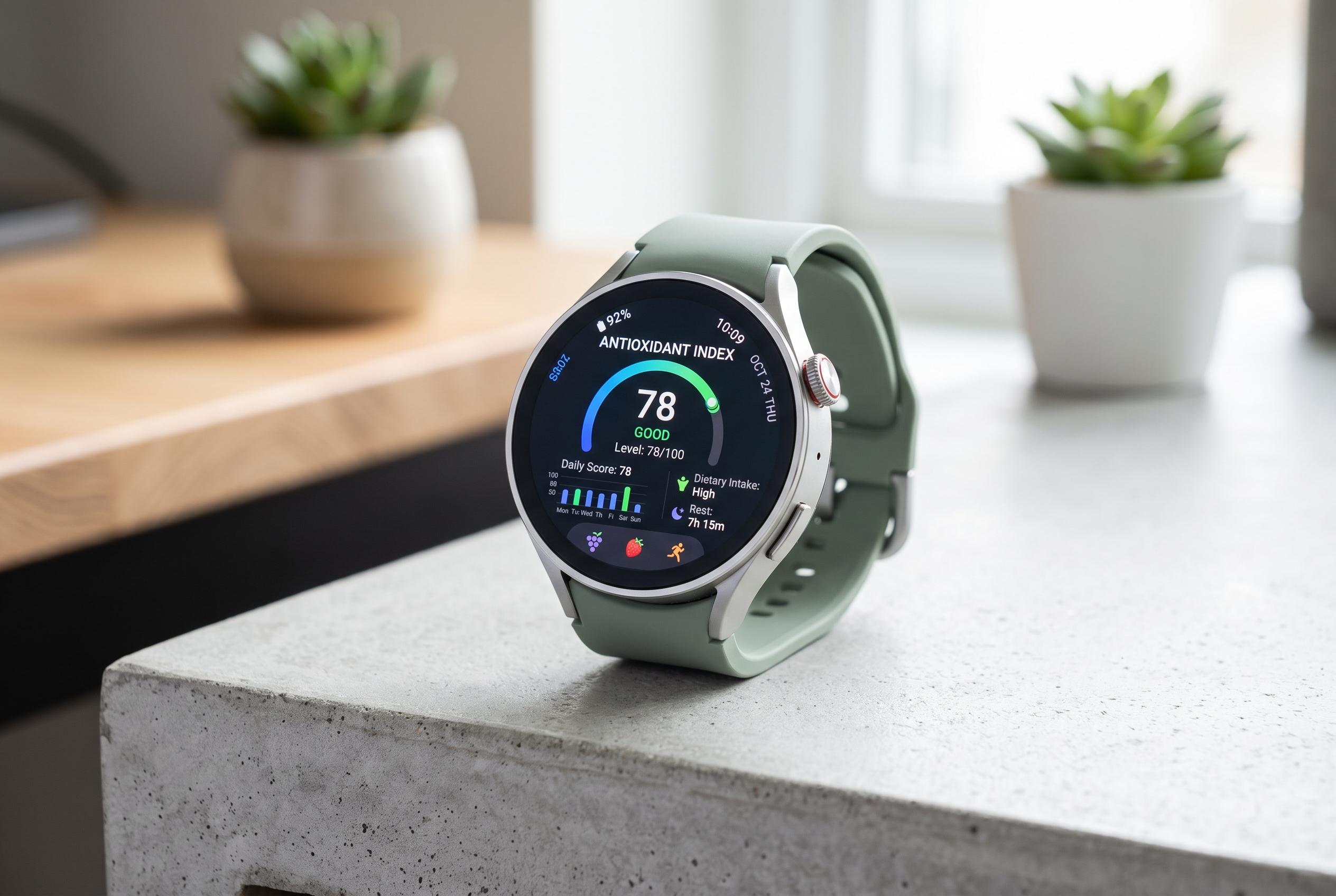

Samsung has launched a new Antioxidant Index in its Galaxy Watch 8, aiming to gauge skin carotenoid levels and monitor dietary effects. Developed with expert collaboration, the feature offers a trend indicator rather than a clinical measure, marking a step forward in health-focused wearables.
Samsung’s Galaxy Watch 8 has drawn attention for a new Antioxidant Index, a metric the company says is designed to show how diet and lifestyle may affect skin carotenoid levels. The feature forms part of a broader health push in Samsung’s wearables, and the company says it worked with specialists in nutrition, medicine and consumer research while developing it.
The measurement is not taken from the wrist in the usual sense. Samsung uses its BioActive sensor and multi-wavelength absorption spectroscopy to assess carotenoids through the skin, with the user pressing a thumb against the sensor to start a reading. That makes the process closer to an ECG-style check than to passive tracking, which may limit how often people use it unless Samsung builds in stronger prompts.
Samsung says it validated the system against Raman spectroscopy, a laboratory method used to measure skin carotenoids, and also compared results with blood tests, food diaries and clinical data from several hundred participants. The company has also pointed to a 2023 randomised controlled trial involving its researchers that found a strong correlation between reflection spectroscopy and Raman spectroscopy for measuring skin carotenoids.
Even so, the feature comes with clear limits. Samsung has not published a simple consumer-facing accuracy figure or margin of error, and it says Antioxidant Index is not intended to diagnose or treat disease. In practice, it appears best understood as a trend indicator rather than a clinical measure. Engadget’s review found the score could be stubborn, while other testers reported that dietary changes sometimes nudged readings upwards over time. Samsung says carotenoids from food generally take two to three weeks to build up in the skin to detectable levels, which may help explain why results can seem slow to change. The company’s US comparison chart currently lists the feature on the Galaxy Watch 8, Watch 8 Classic and Galaxy Watch Ultra, but not on the Galaxy Watch 7, without explaining the omission.
Disclaimer: This content is intended for informational purposes only. Readers are advised to exercise their own judgement, conduct due diligence, or consult a qualified expert before acting on any information provided.