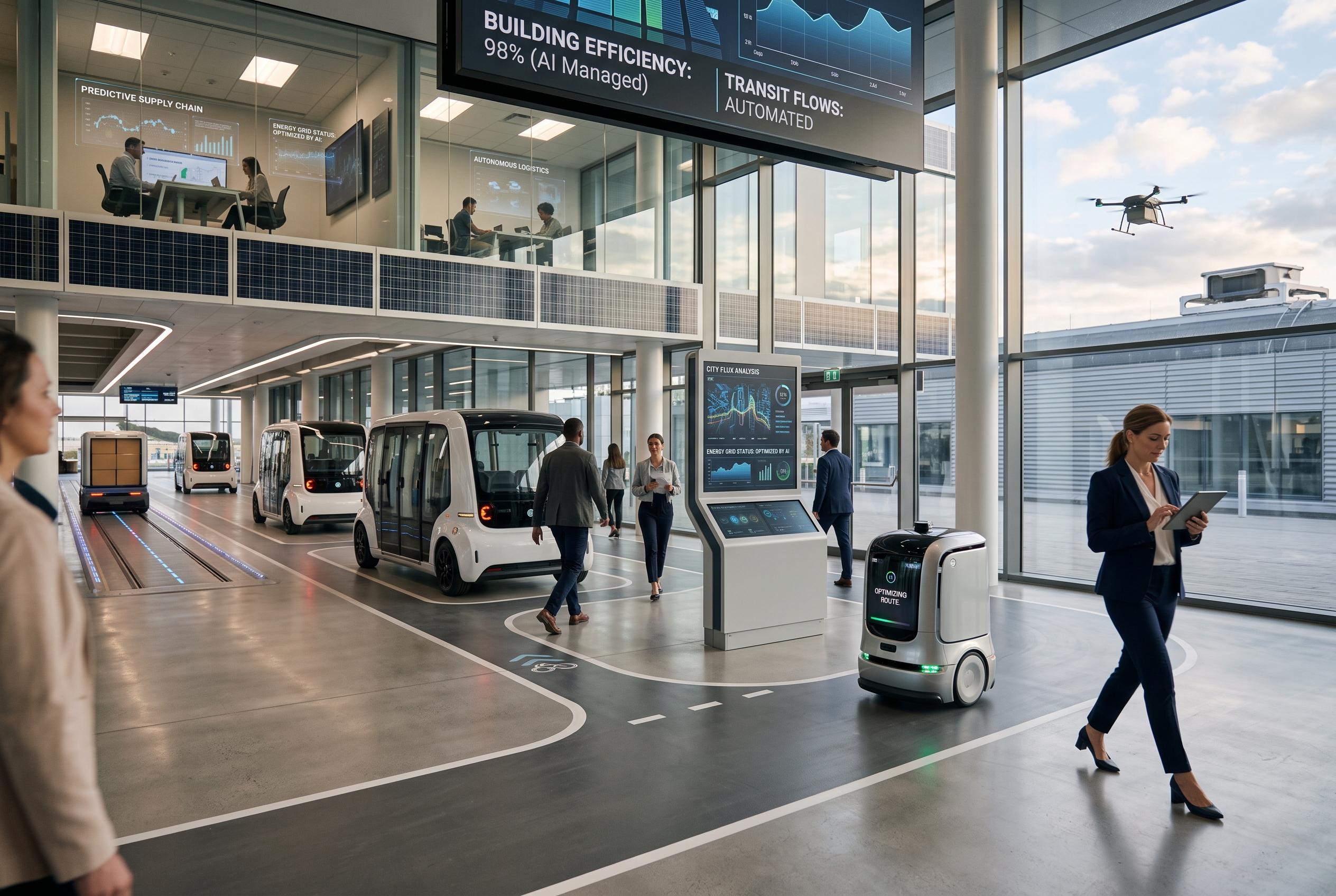

AI is moving beyond specialists to embed deeply in consumer and business software, with advances in autonomous agents, robotics, and smart infrastructure predicted to redefine productivity, mobility, and health by 2025.
Artificial intelligence is moving from a specialist tool to a default layer in consumer and business software. Deloitte’s 2025 Tech Trends report says AI is becoming embedded across daily digital activity, making products and services more responsive, intuitive and efficient. That shift is already visible in search, writing, customer support and workplace software, and it is likely to deepen as AI becomes part of the underlying infrastructure rather than a separate add-on. According to Tom’s Guide, major technology groups are expected to pour vast sums into AI by 2026, which should accelerate that integration.
The next stage is not just generative AI, but software that can act. Deloitte’s reporting on AI agents says these systems are being developed to handle multi-step tasks with limited supervision, from scheduling and analysis to workflow coordination and application development. A separate Deloitte predictions report on agentic AI says the technology remains under development, but could materially raise productivity if businesses can manage the operational and ethical risks. CIO, citing Gartner, has also reported that agentic AI could put as much as $234 billion of enterprise software spending at risk by 2030, as agents interact directly with systems rather than through human users.
That broader automation theme extends into robotics, transport and software-defined vehicles. Humanoid robots may become more practical in manufacturing, logistics and hospitality, where human-built spaces are easier for them to navigate. Autonomous vehicles are advancing more slowly, but controlled environments such as delivery routes and industrial sites may offer early commercial use. In parallel, cars are increasingly being designed as connected technology platforms, with electric drivetrains, driver-assistance systems and over-the-air software updates shaping the next generation of mobility.
Infrastructure will matter just as much as the applications. Faster networks, edge computing and smarter cloud systems are expected to reduce delay and support real-time services such as industrial automation, gaming and connected devices. Battery improvements will remain central, because better energy density, faster charging and longer life affect electric vehicles, phones, laptops and grid storage alike. Energy technology is also moving towards tighter integration, with smart grids, solar, wind and storage systems working together to improve resilience and efficiency.
The same convergence is visible in healthcare, personal devices and security. AI-assisted drug discovery, precision medicine and wearable monitoring could improve diagnosis and treatment, while smart glasses and mixed reality devices may eventually make spatial computing more useful in everyday settings. At the same time, the spread of connected devices and personalised services will heighten the importance of cybersecurity, digital identity and privacy. The most durable technologies, as the report suggests, may be those that remain easy to use, secure and under human control even as they become more intelligent.
Disclaimer: This content is intended for informational purposes only. Readers are advised to exercise their own judgement, conduct due diligence, or consult a qualified expert before acting on any information provided.