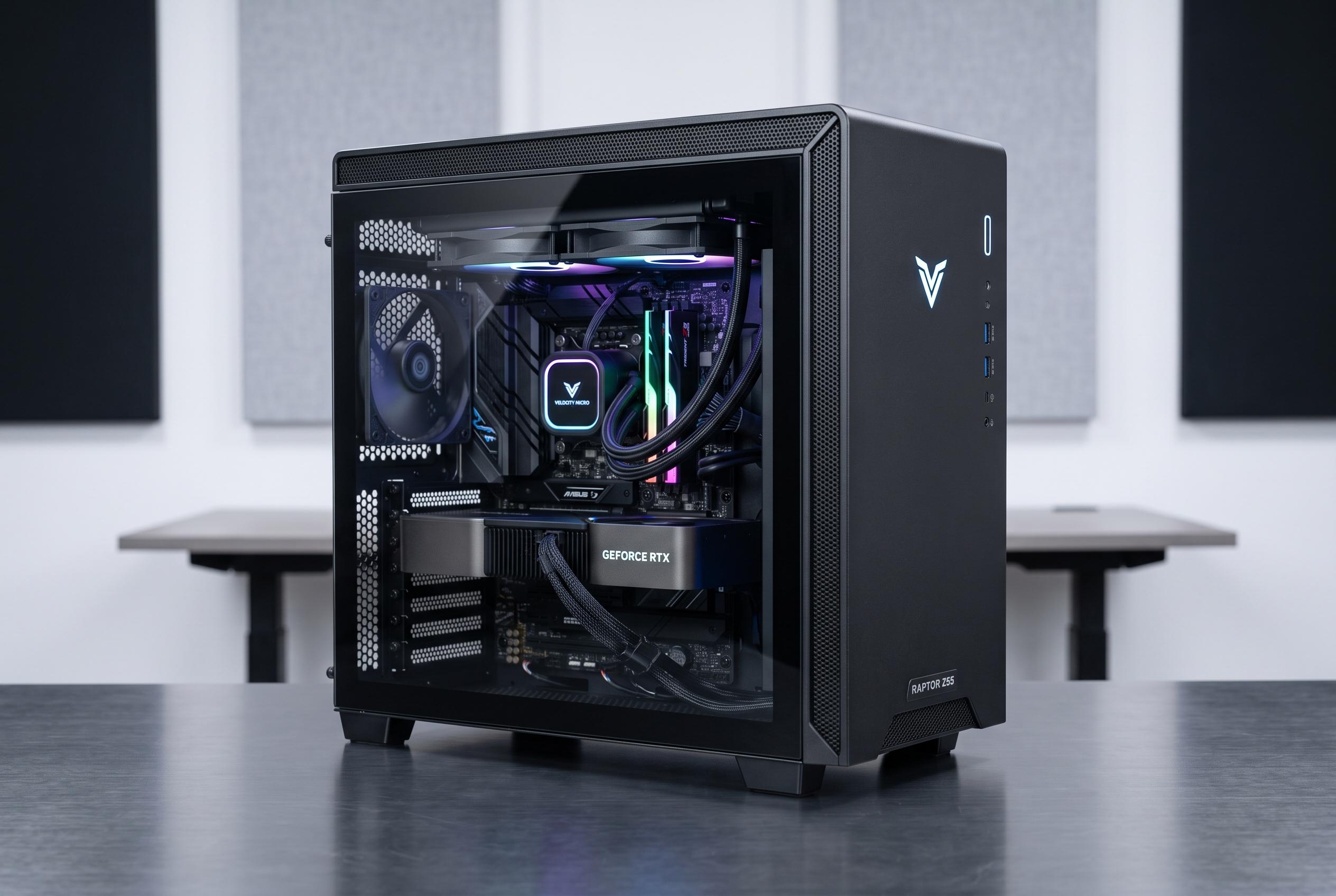

Velocity Micro’s latest Raptor Z55 refresh proves that a restrained, professional-looking chassis can house elite gaming hardware, offering a flexible, upgradable platform that balances performance and design for discerning users.
Velocity Micro’s latest Raptor Z55 refresh reinforces a familiar argument: a restrained chassis can still house genuinely elite gaming hardware. In PCMag’s 2026 review, the system came across less like a stereotypical gaming tower and more like a compact workstation, yet it delivered the kind of speed that matters most to buyers at the top end of the market. That balance helped the earlier Raptor Z55 earn praise for performance, support and value, and the new Intel-based version appears to continue that formula, albeit with a few compromises that keep it short of perfect.
The configuration under review is expensive, at $5,999, but it is not padded with needless flourishes. Velocity Micro lets buyers mix and match AMD or Intel processors, Nvidia or AMD graphics, and several major storage brands, which makes the line unusually flexible for a boutique builder. The reviewed machine pairs Intel’s Core Ultra 7 270K Plus with Nvidia’s GeForce RTX 5090 Founders Edition, 64GB of DDR5 memory and a 2TB PCIe 4.0 SSD. That last detail matters: although the platform supports PCIe 5.0 storage, the company does not currently offer it in the Z55 range, which leaves some performance on the table in a system this costly.
The enclosure follows the same understated logic. Rather than the glass-heavy, RGB-laden look common in gaming PCs, Velocity Micro uses a compact micro-tower with a mesh front and a focus on airflow. Earlier reviews by Tom’s Guide, PC Gamer, InsideHook and TweakTown all made similar points about the Raptor Z55 family: the machine has a clean, professional appearance, tidy internal layout and efficient cooling, but it lacks the visual drama that some buyers expect from a premium gaming rig. That design choice remains divisive, yet it also helps explain why the system appeals to users who want top-tier hardware without a flashy chassis.
Upgradability is another strength. The chassis is not especially large, but it accepts standard parts rather than proprietary components, and the review unit’s Gigabyte Z890M motherboard leaves room for future CPU, GPU, memory and storage changes. PCMag noted support for multiple M.2 drives, extra fan and radiator mounts, and enough clearance for large graphics cards, while also pointing out that modular power supplies are the safest fit. Velocity Micro also backs owner upgrades with a return-to-base service, which may suit buyers who prefer not to open the case themselves.
Performance, however, is the central argument. PCMag found that the Raptor Z55i was broadly ahead of most rivals in productivity and content-creation workloads, though it occasionally trailed systems equipped with faster PCIe 5.0 storage or AMD’s latest cache-heavy chips. In gaming, it proved more than competitive at 4K and with ray tracing enabled, where the GPU carries more of the load. The strongest rival was Maingear’s similarly extreme RTX 5090 build, but the Raptor often kept pace while costing considerably less. That makes the conclusion straightforward: for readers who care first about speed, and can live with a restrained exterior and a few component trade-offs, the Raptor Z55i remains one of the more convincing high-end desktop options.
Disclaimer: This content is intended for informational purposes only. Readers are advised to exercise their own judgement, conduct due diligence, or consult a qualified expert before acting on any information provided.