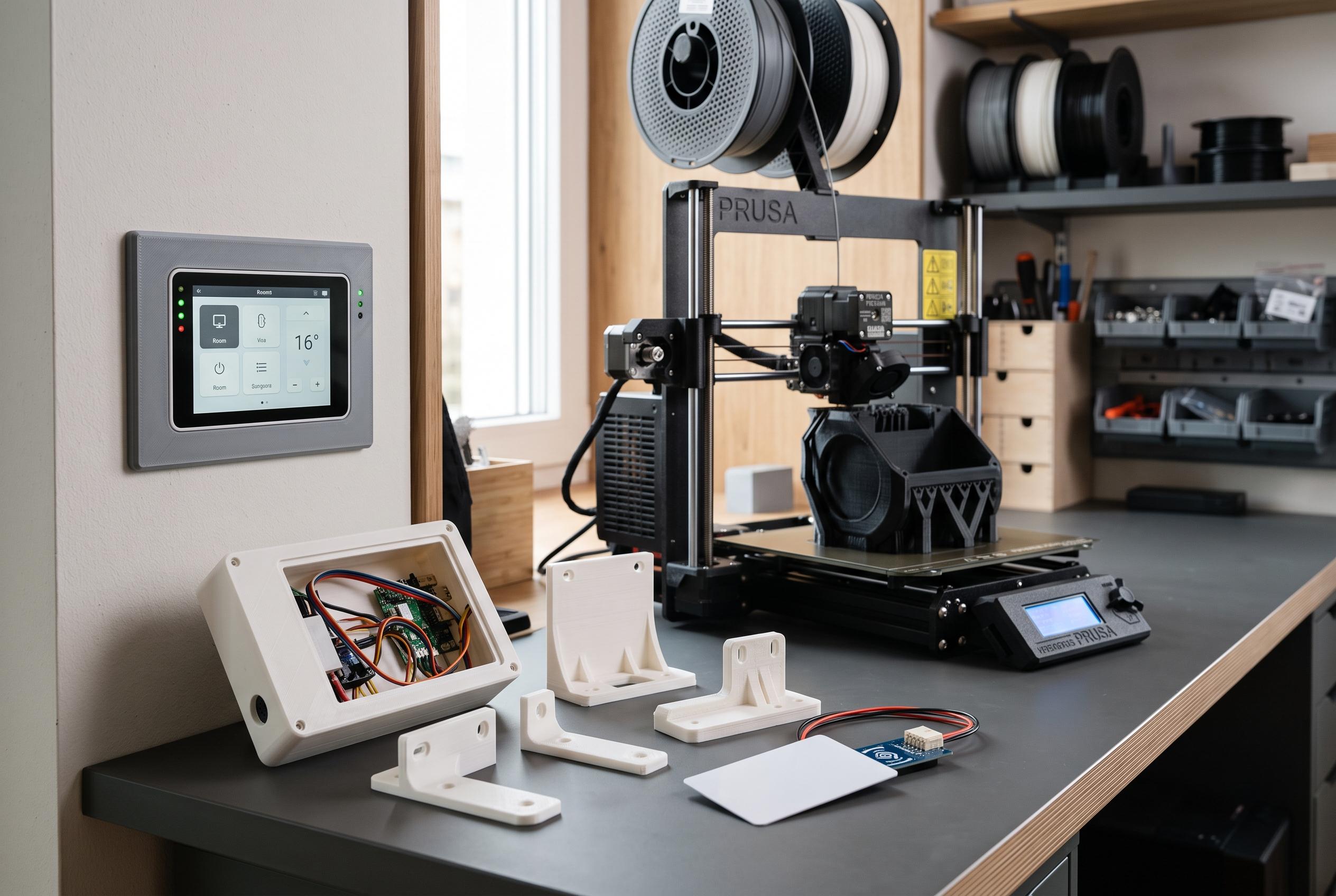

From NFC tags to control panels and device enclosures, 3D printing is unlocking new practicality and customisation in smart home automation, making devices more discreet, accessible, and tailored to household needs.
A 3D printer can do far more than produce decorative objects. In a smart home, it can supply the missing hardware that makes automations easier to use, neater to live with and more accessible. The strongest use cases are practical ones: hiding NFC tags inside printed cases, enclosing DIY electronics, and turning spare devices into proper control points.
One of the simplest examples is NFC. Home Assistant is especially well suited to NFC-triggered routines, and 3D printing gives those tags a better home than a plain sticker on a wall. Printed housings can disguise the tag inside an object that matches the room, such as a cassette-style case for audio playback, a sign for guest Wi-Fi, or a small decorative model for everyday tasks. Because NFC can still work through thin plastic, the result is cleaner without losing function.
The same approach works well for ESPHome projects. Small microcontrollers and sensors are useful, but exposed circuit boards rarely belong on a shelf or desk. Services and makers focused on DIY electronics increasingly treat custom enclosures as a standard part of the build, with designs that include cable pass-throughs, screw bosses, ventilation and precise cut-outs for ports and buttons. That matters because a case does more than improve appearance: it protects the electronics and makes the device feel finished rather than experimental.
3D printing is also well suited to physical control panels. For common automations, a button is often better than opening an app or speaking a command. A printed housing can hold arcade-style buttons, keys or labelled switches for actions such as lighting scenes, media playback or climate control. The advantage is not only convenience. The enclosure can be shaped around the exact layout, spacing and labelling the household needs, which makes the panel easier for guests and family members to understand.
Older tablets can be put back to work in much the same way. A spare Kindle Fire or similar device becomes more useful when it is mounted properly and kept on charge as a wall-based dashboard. Printed brackets and docks can route power neatly and place the screen where everyone can reach it, rather than leaving it buried in a drawer or stranded on a desk. For a household control centre, that is often the difference between an idea and something people actually use.
A final example is the desk presence sensor. In offices with connected lighting, audio and climate control, occupancy detection can automate more than just a light switch. Yet the sensor itself still needs a sensible home. A printed case can let it sit on a desk, hide beneath it or angle towards the user, depending on how the room is arranged. That flexibility is where 3D printing earns its place in the smart home: it turns awkward prototypes into hardware that is useful, discreet and tailored to the space.
Disclaimer: This content is intended for informational purposes only. Readers are advised to exercise their own judgement, conduct due diligence, or consult a qualified expert before acting on any information provided.