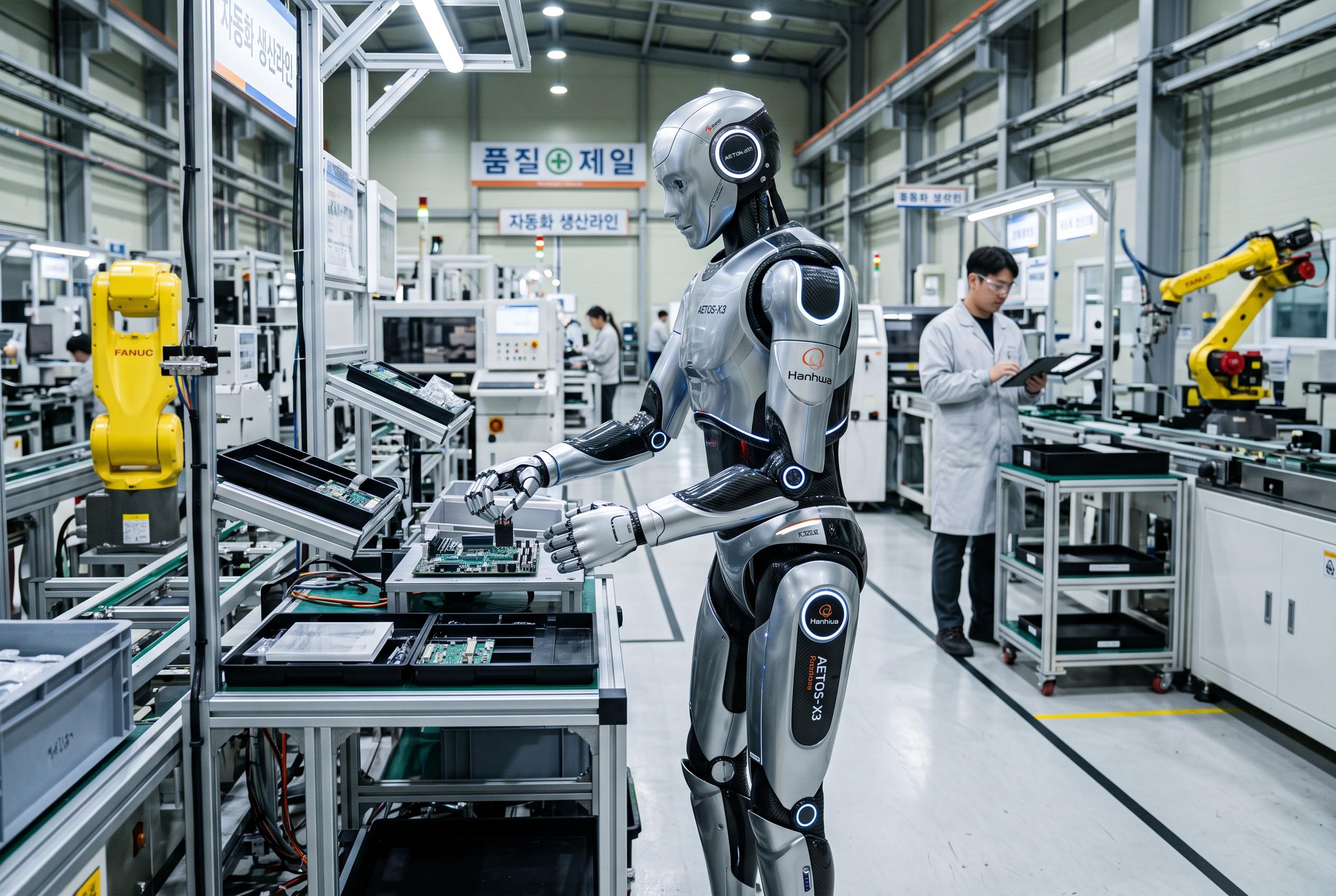

South Korea’s leading robotics companies are shifting their strategic focus from simple collaborative robots towards humanoids, integrating advanced AI and software to perform complex factory tasks, amid evolving domestic and global markets.
South Korea’s leading robotics makers are widening their ambitions beyond collaborative robots, as they channel more capital and engineering effort into humanoids, software and AI-led industrial systems. The shift suggests the domestic market is moving from simple robot arms towards machines that can perform more complex tasks in real factory settings, while still keeping existing cobot lines in production. According to eDaily, the clearest evidence is in the way Rainbow Robotics, Doosan Robotics and Neuromeka are now setting different priorities for scale, supply chains and product development.
Rainbow Robotics is pushing hardest into humanoids. In its half-year filing, the company said it can produce 900 units a year of its RB collaborative robot series and about 120 mobile humanoids, a sharp contrast with its first-quarter disclosure, which cited annual capacity of 2,500 units for the RB5 model alone. Its sales mix is also changing quickly: mobile humanoids accounted for 40.48% of first-half revenue, while collaborative robots made up 21.05%, according to the company’s report cited by eDaily. The company is also trying to bring more of the value chain in-house by developing high-output QDD actuators, motors and reducers, and by shifting a key harmonic-drive reducer supply line away from overseas vendors towards a domestic supplier.
Doosan Robotics is taking a different route, placing less emphasis on expanding robot output and more on higher-value solutions that combine software and AI. Its Suwon plant has held steady at 2,200 collaborative robots a year since 2024, while external production has been cut back and then stopped this year, eDaily reported. The company has been expanding around OneXia, the North American automation specialist it bought last year, and said North American sales represented roughly 53% of first-half revenue. In the longer term, Doosan wants to move into what it calls industrial humanoids, with the aim of embedding worker-level task intelligence into robotic arms and combining that with AI so the machines can carry out actual manufacturing work.
Neuromeka remains the most conservative of the three, keeping annual capacity for its main Indie7 collaborative robot at 1,200 units. Even so, market forecasts suggest the cobot segment is still growing. Interact Analysis expects global collaborative robot shipments to rise from about 57,000 units in 2025 to 129,000 in 2030, indicating that the current pivot towards humanoids is happening alongside, rather than in place of, continued demand for robot arms. The broader industry trend is to treat collaborative robots as the foundation for humanoids: the arm and joint-control technologies developed for cobots are being paired with mobility and AI to build full-bodied robots for future factory use.
Disclaimer: This content is intended for informational purposes only. Readers are advised to exercise their own judgement, conduct due diligence, or consult a qualified expert before acting on any information provided.