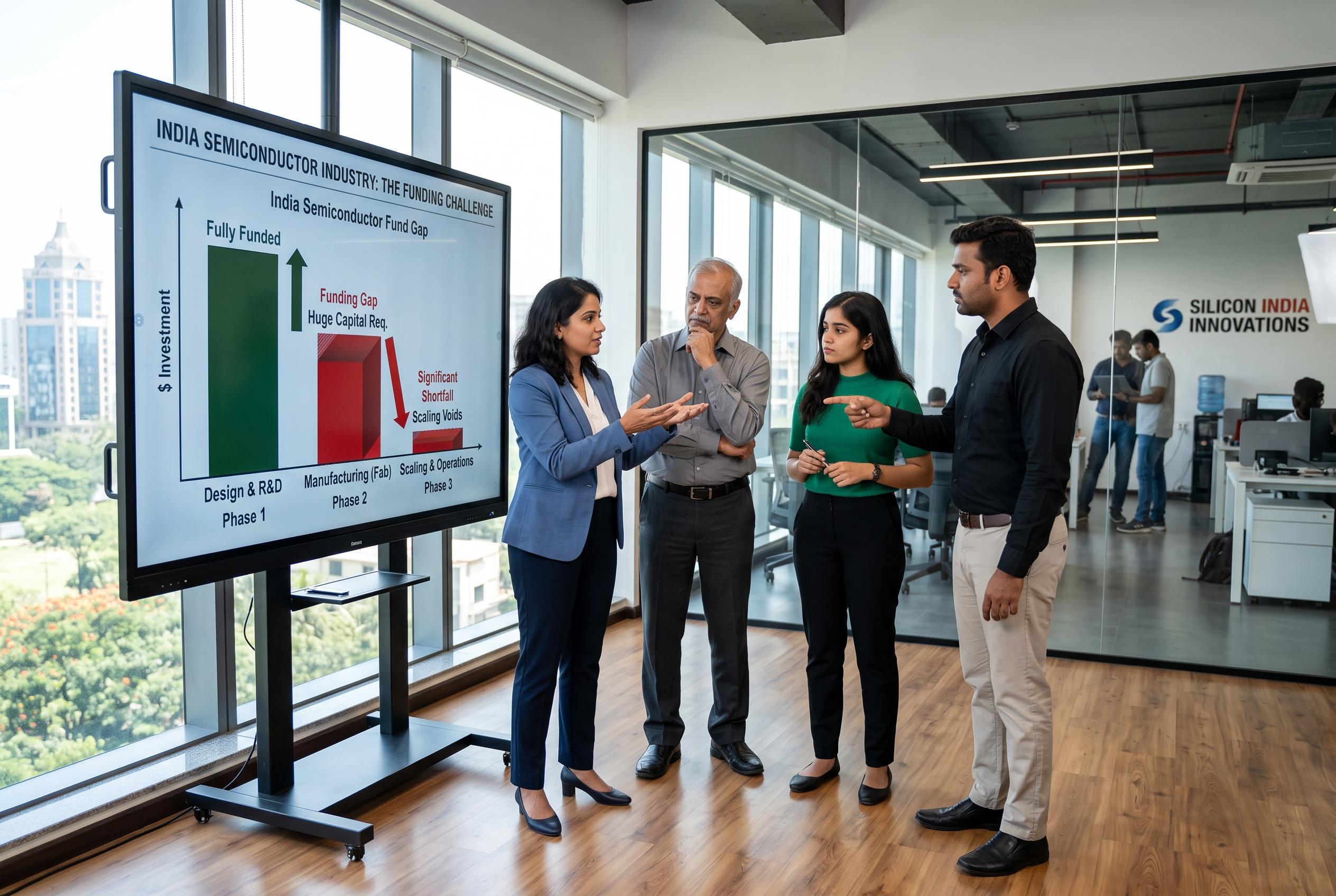

While investment in India’s semiconductor startups is accelerating, most funding remains concentrated on design, leaving a significant gap in capital needed for mass production and scaling, posing challenges for the sector’s growth and global competitiveness.
India’s semiconductor startups are drawing more investor attention, but the money is still arriving in a shape that favours design over scale. Tracxn data cited by Communications Today show funding rising sharply in 2025, yet the broader picture remains one of early-stage enthusiasm rather than the deep pools of capital needed for production, validation and market entry. The result is a sector with growing momentum and a widening gap between prototype success and commercial manufacturing.
The central problem is capital intensity. Industry estimates cited in the report suggest that a startup aiming to compete globally may need hundreds of millions of dollars, even before it reaches meaningful volume. That makes sense in a field where spending does not end at chip design. Fabless companies still have to pay for design software, intellectual-property licences, foundry access, packaging, testing and certification, as well as sales and customer qualification. For many venture funds in India, that scale of commitment still sits outside the usual software-style investment model.
The mix of public support has helped, but not enough to remove that structural strain. According to industry and media reports, early-stage funding in the sector has accelerated, supported by government schemes such as the Production Linked Incentive programme and the India Semiconductor Mission. Yet reimbursement-based incentives can leave smaller firms short of working capital because they must spend first and claim later. At the same time, a larger share of funding is flowing to companies already closer to commercialisation, which leaves many younger ventures dependent on patient investors and strategic backers.
That challenge matters because India is trying to build a full semiconductor stack, not just a design base. Recent reporting also points to a broader pipeline of startups, rising filings and more corporate participation, including ambitious projects from larger industrial groups. But the next stage of growth will require more than policy support and seed rounds. It will need long-term domestic capital, stronger partnerships with global manufacturers and customers, and a clearer route from chip design to mass production.
Disclaimer: This content is intended for informational purposes only. Readers are advised to exercise their own judgement, conduct due diligence, or consult a qualified expert before acting on any information provided.