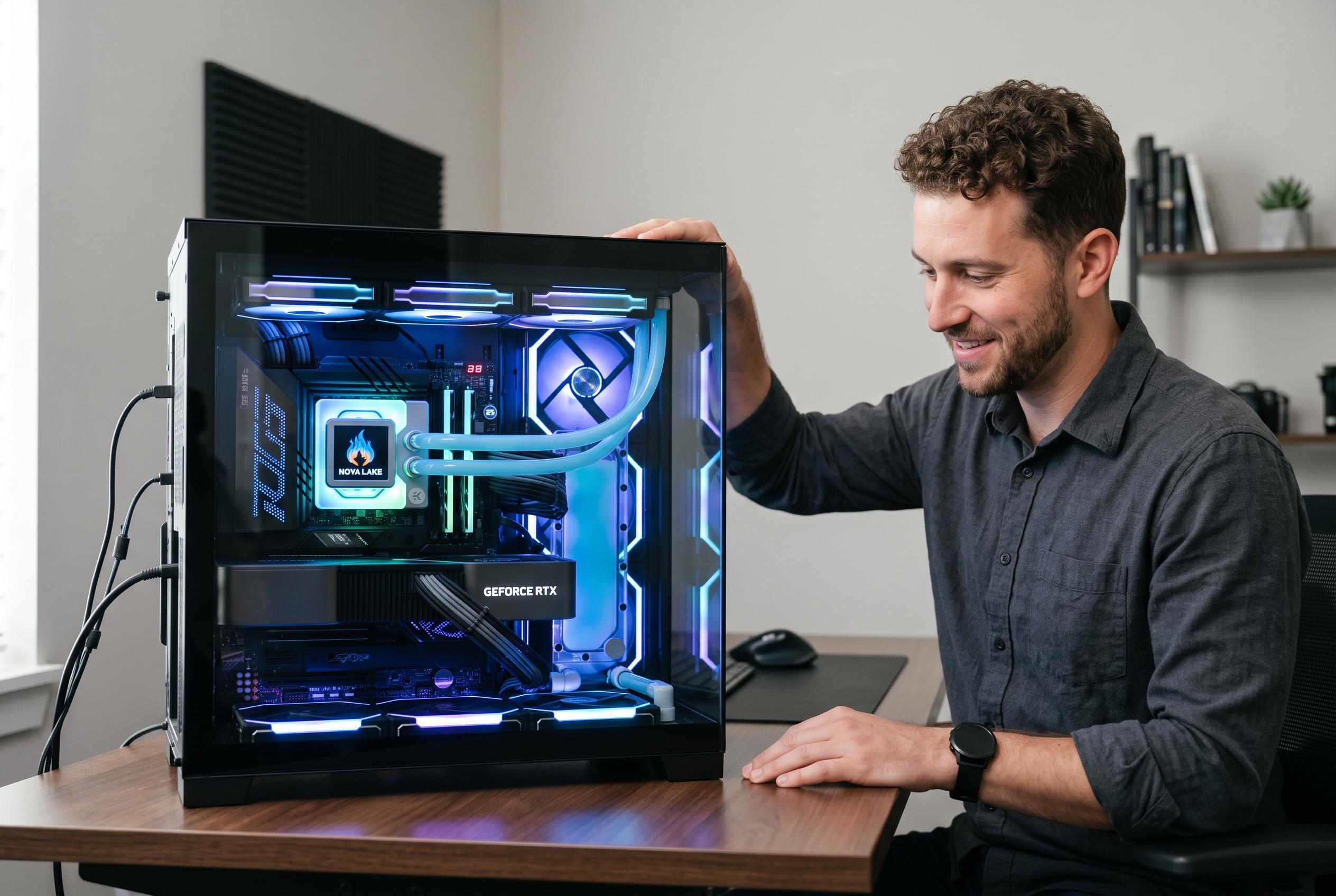

Intel plans to release its upcoming Nova Lake CPUs first for desktop PCs in a strategic move to revitalise its client market, signalling a departure from the industry trend of prioritising data centre products and pushing ahead of AMD’s launch schedule.
Intel is preparing Nova Lake to reach desktop PCs before servers, a notable break from an industry pattern that has increasingly prioritised data centres. According to the company’s latest comments, the plan is meant to restore momentum in the client PC market after a difficult reception for Arrow Lake and to signal that desktop buyers are not being pushed behind enterprise demand.
That approach also sets Intel apart from AMD, which has leaned harder into a unified design strategy that can be scaled across consumer and server products. Tom’s Hardware noted that AMD has itself recently bent its usual launch order, with EPYC Venice based on Zen 6 said to arrive before desktop equivalents. Intel, by contrast, appears to be reversing its own earlier practice: previous core designs such as Golden Cove and Redwood Cove first appeared in other segments before reaching desktops, whereas Nova Lake is now being positioned to debut on the client side first and only later in Xeon.
Intel chief executive Lip-Bu Tan has already confirmed that Nova Lake remains on the roadmap for 2026, following Arrow Lake Refresh early in the year. TechSpot reported that Intel has also linked the launch to a broader reset in its client business, with the company telling investors that its desktop schedule is intact and that it intends to accelerate rather than slow its consumer cadence. The same reporting points to a late-2026 launch window for the desktop chips, with the architecture expected to form the basis of the next Core Ultra family.
The company’s push comes after a period in which gaming performance and platform consistency have drawn criticism. Robert Hallock, Intel’s vice-president, has acknowledged that buyers have become wary after Arrow Lake sometimes trailed older parts in games. Intel responded with Arrow Lake Refresh, developed by a different internal team, and Hallock said that the engineers now working on Nova Lake have been given a more formal structure, dedicated budget and clearer ownership of the desktop roadmap.
That organisational change matters as much as the silicon. Hallock said the desktop group no longer has to compete for the same resources as other business lines, which should make it easier to build products around enthusiast and gaming needs rather than treating them as secondary. His background also shapes the message: before joining Intel in 2023, he spent 12 years at AMD and helped launch the first Ryzen processors and 3D V-Cache, giving him a close view of what matters to technically demanding buyers.
Early leaks suggest Intel may also be using Nova Lake to close the gap with AMD on cache-heavy gaming parts. Tom’s Hardware reported that some lower-E-core configurations may still retain full L3 cache pools, while higher-end versions could add a separate backside Level Last Cache, or bLLC, in sizes meant to rival AMD’s 3D V-Cache approach. TechSpot has also reported that Nova Lake is expected to move to a new LGA 1954 socket and a 900-series chipset family, underlining that this will be a major platform shift as well as a new processor generation.
Disclaimer: This content is intended for informational purposes only. Readers are advised to exercise their own judgement, conduct due diligence, or consult a qualified expert before acting on any information provided.