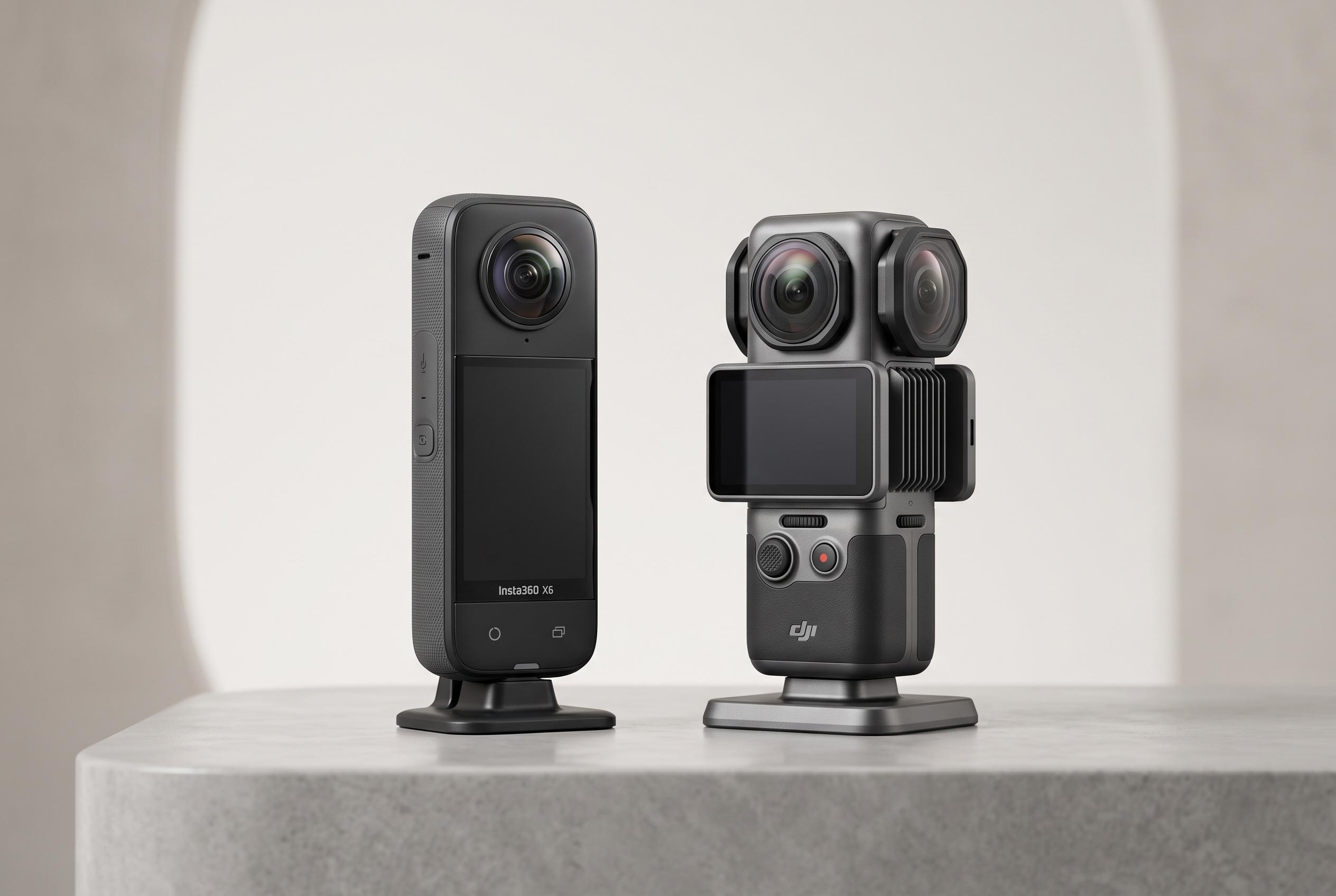

The new Insta360 X6 and DJI Osmo 360 II exemplify divergent philosophies in flagship 360-degree camera design, one emphasising software ecosystem, the other prioritising hardware specifications, offering users distinct advantages depending on shooting and editing routines.
The DJI Osmo 360 II and Insta360 X6 illustrate two different ideas of what a flagship 360-degree camera should be. DJI has leaned towards outright hardware capability, while Insta360 has focused on software, workflow and ecosystem. For buyers, the choice is less about headline resolution alone than about how each camera fits into a shooting and editing routine.
According to DJI’s own specifications, the Osmo 360 II records 8K video at 60fps, uses 10-bit colour, and includes 128GB of built-in storage, with 105GB available to the user. It also offers replaceable lenses, a 2-inch touchscreen, 120MP panoramic stills and AI Super Night 2.0 for darker scenes. At roughly $499, it looks well priced on paper, although DJI says availability remains restricted in some regions, including parts of the United States.
By contrast, review coverage from TechRadar and Tom’s Guide describes the Insta360 X6 as a more mature software-led package. It uses dual 1/1.1-inch sensors, records 8K at up to 50fps, supports 10-bit colour and Dolby Vision, and comes with AI tools such as Panomind, AI Director and Auto Edit. The X6 is also built for tougher use, with waterproofing to 20 metres and a design aimed at simplifying post-production for creators.
Battery life is one of the clearest practical differences. TechRadar and T3 report that the X6 can last up to 140 minutes when shooting 8K at 30fps, with some testing suggesting strong endurance even under heavier use. The DJI camera is quoted at around 100 minutes in the same recording mode. Storage also favours DJI, which ships with far more internal capacity than the X6’s 47GB usable onboard space.
Image quality in lower light appears to be a more nuanced contest. DJI’s AI Super Night 2.0 is intended to improve night performance, while Insta360’s larger sensors and processing upgrades are aimed at cleaner detail and stronger low-light results. In practice, that means DJI may appeal more to users who value spec-sheet strength, while Insta360 is likely to suit those who want more polished footage straight out of the camera and less time spent correcting it afterwards.
Availability may ultimately decide the matter for many buyers. The X6 is widely sold in the US and supported by a broad accessory ecosystem, whereas DJI’s 360 camera faces a more limited launch footprint. For creators already using Insta360 gear, the X6 is the easier upgrade. For new buyers who want the strongest hardware value and do not mind regional distribution issues, the Osmo 360 II is the more aggressive proposition.
Disclaimer: This content is intended for informational purposes only. Readers are advised to exercise their own judgement, conduct due diligence, or consult a qualified expert before acting on any information provided.