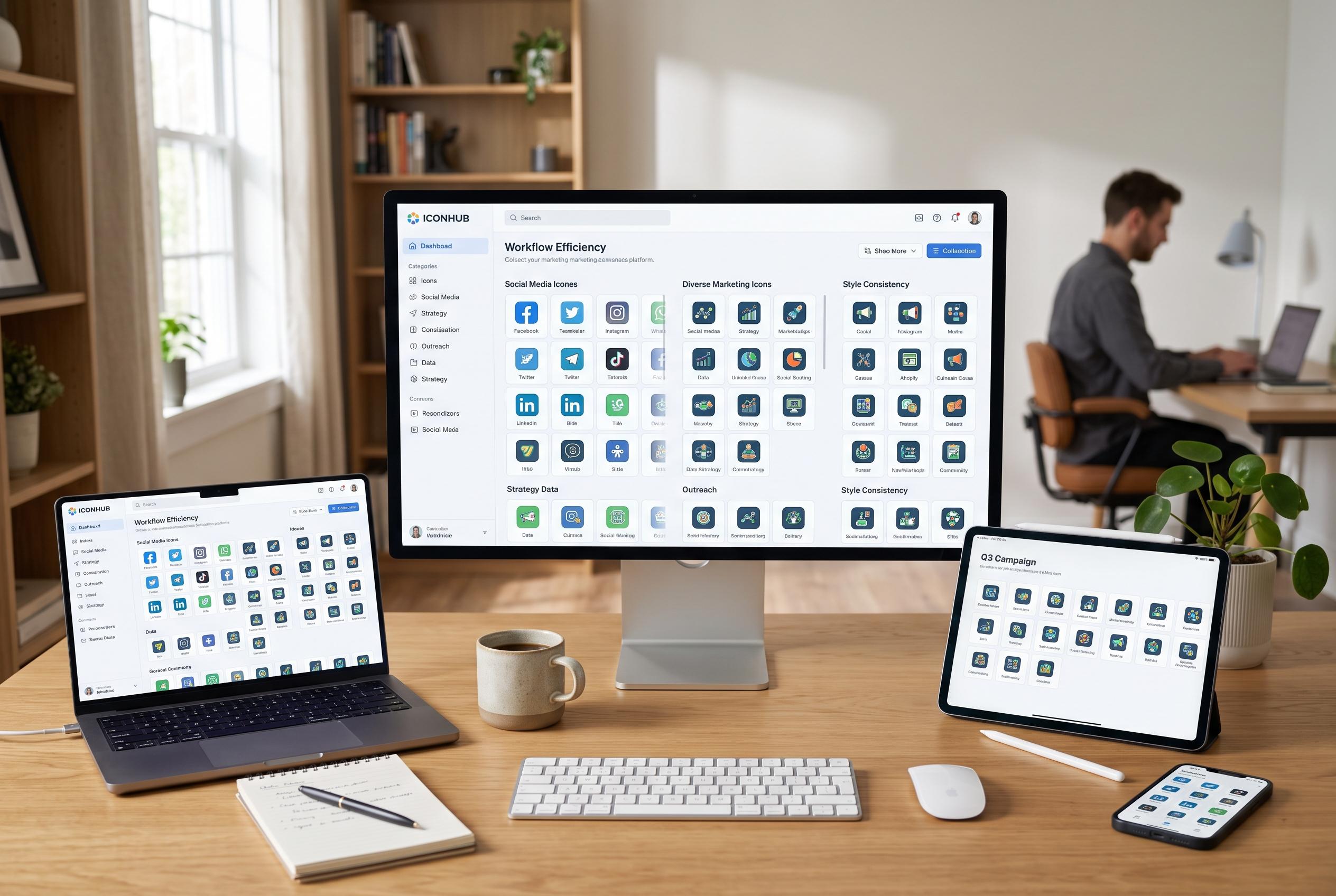

Icons8’s comprehensive icon and illustration platform offers marketing teams a streamlined, style-consistent solution for fast, controlled visual content creation, reducing reliance on traditional design software.
Marketing teams often need visuals faster than in-house design systems can supply them. According to a review of Icons8 and the company’s own background material, the platform was built in 2012 and now offers a large in-house library of design assets, including icons, illustrations and AI tools. For non-designers, that matters because it reduces the time spent waiting on specialist teams and keeps production moving when presentations, social graphics and product explainers are due. The practical case for a broad icon platform is strongest when the work is repetitive, deadline-driven and brand-sensitive.
That is the point made by the lead article’s account of a late-night presentation rescue. A product or content lead, working in Google Slides rather than a design app, can search a style-specific library, adjust colour and spacing in-browser, and download a coherent set of assets without opening Figma or Illustrator. Icons8’s own editor documentation says the platform supports collections, grid view, effects, importing custom icons and exports in PNG and vector formats, which helps explain why it can function as a lightweight production tool rather than just a stock library. The advantage is not only volume, but control.
Consistency is where the larger platforms differ most sharply from open-source packs and open marketplaces. Feather or Heroicons are clean, but often too sparse for campaign work. Flaticon or The Noun Project can deliver breadth, yet style variation between contributors can make a deck look uneven. By contrast, Icons8 says it produces content in-house, and third-party listings describe style families that are kept visually aligned across categories. For teams building customer-facing material, that uniformity can be more valuable than sheer choice, especially when the same visual language must work across slides, landing pages and social posts.
The limits are equally important. The lead article notes that free downloads can be restrictive for print and large-format work, and that attribution obligations may be awkward in corporate settings. Icons8 and independent reviews also indicate that premium plans unlock scalable vector files such as SVG and PDF, while some free use is limited to specific categories. That distinction matters for developers as well as designers, because simplified exports can be less useful when editable vector paths are required. In other words, the platform is powerful, but not frictionless.
What makes the tool most attractive is the workflow around it. Icons8’s editor features, including collections and bulk adjustment, allow a marketer to assemble a set of assets, recolour them in one pass and export them together. The lead article also points to practical habits that improve results: adjusting padding so different shapes feel visually balanced, testing assets against both light and dark backgrounds, and sharing collections rather than sending files back and forth. For content teams, that combination of standardisation and browser-based editing can narrow the gap between design and delivery without fully replacing either.
Disclaimer: This content is intended for informational purposes only. Readers are advised to exercise their own judgement, conduct due diligence, or consult a qualified expert before acting on any information provided.