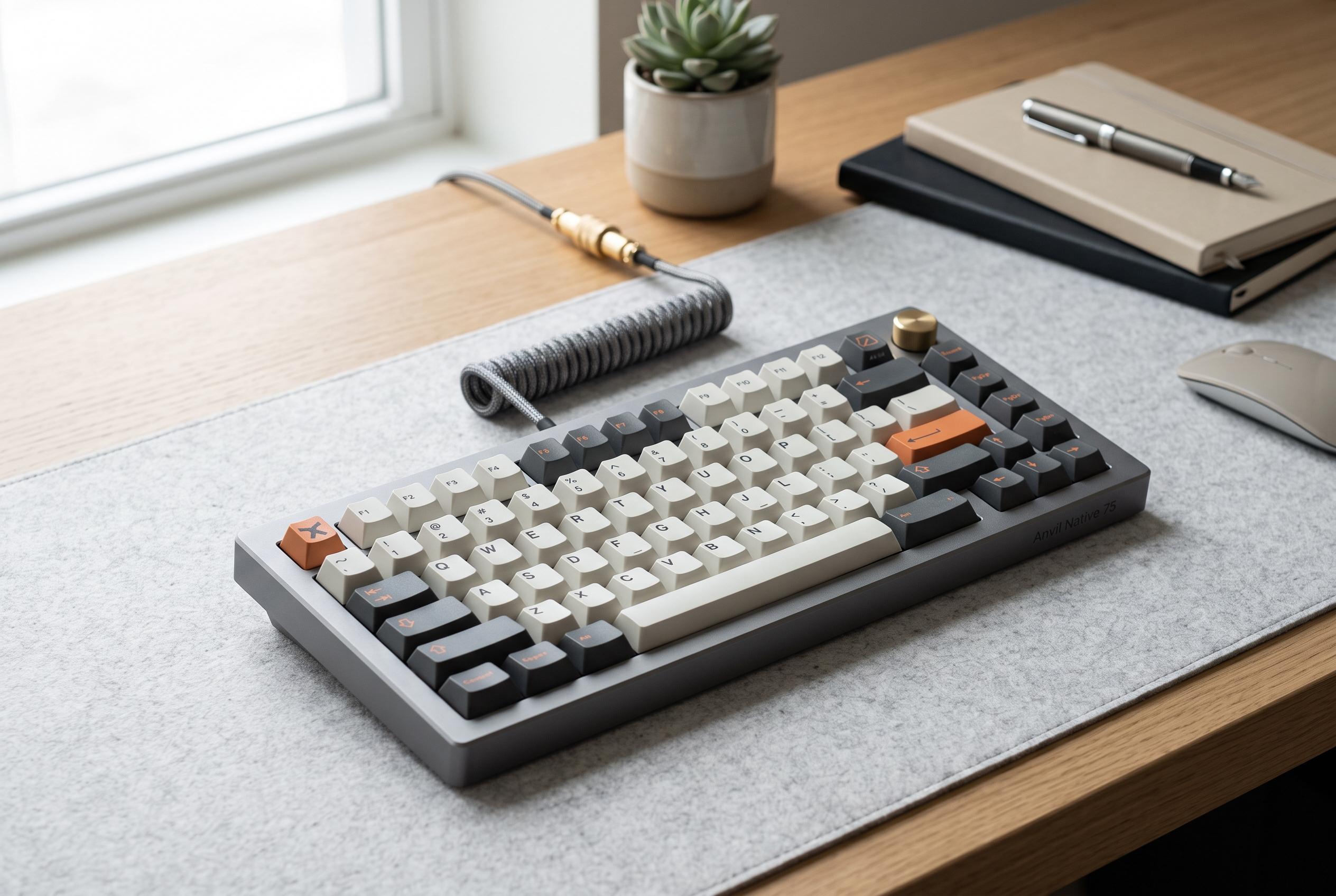

The Anvil Native 75 impresses with its aluminium build, sound tuning, hot-swappable switches, and open-source firmware, appealing to experienced typists seeking quality and customisation without flashy gaming features.
Anvil’s Native 75 is aimed squarely at keyboard enthusiasts who care more about feel, sound and layout than spectacle. According to ComputerBase, the 75% board pairs a hefty aluminium chassis with a deliberately restrained design, open-source QMK firmware and browser-based VIA configuration. The result is a compact, wired keyboard that tries to deliver premium typing quality without the usual gaming flourish.
That approach extends to the hardware choices. ComputerBase reports that buyers can choose from several case colours, different switch plates and multiple switch options, while the keyboard also supports hot-swapping. The review says the tested configuration weighed about 1.7kg, which gives the board a dense, solid presence on the desk. GameStar similarly described the Native 75 as exceptionally weighty, noting that the mass contributes to its premium feel and stable typing behaviour.
Sound tuning is one of the Native 75’s strongest points. ComputerBase says the combination of foam layers, an aluminium case and the FR4 plate creates a dry, controlled acoustic profile that is more restrained than many other full-metal boards. The review adds that Gateron G Pro 3.0 Yellow switches suit the chassis particularly well, while Cherry MX2 Silent switches trade some firmness for lower noise. GameStar likewise highlighted pre-lubed, sound-dampened switches and Durock stabilisers as part of the board’s refined typing experience. ComputerBase did note that acoustics are not perfectly even across the board, especially towards the edges.
Usability is mostly aimed at experienced users. The tighter key spacing is efficient once learned, but it demands adjustment, and the low-profile case shape makes lifting the keyboard less convenient than on designs with clearer grip cut-outs. ComputerBase said the legends are clear and the default key layout forms a sensible starting point for custom remapping. The board also uses south-facing lighting and opaque PBT keycaps, so RGB is largely a background feature rather than a main visual draw.
On software, the Native 75 follows the established QMK-and-VIA formula. ComputerBase says that gives users broad remapping control, including multiple layers and custom profiles, without tying the board to proprietary software. That keeps it in the same enthusiast category as premium rivals such as the Wuque Studio Mammoth75 and NuPhy’s VIA-compatible boards, both of which Tom’s Hardware and Tom’s Guide have praised for combining aluminium construction with deep customisation. The Native 75’s distinction is not novelty but execution: it is built for users who want a compact custom keyboard that sounds considered, feels substantial and stays out of the way.
ComputerBase ultimately judged the Native 75 an excellent but expensive enthusiast board, with the tested build costing around €290 and the fully loaded version rising to €327. The site said the board does not aim to impress with gimmicks, but with coherence: solid materials, careful tuning and broad customisation. For buyers who want the same switches and firmware at a much lower price, it pointed to Sharkoon’s SGK50 S3 PBT, though that alternative lacks the Native 75’s more polished acoustic and tactile character.
Disclaimer: This content is intended for informational purposes only. Readers are advised to exercise their own judgement, conduct due diligence, or consult a qualified expert before acting on any information provided.